the melting pot

Failed Democratic Experiments

One scorecard per democracy that failed. Rows one to four are the indicators of authoritarian behavior that Steven Levitsky and Daniel Ziblatt use as a litmus test in their book How Democracies Die. Row five is ours: who could still hold them to account. Columns are checkpoints across their time in power, and every cell shades the indicator at that moment, from cream to oxblood. Nine cases, picked from the menu, and a first page comparing all of them.

Nine cases on one time axis

Built from the 9 case tables

Counted from the month the leader took office, how long did it take until four of the five indicators scored 3, fully authoritarian?

Every case sits on the same time axis. Month 0 is the column each case page labels month 0 or year 0. Each band is the five indicator rows of one case table, stacked thin, in the table's order from top to bottom. The blue bar marks the first column where at least four of the five rows score 3. Hover over a cell to see its column and turning point. Click a cell to open that case at that column.

0 Norm holding 1 Testing the limits 2 Serious and repeated violation 3 Fully authoritarian Not scored on the case page Four of five rows at 3
  • Speed here means breadth: the first column where four of the five rows are at the darkest step. Hungary and Poland never reach that point on their own pages. That is a result of the scoring, not missing data.
  • Columns labelled by year ("Years 5 to 8") are drawn as whole 12 month blocks counted from the start of year 0, so for Peru, Venezuela, Russia, Turkey, Hungary and Poland a position is accurate to within about a year. Italy, Germany and Chile are labelled in months.
  • Hatched gaps are periods the case page does not score (Russia is scored every four years at first). They are not zeros.
  • Chile's month 0 is November 1970, the month Allende took office, as implied by its page labelling 1971 "Months 2 to 13".
  • The indicators in rows one to four are from Steven Levitsky and Daniel Ziblatt, How Democracies Die. Row five is ours.

This is the earliest death in the series and the one that shows how little had to be hidden. The columns here are months rather than years, and almost every step in them was taken by a vote of one chamber or the other.

Italy on its own page

Italy under Benito Mussolini

October 1922 to November 1926
Darker means further gone
Norm holding Testing the limits Serious and repeated violation Fully authoritarian

The darker the cell, the further gone the indicator at that point. Events set in bold are the turning points: the moment in that cell where something stopped being possible to undo.

Scroll the table sideways for the later months
Indicator October 1922Month 0 November 1922 to June 1923Months 1 to 8 July to November 1923Months 9 to 13 December 1923 to April 1924Months 14 to 18 May to June 1924Months 19 to 20 July to December 1924Months 21 to 26 January 1925Month 27 July 1925 to November 1926Months 33 to 49
Indicator 1 Rejection of the democratic rules of the game Score 2 of 3
  • The king refuses on 28 October to sign the state of siege that Facta's resigned cabinet has approved. He gives the mandate that afternoon to Salandra, and when the fascists refuse to serve under him he calls Mussolini to Rome on the 29th and swears in his government on 31 October
  • About sixteen thousand men are concentrated outside Rome, armed mostly with rifles handed over by soldiers or taken from army stores, and the Rome garrison has a plan in force to hold the city, rail junctions cut and blocks on the bridges, which is stood down on the king's orders
  • He is appointed at the head of a party holding 37 of the 535 seats in the Chamber, 35 of them won the year before on lists shared with the liberals and two on fascist lists of its own
Score 2 of 3
  • On 16 November he tells the Chamber he could have made of it a bivouac for his squads and shut it, and that he chose not to, at least in this first period. The next day it votes him confidence, 306 to 116
  • On 25 November it votes him full powers over taxation and the administration until the end of 1923, by 215 to 80 in a secret ballot after backing the government 275 to 90 on the motion before it, and the Senate agrees
  • He governs in coalition with both chambers still in being, which is the whole difference from the German case
Score 3 of 3
  • The Acerbo law gives the list with the most votes two thirds of the seats, 356 of the 535, provided it has at least a quarter of the votes, and shares the remaining 179 out proportionally. The Chamber passes it on 21 July by 223 to 123, the Senate on 14 November by 165 to 41, and the king signs it on 18 November
  • This is a parliament voting on how the next parliament will be composed, and voting to make it his
Score 3 of 3
  • The election of 6 April is fought under the new law. The National List takes about 60 percent of the vote and 355 seats, and with a second list running alongside it the government holds 374 of the 535
  • Turnout is about 64 percent and the opposition parties return about 160 deputies between them
Score 3 of 3
  • On 30 May Matteotti stands in the Chamber and challenges the validity of the majority's election, arguing that no Italian voter had been free to decide
  • The Chamber refuses even to send the returns back to its elections committee, 285 to 57 with 42 abstentions. Eleven days later he is dead
Score 3 of 3
  • The Aventine deputies stay out of the Chamber for the rest of the year, the communists excepted, and appeal to the king instead of voting. The Chamber sits without them, and though Giolitti crosses to the opposition over the press decrees in November his majority still holds
  • The one instrument the opposition still holds, its votes in the chamber, is the one it declines to use
Score 3 of 3
  • On 3 January he tells the Chamber that he takes upon himself, alone, the political, moral and historical responsibility for everything that has happened, and that if fascism has been a criminal association the responsibility is his, because he created the climate that produced the violence
  • He then asks formally whether anyone, in the Chamber or outside it, wishes to use article 47 of the constitution, which lets the Chamber accuse a minister before the high court. Nobody does
  • The Aventine opposition is not in the room to answer, because it walked out in June. The communists had ended their secession on 26 November and Giolitti, by then in opposition, was in the chamber. Neither moves
Score 3 of 3
  • The law of 24 December 1925 replaces the president of the council with a head of government appointed and dismissed by the king, answerable to the king and not to parliament, and nothing can go on either chamber's agenda without his consent
  • Elected councils go: from February 1926 a podestà appointed from Rome replaces the mayor and the council, at first only in communes of five thousand people or fewer and from September everywhere
  • On 9 November 1926 the Chamber declares 123 opposition deputies to have forfeited their seats: the Aventine secessionists who walked out in June 1924, together with the communists who had gone back to their benches
Indicator 2 Denial of the legitimacy of political opponents Score 3 of 3
  • The two years behind the appointment are not an argument with the socialists but a campaign against their institutions: in the Po valley in the first half of 1921 alone, on Candeloro's count, which he calls certainly incomplete, 119 chambers of labour, 107 cooperatives and 141 socialist or communist branches were wrecked or burned
  • In Bologna the socialists win the council in the autumn of 1920 and never take office: on 21 November 1920 seven of their supporters are killed in the crossfire of fascists, police and their own guards' grenades and three more die later of their wounds, a liberal councillor of the minority is shot in the chamber, and a prefect's commissioner is put in over them
  • At Naples on 24 October, six days before the king sends for him, he tells a fascist rally that they mean to govern Italy
Score 3 of 3
  • The Popular Party's ministers are removed from the government on 17 April 1923, four days after the party's congress at Turin renews the alliance only on condition that no majority premium is introduced: a partner in government is removed for a vote taken at its own conference
  • The Nationalist Association signs a pact of fusion with the fascist party on 26 February 1923, its own blue shirt squads having already been dissolved into the new state militia on 1 February
  • The party's Grand Council, convened for the first time on 15 December 1922 and constituted as a standing body in January 1923, settles the militia and the principle of a majority premium before either goes near the cabinet
Score 3 of 3
  • Sturzo resigns as secretary of the Popular Party on 10 July 1923 under pressure that includes the Vatican's, and the party that had two ministers in his first cabinet has neither them nor him
  • Some of its deputies vote for the electoral law anyway; one of them, Cavazzoni, is later expelled from the party for it
Score 3 of 3
  • Giovanni Amendola, a liberal deputy and the most persistent critic in the Chamber, is beaten in a Rome street by four men on 26 December 1923, three months before the vote
  • Opposition meetings are broken up, the posting of bills is stopped, print shops are attacked and papers burned through the campaign, and in Genoa on 27 January 1924 the fascists beat the opposition deputies Enrico Gonzales and Giuseppe Canepa
Score 3 of 3
  • The man killed is the secretary of a party that sits in parliament, and he is killed for what he said in the chamber on 30 May and for what he had announced he would say there on 11 June
  • Five men are named within days and the police take the first of them on 12 June. An investigating magistrate, Mauro Del Giudice, then takes the case off the government's hands and by 18 June has the party's administrative secretary arrested too, so nobody can pretend the killing is a private quarrel
Score 3 of 3
  • The party's provincial bosses want a new round of violence rather than a settlement, and on 31 December about forty consuls of the militia come to him and tell him to have done with legality
  • The communists abandon the walkout in November, Luigi Repossi returning alone on the 12th to commemorate Matteotti and the whole group on the 26th, so the opposition is now divided about whether to be in the building at all
Score 3 of 3
  • In the three days after the speech the prefects close 95 clubs and meeting places, 150 licensed premises and 25 organisations they call subversive, dissolve 120 branches of the veterans' association Italia Libera and arrest 111 people, by the interior ministry's own count, reported to the Council of Ministers on 6 January
  • Being in opposition has become a matter for the prefect rather than for the chamber
Score 3 of 3
  • After the attempt on his life at Bologna on 31 October 1926 the government dissolves the opposition parties, and the law of 25 November sets up a Special Tribunal for the Defence of the State with military judges and restores the death penalty for political crimes
  • Antonio Gramsci is arrested in Rome on 8 November 1926 although he is a sitting deputy with immunity, and that tribunal sentences him in 1928
  • Matteotti's own party, the Unitary Socialists, had already been dissolved in November 1925, days after one of its members, the former deputy Tito Zaniboni, was caught planning to shoot him
Indicator 3 Toleration or encouragement of violence Score 3 of 3
  • Two years of squad violence are on the public record before he holds any office: elected councils driven out of town halls, socialist deputies beaten and dosed with castor oil, labour halls and cooperatives burned, and prefects and police mostly standing by
  • The general strike called against that violence on 31 July 1922 is broken by the squads themselves, who take over several cities. Only at Parma and Bari are they driven back, at Parma by the Arditi del Popolo behind barricades in the Oltretorrente
  • This is why this cell is already black. Nothing about it had to be discovered later
Score 3 of 3
  • The squads become an organ of the state: a royal decree-law of 14 January 1923, not converted into law until 1925, creates a militia paid for by the state, operative from 1 February, whose men swear to him while the army swears to the king
  • Between 18 and 20 December 1922 squads in Turin kill eleven people, among them Pietro Ferrero of the metalworkers' union, and an amnesty of 22 December, published two days later, stops the prosecutions before they start
Score 3 of 3
  • Don Giovanni Minzoni, the parish priest at Argenta who had organised Catholic youth against the local squad, is beaten in the street on the night of 23 August 1923 and dies of a fractured skull before midnight; the men tried for it are acquitted in 1925
  • Speaking against the bill on 15 July, Turati tells the Chamber that it is a law whose approval is being recommended to them by three hundred thousand muskets
Score 3 of 3
  • Antonio Piccinini, the socialist leader in Reggio Emilia and a candidate on the party's Emilia list, is taken from his house on the evening of 28 February 1924 and killed, and his body left by the railway line. His name is still on the ballot on 6 April and draws enough preference votes for a seat, which goes to the next man because he is dead. All four men accused are acquitted at Reggio Emilia in October 1925
  • The government does not repress the campaign violence, and its own militia is on one side of it
Score 3 of 3
  • Matteotti is forced into a car on the Lungotevere Arnaldo da Brescia on the afternoon of 10 June 1924 and stabbed. His body is not found for two months
  • It is the twentieth month of the government and the killing has not stopped since 1920. This is only the one that cannot be ignored
Score 3 of 3
  • The body is found near Riano on 16 August, two months after the abduction, and has to be identified from the teeth
  • The militia is reorganised in August 1924 and its men are made to swear to the king instead of to him, which is offered as a concession. It is not disbanded
Score 3 of 3
  • The instruction goes out to the prefects on the night of 3 January, and 655 house searches follow inside three days, on the same ministry count
  • Nobody has been convicted for Matteotti, and the man who has just claimed the responsibility is still prime minister
Score 3 of 3
  • Giovanni Amendola, put into a car by the fascist federal secretary of Lucca on the promise of an escort and then ambushed past Pieve a Nievole in Tuscany on 20 July 1925 and beaten through the smashed window, dies at Cannes on 7 April 1926
  • Piero Gobetti, beaten more than once in Turin, leaves for Paris in February 1926 and dies there on the 15th, at twenty four
  • Internment without trial, confino, is extended to political cases by the public security measures of November 1926
Indicator 4 Readiness to curtail civil liberties and the press Score 2 of 3
  • Newspapers are among the buildings burned. The Avanti! offices in Milan were sacked and set alight on 15 April 1919, and printing works were still being wrecked in 1922
  • Nothing has been banned in law and the socialist, Catholic and liberal papers all print, though on 28 October the papers not tied to the fascists are warned off appearing the next day and several of their printing works are burned. The largest of them, the Corriere della Sera, is not yet against him
Score 2 of 3
  • Still nothing in law. The papers that attacked him in November are still attacking him in June, and no newspaper has been closed, though prefects can already seize an issue and suspend a paper after two seizures
  • What holds them back is arson, and the amnesty that protects the men who commit it
Score 2 of 3
  • A decree of 15 July 1923 lets a prefect refuse to recognise the man legally answerable for a newspaper, which is enough to close it. It is signed and then left unused for a year
  • The Corriere della Sera under Luigi Albertini is turning against him in these months and is not stopped
Score 2 of 3
  • The opposition press reports the campaign violence and is not shut for it: the decree that could close a paper has still not been used
  • The pressure is put on the copies rather than the licence, with papers burned and print shops attacked
Score 2 of 3
  • The press is first with the story and stays on it: for weeks the opposition papers print the investigation day by day, and none of them is closed for it
  • A prime minister is held responsible for a murder, in print, in Rome, and answers it from the floor of the Chamber on 13 June. This is as much as the press ever gets to say
Score 2 of 3
  • The decree signed in July 1923 and never used is brought into force in July 1924, four weeks after the murder, and preventive seizure of newspapers comes back with it
  • It closes nothing yet, though seizures of single issues multiply through the autumn: on 27 December Il Mondo prints Cesare Rossi's memorandum naming Mussolini as the man behind the squad, and the paper goes on printing into the new year
Score 2 of 3
  • The same instruction of 3 January tells the prefects to apply the press decree rigorously, the one on abuses of the periodical press that had sat largely unused since July 1924, and the seizures begin in earnest
  • The clubs and associations that could have called a meeting against him are shut in the same week
  • No title is closed by law yet. La Rivoluzione Liberale prints until 8 November, Albertini keeps the Corriere until the end of that month, and what ends the opposition press is the law of 31 December
Score 3 of 3
  • The press law of 31 December 1925 makes a newspaper unlawful unless the man responsible for it has been approved, so one refusal closes a paper
  • Luigi Albertini is removed from the Corriere della Sera on 28 November 1925 after twenty five years in the chair
  • Avanti! and l'Unità are suppressed in the measures that follow the Bologna attempt, and Il Mondo, which had printed the Rossi memorandum, is suspended with them on 31 October 1926 and has its gerenza declared forfeit on 5 November
Indicator 5 Who could still hold him to account Added, not from the book Score 1 of 3
  • The king holds the decision alone on 28 October and takes the other side of it: he refuses the state of siege, the troops that had begun applying it stand down, and the next day, after Salandra has failed to form a government because the fascists will not serve under him, he calls Mussolini
  • Four of the fourteen ministers are fascists, counting him. The rest are two liberals, two Catholics, two social democrats, a nationalist, an independent and two serving officers, and they believe they are the ones containing him
  • The Chamber can withdraw its confidence, by a convention rather than by the Statuto, the king can dismiss him at any time, and the army is the king's
Score 1 of 3
  • Both chambers could have refused and did not: confidence on 17 November by 306 to 116, full powers on 25 November by 215 to 80 in a secret ballot
  • The Popular Party's ministers leave in April, so the coalition that was meant to hold him is thinner after six months and nothing has replaced it
  • He now commands an armed force paid for by the state that does not answer to the king
Score 2 of 3
  • The commission that examined the electoral bill was chaired by Giolitti and much of the liberal benches voted for it: this is the old liberal governing class voting for the rules under which the government list won the next election
  • The Senate could have stopped it and passed it 165 to 41; the king could have withheld his signature and gave it
  • The Popular Party splits over the vote instead of blocking it
Score 2 of 3
  • Voters can still refuse him, and in the industrial north many do: the government list falls under half the vote in the northern cities, taking 36.6 percent in Turin, 36.5 percent in Venice, 38.4 percent in Milan and 47.2 percent in Genoa against 60 percent nationally. It is a minority of the voters even where it wins
  • The chamber that would judge his ministers is now two thirds his, and it is the chamber that validates its own members' elections
Score 2 of 3
  • Within a fortnight the government and its majority stand together behind Mussolini, while the magistrates keep the case open for another year: the police arrest the squad and a magistrate extends the inquiry beyond them to the party's administrative secretary. On 17 June Mussolini gives up the interior ministry to Federzoni, and the chief of police De Bono goes but keeps the militia command he has held since February 1923
  • The Senate votes him confidence on 26 June, 225 votes out of 252
  • From 27 June the opposition deputies stop attending, so the chamber that could have held him to account is missing them by their own decision
Score 2 of 3
  • In November the king is handed memoranda through Bonomi said to implicate the prime minister in the murder, and gives them back without acting
  • The courts still hold the men who took Matteotti. Three of them are convicted at Chieti in March 1926 of unintentional homicide and freed under an amnesty
  • Six months after the murder nothing has been decided, and everything that could remove him is still standing
Score 3 of 3
  • He dares the chamber to accuse him and it does not, the king does not move, and he promises that the situation will be clarified within forty eight hours
  • The only body that could have accused him is the one he is speaking to, and two thirds of it is his
  • This is the date historians use for the beginning of the dictatorship, and no law was passed on it
Score 3 of 3
  • By the law of 24 December 1925 he answers to the king and to nobody else, and the king does not use that power until July 1943
  • Strikes are unlawful from 3 April 1926 and only fascist unions may sign a contract, so the strike, which had forced governments out before 1922, can no longer be used
  • No opposition party, no opposition daily, no elected town council, and no deputy who can put anything to him that he has not agreed to. The elected provincial councils last, on paper, until the law of 27 December 1928

The same four years, seven photographs

Scroll inside the box
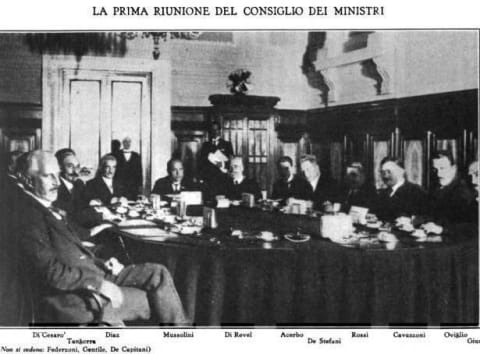
A press photograph of the first meeting of the Mussolini cabinet, ministers seated around a table with their names printed underneath

October 1922 · Month 0

The first meeting of the new cabinet, sworn in on 31 October 1922, with those present named along the bottom of the print. Four of the fourteen ministers are fascists, counting the prime minister. The rest are two liberals, two Catholics, two social democrats, a nationalist, an independent and two serving officers, and they were the men who believed they had hired him.

Serious and repeated violation

Photo: Unknown photographer, from the review Il Carroccio, Public domain, Wikimedia Commons
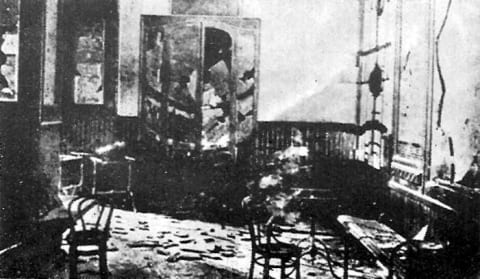
The wrecked and burned interior of the Turin Chamber of Labour, broken panelling and overturned chairs

November 1922 to June 1923 · Months 1 to 8

The Chamber of Labour in Turin after fascist squads burned it on 19 December 1922. Eleven people were killed in the city over three days, among them Pietro Ferrero of the metalworkers' union, and an amnesty of 22 December stopped the prosecutions before they began.

Serious and repeated violation

Photo: Unknown photographer, Public domain, Wikimedia Commons
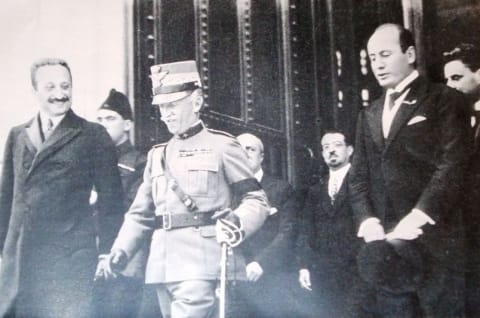
Three men in the doorway of the Palazzo Montecitorio, the king in uniform in the centre, officials behind them

July to November 1923 · Months 9 to 13

The king leaving Montecitorio with Enrico De Nicola, the president of the Chamber, and the prime minister. Wikimedia Commons dates it 9 July 1923, which the Chamber’s own record for that sitting does not confirm. On 21 July that Chamber voted to give the leading list two thirds of the seats, and on 18 November the king signed the law.

Fully authoritarian

Photo: Unknown photographer, Public domain, Wikimedia Commons
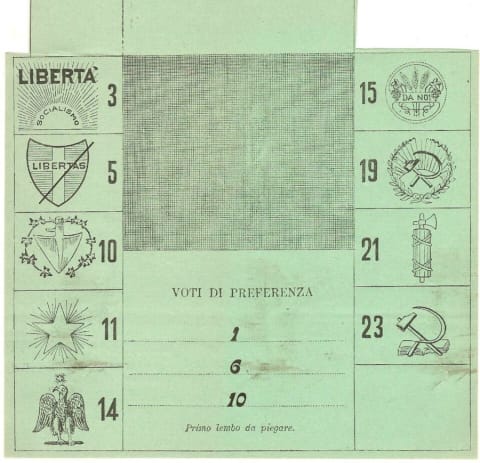
A green Italian ballot paper of 1924 showing nine party symbols in boxes and lines for preference votes

December 1923 to April 1924 · Months 14 to 18

A facsimile of the ballot paper used in the Lombardy constituency on 6 April 1924: nine list symbols, the fasces among the socialist, Catholic and communist ones, and three lines for preference votes. Under the law passed the previous November the leading list took two thirds of the seats if it had at least a quarter of the vote. It took about 60 percent.

Fully authoritarian

Photo: Ballot paper facsimile, Italian general election of 1924, Public domain, Wikimedia Commons
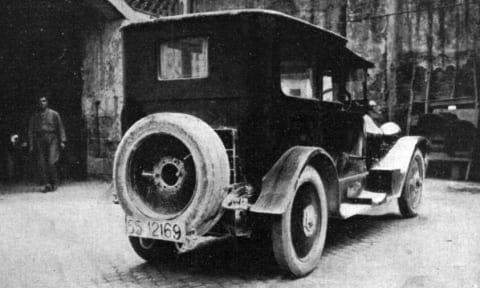
A large 1920s saloon car with a spare wheel on the back, standing in a yard with a man in a doorway behind it

May to June 1924 · Months 19 to 20

The car in which Giacomo Matteotti was carried away, published in L'Illustrazione Italiana. He was forced into it on the Lungotevere Arnaldo da Brescia on the afternoon of 10 June 1924, eleven days after telling the Chamber that the election just held was not free. The plate, 55-12169, is what led the investigation to the car within two days.

Fully authoritarian

Photo: Unknown photographer, L'Illustrazione Italiana, 1924, Public domain, Wikimedia Commons
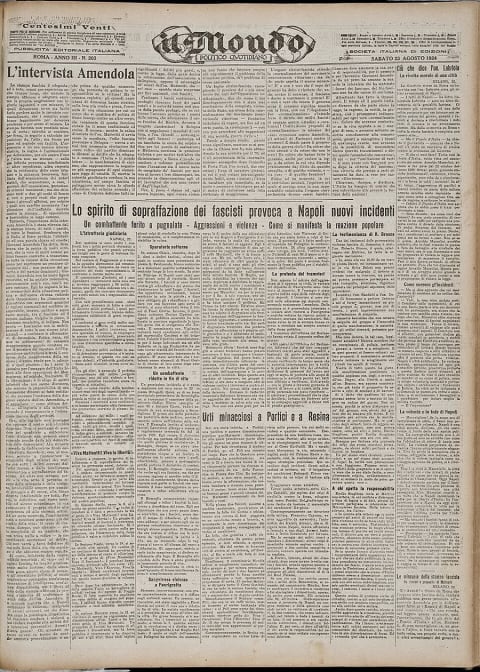
The dense front page of the Roman daily Il Mondo of 23 August 1924

July to December 1924 · Months 21 to 26

The front page of Il Mondo, an independent Roman daily, on 23 August 1924, a week after Matteotti's body was found. It leads on an interview with Giovanni Amendola and on fascist violence in Naples. The paper was still legal, and in December it printed the memorandum in which Cesare Rossi named the prime minister.

Fully authoritarian

Photo: Il Mondo, 23 August 1924, Public domain, Wikimedia Commons
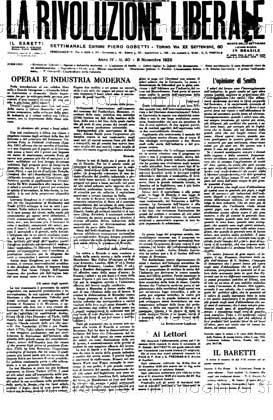
The front page of the weekly La Rivoluzione Liberale of 8 November 1925

July 1925 to November 1926 · Months 33 to 49

The last issue of La Rivoluzione Liberale, the Turin weekly edited by Piero Gobetti, dated 8 November 1925. Gobetti had been beaten more than once; he left for Paris in February 1926 and died there on the 15th, at twenty four. The press law signed on 31 December 1925 made a paper unlawful unless the man answerable for it had been approved.

Fully authoritarian

Photo: La Rivoluzione Liberale, 8 November 1925, Public domain, Wikimedia Commons

The people and the votes

Three people who did the most to end parliamentary government, three who warned earliest and kept warning, and the three national votes that carried the process forward.

Who ended it

Ranked by what their decisions made possible, not by how well known they are. Antonio Salandra, who was offered the government on 28 October 1922 and could not form one, and was elected on the National List in 1924, and Luigi Facta, whose cabinet asked for the state of siege the king refused to sign, are left out: neither could have given Mussolini office or kept him there.

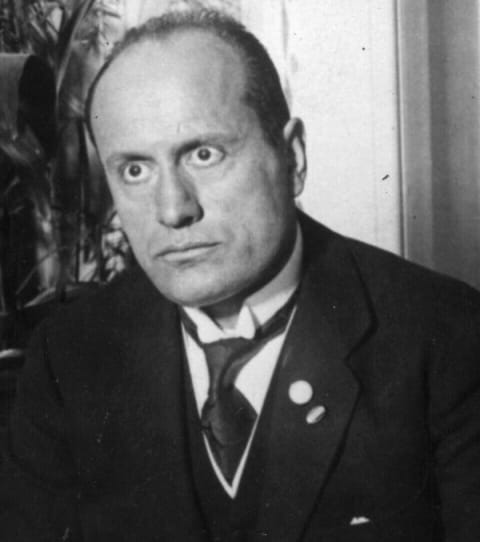
  1. Benito Mussolini in a dark suit and tie, head and shoulders, 1922

    1 · Most responsible

    Benito Mussolini

    Founder of the fascist movement in 1919; prime minister from 31 October 1922

    Was sworn in on 31 October 1922 at the head of a coalition. On 3 January 1925 he told the Chamber that he alone took responsibility for everything that had happened. The law of 24 December 1925 made him answerable only to the king, and by the end of 1926 every other party had been dissolved and a Special Tribunal set up for political crimes.

    Why firstHe founded the movement, took office, and put through each of the laws that ended parliamentary government.

    31 October 1922 to November 1926

    Photo: Topical Press Agency, 1922, Public domain, Wikimedia Commons
  2. King Victor Emmanuel III in uniform with a sash and medals, head and shoulders, 1918

    2

    Victor Emmanuel III

    King of Italy from 1900 until his abdication in May 1946

    On the morning of 28 October 1922 refused to sign the state of siege that Facta brought him, and on 29 October asked Mussolini to form a government. He signed the Acerbo law on 18 November 1923. After the murder of Matteotti he would act only if parliament voted against the government first, and in December 1925 he signed the law that made the head of government answerable to him alone.

    Why secondUnder the Statuto only the king appointed and dismissed ministers, and he used that power for Mussolini in 1922 and did not use it against him in 1924.

    28 October 1922 to December 1925

    Photo: Mario Nunes Vais, 1918, Public domain, Wikimedia Commons
  3. Giovanni Giolitti, grey haired with a white moustache, in a dark suit and bow tie, press portrait of 1915

    3

    Giovanni Giolitti

    Prime minister five times, the last from June 1920 to July 1921

    Backed putting fascist candidates on the National Bloc lists for the election of 15 May 1921, which brought 35 fascist deputies into the Chamber on those lists. In 1923 he chaired the Chamber commission on the Acerbo bill, which approved it by ten votes to eight. He moved into opposition only on 15 November 1924.

    Why thirdHe brought the fascists into parliament on his coalition's lists, and chaired the commission that sent the law giving them the Chamber to a vote.

    May 1921 to July 1923

    Photo: Agence Meurisse, 1915, Bibliothèque nationale de France, Public domain, Wikimedia Commons

Who warned first

The earliest three who raised the alarm and kept raising it for years, chosen by how early they started and how long they held on. Giovanni Amendola, beaten in 1923 and again in 1925, is left out by this rule: his opposition became unconditional only in July 1923.

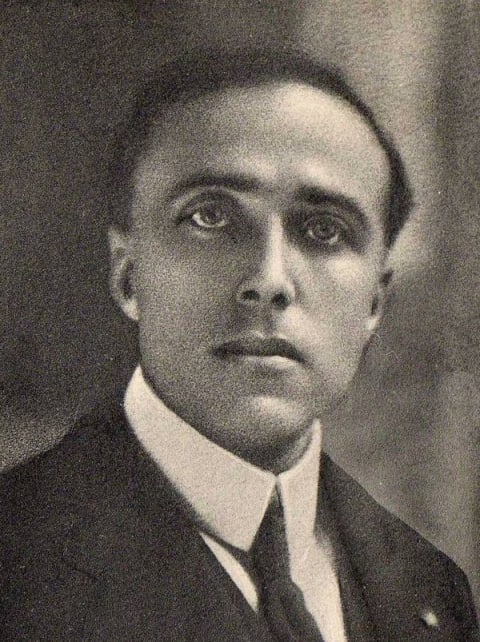
  1. Giacomo Matteotti, head and shoulders, in a dark jacket and white collar

    Warned from 1921

    Giacomo Matteotti

    Socialist deputy from 1919; secretary of the Unitary Socialist Party from October 1922

    Publicly denounced the squads' violence in the Polesine from early 1921, and told his party's congress in October 1921 that fascism was an emergency, not a passing phenomenon. He set out the government's first year in the pamphlet Un anno di dominazione fascista (1924), and on 30 May 1924 told the Chamber the April election had not been free.

    What it costAssaulted by fascists at Castelguglielmo on 12 March 1921. The government withdrew his passport in 1923. Forced into a car in Rome on 10 June 1924 and stabbed; his body was found on 16 August.

    1921 to June 1924

    Photo: Unknown author, before 1924, Public domain, Wikimedia Commons
  2. No free photograph

    Warned from 1922

    Piero Gobetti

    Turin editor of the weekly La Rivoluzione Liberale, February 1922 to November 1925

    Turned his weekly against the new government after the March on Rome, and on 23 November 1922 wrote that under fascism liberty and tyranny could no longer be reconciled. From March 1923 he also ran a publishing house, which issued Sturzo's Popolarismo e fascismo in 1924.

    What it costArrested on 6 February 1923 and held again on 29 May. On 1 June 1924 Mussolini telegraphed the prefect of Turin to make his life difficult again. Beaten by a squad on 5 September 1924. Ordered on 11 November 1925 to stop all publishing, he left for Paris on 8 February 1926 and died there on 15 February, aged 24.

    November 1922 to February 1926

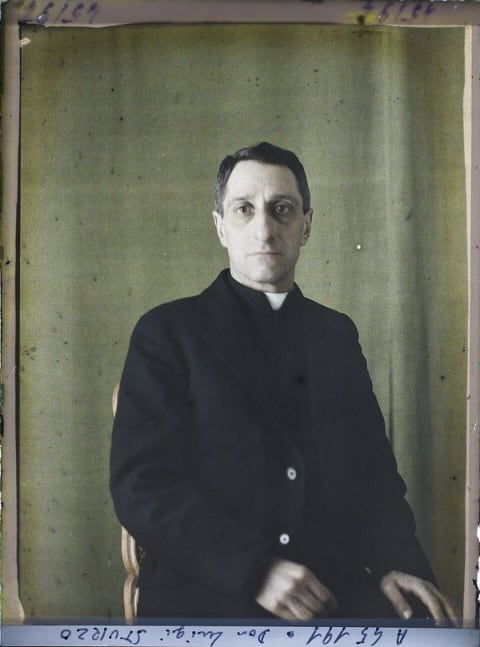
  3. Luigi Sturzo seated, in black with a clerical collar, a colour autochrome, April 1925

    Warned from 1922

    Luigi Sturzo

    Priest; political secretary of the Italian People's Party, which he founded in 1919

    Opposed his party's decision to support Mussolini's first government in 1922. At the party congress in Turin on 12 and 13 April 1923 he said the fascist idea of the state and his party's could not be reconciled. Within the month Mussolini removed the party's ministers from his government.

    What it costResigned as party secretary on 10 July 1923 under pressure that included the Vatican's. Left Rome on 25 October 1924 and lived in exile, first in London, for 22 years.

    October 1922 to October 1924, then from exile

    Photo: Georges Chevalier, 4 April 1925, Musée départemental Albert-Kahn, CC BY-SA 4.0, Wikimedia Commons

The votes that let it happen

Three national votes. In 1921 the fascists entered the Chamber on the lists of a coalition that came second. In 1924 the government list won a majority of the votes, in a campaign of violence, under a law written to give the leading list two thirds of the seats. In 1929 voters could only accept or reject a single list, after every other party had been dissolved.

  1. A printed poster headed Elezioni politiche 15 maggio 1921, Candidati del Blocco Nazionale, listing twenty names, Mussolini among the ones marked fascista

    15 May 1921

    Chamber election

    19.1 percentNational Blocs, 105 of 535 seats, 35 of them won by fascists. The Socialists had 24.7 percent. Turnout 58.4 percent.

    The fascists entered the Chamber on the lists of Giolitti's coalition. Seventeen months later the king made their leader prime minister.

    Second place, not a majority

    Photo: the National Bloc's candidate poster in Bologna for the election of 15 May 1921. Unknown author, Public domain, Wikimedia Commons
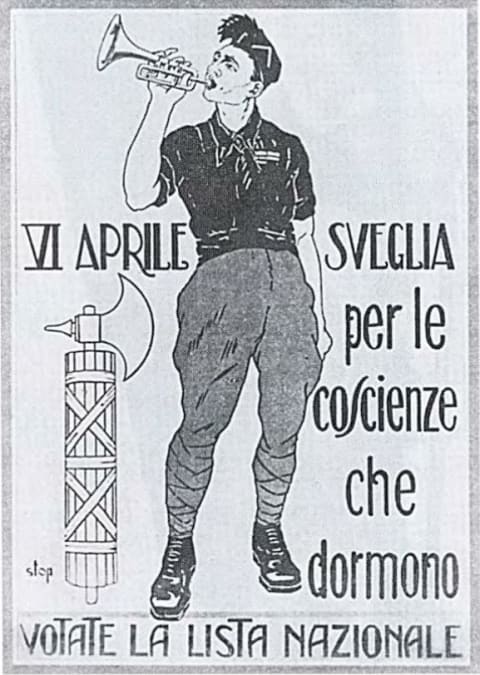
  2. A drawn poster of a young man in a black shirt blowing a bugle beside a fasces, with the words VI Aprile, wake up the consciences that sleep, vote for the National List

    6 April 1924

    Chamber election under the Acerbo law

    60.1 percentNational List, 355 of 535 seats, and 374 with a second government list. Turnout 63.8 percent.

    Opposition meetings were broken up during the campaign and the socialist candidate Antonio Piccinini was killed on 28 February. On 30 May Matteotti told the new Chamber that no voter had been free to decide, and on 10 June he was abducted and killed.

    Held under violence

    Photo: a campaign poster for the National List, "6 April: vote for the National List". Unknown author, 1924, Public domain, Wikimedia Commons
  3. Front page of the newspaper L'Unione Sarda on the day of the 1929 plebiscite, opening with the words: today's vote is an act of faith

    24 March 1929

    Plebiscite on one list of 400 deputies chosen by the Fascist Grand Council

    98.4 percentyes. Turnout 89.9 percent.

    Every other party had been dissolved in 1926. Voters were given a Yes paper printed with the national colours and a plain No paper, and discarded one before handing in the other, a procedure that did not guarantee a secret vote.

    Not a free vote

    Photo: front page of L'Unione Sarda on polling day, 24 March 1929. Unknown author, Public domain, Wikimedia Commons
Reading the rows across

Almost all of it was voted for. That is what separates this table from the German one twelve years later. Look at row 3 in the first column: it is already as dark as it goes, and it got there before he held any office. Labour halls, cooperatives and party branches had been burned in the hundreds since 1920, elected councils had been driven out of town halls by armed men, and in Bologna ten people were killed in and around the main square in November 1920, and a liberal councillor was shot inside the chamber, so that a council elected that autumn never sat. None of that was secret. It was in the newspapers, and the newspapers went on printing. Then read the rows around it. Rows 1, 4 and 5 are the ones that begin lower, and rows 1 and 5 begin lower because the forms were kept: a coalition of fourteen ministers with four fascists in it, a confidence motion carried 306 to 116, a full powers bill carried 215 to 80, an electoral law carried 223 to 123 in the Chamber and 165 to 41 in the Senate, and an election that gave the government list two thirds of the seats it had just written into law. Nobody took power by force. It was handed over, again and again, by a king who would not sign a state of siege, by liberals who thought office would make him moderate, and by a Senate that voted him confidence sixteen days after Matteotti disappeared. Row 4 is the slowest to move, and the reason is this: an independent Roman daily printed a memorandum accusing the prime minister of being behind a murder on 27 December 1924, and was still on sale afterwards. Newspapers could still attack the government after the 1924 election. What the speech of 3 January 1925 did was end the government's restraint in seizing them. He claimed the responsibility out loud, asked the chamber whether anybody wanted to impeach him, and in the seventy two hours that followed the prefects closed the clubs and searched the houses. The papers still came out, La Rivoluzione Liberale until 8 November and Albertini's Corriere until the end of that month. What ended the independent press was the law of 31 December 1925, eleven months later, when there was nobody left to vote against it.

Claude's scoring

The numbers are not in the book. Levitsky and Ziblatt supply the four indicators and the argument, and they use Italy alongside Germany as their case of gatekeeping failure; the four steps of shading here are Claude applying that framework to the historical record, one cell at a time, and they are open to argument. The events named in each cell are the evidence, so you can disagree with a score rather than take it on trust. Indicator 5 is not in the book at all: it asks who could still make them answer for something at that point, and it is shaded the same way, where the darkest cell means answerable to nobody. The columns here are months, not years, counted from 30 October 1922, and they are not evenly spaced: they are the checkpoints where something changed. Dates in a cell are the dates of the event, which sometimes sit slightly outside the column that holds them. One column carries no photograph. Wikimedia Commons holds no freely licensed picture of what the prefects did in January 1925, no closed club, no seized paper, no order, and the one image the file catalogue offers for the speech is undated and identifies nobody, so the panel is left out rather than filled with a portrait.

Framework from How Democracies Die by Steven Levitsky and Daniel Ziblatt, 2018. Part of the melting pot.

Most democracies take years to kill. This one took about eighteen months, so the columns here are months rather than years, and the first column is the summer before he was ever given office.

Germany on its own page

Germany under Adolf Hitler

About eighteen months · July 1932 to August 1934
Darker means further gone
Norm holding Testing the limits Serious and repeated violation Fully authoritarian

The darker the cell, the further gone the indicator that month. Events set in bold are the turning points: the moment in that cell where something stopped being possible to undo.

Scroll the table sideways for the later months
Indicator July 1932Six months before January 1933Week 0 February 1933Month 1 March 1933Month 2 April to June 1933Months 3 to 5 July to November 1933Months 6 to 10 June to July 1934Month 17 August 1934Month 18
Indicator 1 Rejection of the democratic rules of the game Score 2 of 3
  • The party says in public that it will end the parliamentary republic once it is inside it
  • The July election makes it the largest party on 37 percent, and and in August he refuses every post except the chancellorship
  • From 30 August the new Nazi bloc makes the Reichstag unusable, voting with the communists to bring the government down
Score 3 of 3
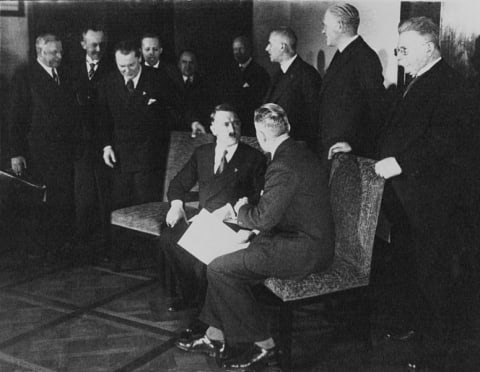
  • Appointed chancellor on 30 January by Hindenburg, on Papen's arrangement, having never won a majority of the vote
  • The Reichstag is dissolved on 1 February, two days in, before it can vote on him
  • On 3 February he tells the army commanders that democracy will be rooted out
Score 3 of 3
  • The decree of 28 February suspends the constitution's civil rights articles, and it is never lifted again
  • Emergency rule by decree, ordinary since 1930, is now turned on the parties themselves
  • The election is fought with the opposition press shut
Score 3 of 3
  • The Enabling Act of 23 March lets the cabinet write law without the Reichstag and against the constitution
  • The 5 March election gives 43.9 percent, still short, so the 81 communist seats are annulled to hand the party a bare majority of the chamber
  • The Day of Potsdam, 21 March, stages the new government as the old Germany continuing
Score 3 of 3
  • From 7 April a Reich governor appointed from Berlin can hire and fire each state's government
  • Every other party is banned or dissolves itself within ten weeks, the last of them on 5 July
  • Law is now made by cabinet decree and published as such
Score 3 of 3
  • The law of 14 July makes the NSDAP the only legal party and founding another a criminal offence
  • The Concordat of 20 July buys recognition abroad six months in
  • The November election offers voters a single list and no alternative
Score 3 of 3
  • On 3 July the cabinet passes a one sentence law declaring the previous week's murders lawful defence of the state
  • On 13 July he tells the Reichstag that he had been the supreme judge of the German people
Score 3 of 3
  • The offices of president and chancellor are merged into his own by a law signed the day before Hindenburg dies
  • A plebiscite on 19 August approves it afterwards, with about 90 percent
  • Nothing written in the Weimar constitution still binds anyone
Indicator 2 Denial of the legitimacy of political opponents Score 3 of 3
  • Social democrats are the November criminals and communists a foreign conspiracy: both are to be destroyed, not beaten at an election
  • Other parties' meetings are broken up as a matter of routine
  • Jews and the republic are presented to voters as the same enemy
Score 3 of 3
  • The appeal to the country on 1 February blames fourteen years of ruin on the parties that governed, and asks for four years to undo them
  • Communist demonstrations are banned across Prussia on 2 February, three days in
  • Göring inherits a Prussian police already cleared of republicans by Papen, and puts Nazis over what is left
Score 3 of 3
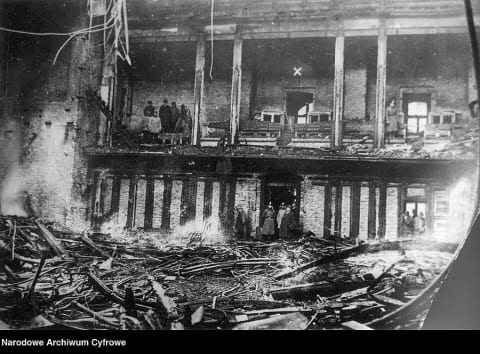
  • The fire is announced as the start of a communist rising, and thousands of communists and social democrats are arrested within days
  • The KPD is never formally banned, which is neater: its deputies are simply taken away
Score 3 of 3
  • The 81 elected communist deputies are kept out of the chamber, and on 22 March the standing orders are changed so that absent deputies count as present
  • SA men line the Kroll Opera House while the social democrats vote
  • Otto Wels speaks against the act for the SPD, the only party that opposes it
Score 3 of 3
  • The civil service law of 7 April removes Jews and political opponents from the state, the universities and the courts
  • On 1 April a national boycott puts SA men outside Jewish shops and surgeries
  • On 22 June the SPD is banned as hostile to the people and the state
Score 3 of 3
  • Opposition is now criminal by definition: there is one party, so there is no lawful way to be against it
  • A law of 14 July cancels the naturalisation of some 16,000 Eastern European Jews and strips citizenship from opponents abroad
  • The Centre Party, which had voted for the Enabling Act, dissolves itself on 5 July
Score 3 of 3
  • Opponents inside the movement are killed, Röhm and Gregor Strasser, and so are opponents who were never in it: Kurt von Schleicher and his wife at their own front door
  • Gustav von Kahr, who had blocked him in 1923, is murdered ten years later
  • Papen's speechwriter Edgar Jung is shot and Papen himself put under guard
Score 3 of 3
  • There is no longer a lawful way to be an opponent, only a criminal one
  • The People's Court, set up in April, tries treason with no appeal
  • The Social Democrats now run their leadership from Prague
Indicator 3 Toleration or encouragement of violence Score 3 of 3
  • In August he publicly sides with five SA men sentenced to death for kicking a communist labourer to death at Potempa, addressing them as comrades
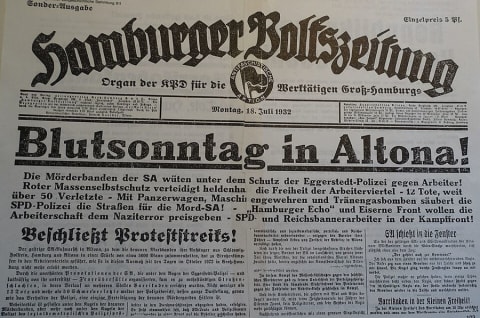
  • On 17 July an SA march through a working class district of Altona ends with eighteen people dead
  • The SA has hundreds of thousands of men and the summer's street fighting kills dozens
Score 3 of 3
  • The men who have been doing the street violence for years are now the government, and nothing is asked of them
  • Attacks on communist premises begin in the first week with the police standing by; the union offices are not touched until May
Score 3 of 3
  • On 22 February the SA and SS are sworn in as auxiliary police in Prussia, so the militia now makes the arrests
  • Göring's order of 17 February tells police to use their firearms and promises to cover those who do
  • From early March unofficial SA prisons and cellars open in ordinary buildings, the first camp at Nohra in a school
Score 3 of 3
  • Dachau opens on 22 March, announced in the newspapers as a camp for political prisoners
  • Protective custody under the February decree means arrest with no charge, no limit and no court
  • The first prisoners are dead within weeks
Score 3 of 3
  • On 2 May union offices are stormed across the country in one coordinated morning and the officials taken to camps
  • The boycott of 1 April is enforced by SA men at the doors, photographed doing it
  • The Gestapo is founded in Prussia on 26 April and answers to Göring, and by 1936 to no court at all
Score 3 of 3
  • The violence is a department of state now, not a street fight: tens of thousands pass through the camps in 1933
  • The auxiliary police badges given to the SA, SS and Stahlhelm are withdrawn during the year, because the state can do it without them
Score 3 of 3
  • Between 30 June and 2 July the state murders its own: at least eighty five people are killed, none of them charged or tried
  • The army supplies transport and weapons, and says nothing when two of its own generals are among the dead
  • The killings are announced publicly and defended as a duty
Score 3 of 3
  • Political murder has been declared lawful after the fact, by a law the cabinet approved and three ministers signed
  • The camps hold whoever the political police decide, on orders no court will overturn
Indicator 4 Readiness to curtail civil liberties and the press Score 2 of 3
  • Where the party already holds office it already censors: as Thuringia's interior minister in 1930 and 1931, Wilhelm Frick banned books, films and plays
  • The party press says plainly which newspapers will be shut when it comes in
  • Papen's own emergency decrees have already accustomed Germany to banning a paper for what it printed
Score 2 of 3
  • The party takes both interior ministries, the Reich one and Prussia's, which is where the police and the press are controlled from
  • Frick takes the Reich Interior Ministry and Göring the Prussian one on day one
  • Radio is already a state monopoly, and the new government uses it from the first week
Score 3 of 3
  • The decree of 4 February lets any paper or meeting be banned; the decree of 28 February removes press freedom from the constitution altogether
  • Speech, assembly, association, letters and telephone calls all lose their protection in one document
  • Communist and social democrat papers are shut before polling day
Score 3 of 3
  • The decree of 21 March makes false or distorted statements about the government a crime, tried in new special courts
  • A Ministry of Propaganda is created on 13 March, and by 30 June it holds the press, radio, film and theatre powers taken from the other ministries
Score 3 of 3
  • On 10 May students burn books in university towns across the country, with the ministry's blessing and the fire brigade in attendance
  • Union and party newspapers, buildings and funds are seized in May and June
  • Radio's own leadership is cleared out by April, and editors are licensed by a law of their own in October
Score 3 of 3
  • The Editors Law of October makes every journalist a licensed state servant, removable for a single article
  • A cheap radio set goes on sale in August, made insensitive enough that the state stations are what a kitchen can reliably hear
  • The party's own publishing house begins absorbing what is left of the press
Score 3 of 3
  • Papen's Marburg speech of 17 June, the last public criticism from inside the establishment, is banned from print and radio and its author is shot two weeks later
  • The country reads about the killings in the government's own words, because no other account is printable
Score 3 of 3
  • The plebiscite of 19 August is put to a country where the case for voting no has nowhere to be printed
  • Every editor, broadcaster and film office answers to one ministry
Indicator 5 Who could still hold him to account Added, not from the book Score 1 of 3
  • Hindenburg refuses him the chancellorship to his face on 13 August, and refuses again in November
  • Voters: the November election costs the party two million votes and thirty four seats, and it runs out of money
  • In December Schleicher tries to split the party by offering Gregor Strasser the vice chancellorship, and nearly manages it
Score 1 of 3
  • Hindenburg appoints him, can dismiss him at will, and holds the emergency power the whole government depends on
  • Only three of eleven cabinet seats are Nazi: the rest go to conservatives who believe they have hired him, with Papen entitled to attend every meeting with the president
  • The Reichstag can still vote the government out, and the army is Hindenburg's, not his
Score 2 of 3
  • Hindenburg signs the emergency decree on 28 February, the day after the fire: without his signature there is no decree, and he gives it
  • The conservative ministers raise no objection in cabinet, because the arrests are of communists
  • Courts still sit, but protective custody puts the arrests out of their reach
Score 2 of 3
  • The Reichstag votes away its own power by 444 votes to 94, the Centre Party voting yes for written guarantees it never receives
  • Only the Social Democrats vote no
  • Still standing: Hindenburg, the army, the churches and the unions; the states go this month
Score 2 of 3
  • The unions go on 2 May and the last party on 5 July, so the two largest organised bodies outside the state stop existing in about ten weeks
  • The states are put under Reich governors who can dissolve their parliaments and dismiss their governments
  • Left on the list: a president of eighty five, the army, and the churches
Score 3 of 3
  • With one party lawful, there is no longer an institution that can refuse him and survive doing it
  • The Concordat of 20 July takes the Catholic clergy out of politics by agreement, signed on the Vatican's side
  • The army holds off because it has been promised rearmament and told in February that it will remain the only armed force
Score 3 of 3
  • The conservatives who thought they could control him find out: Schleicher shot at home, Jung shot, Papen held under guard and then sent to Vienna as envoy
  • The army gets the SA broken, as promised, and pays for it by accepting the murder of two of its own generals
  • The cabinet signs the killings into law three days later, so the last body that could have refused signs instead
Score 3 of 3
  • Hindenburg dies on 2 August and the one office that could have dismissed him is abolished the same day
  • Every soldier swears a personal oath to him by name, the last words about the constitution having gone from it in 1933
  • Nobody left: no president, no opposition party, no free union, no state parliament, and no chamber or court that will rule against him

The same eighteen months, one photograph per column

Scroll inside the box
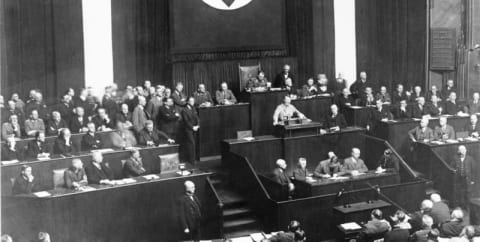
The Reichstag sitting in the Kroll Opera House during the Enabling Act debate, deputies at their desks under a party banner

March 1933 · Month 2

The Reichstag, meeting in the Kroll Opera House on 23 March 1933, votes 444 to 94 to let the cabinet make law without it. The communist deputies had already been arrested or driven out.

Fully authoritarian

Photo: Georg Pahl, CC BY-SA 3.0 de, Wikimedia Commons
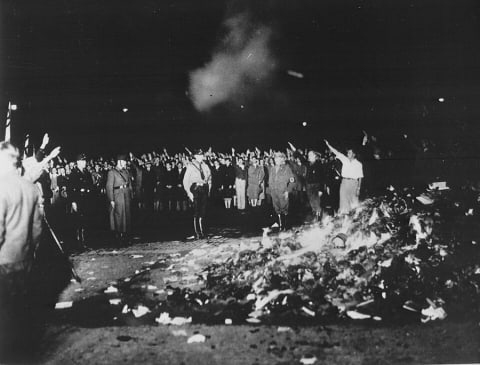
A pile of books burning at night on the Opernplatz in Berlin, a crowd standing behind the fire

April to June 1933 · Months 3 to 5

Books burn on the Opernplatz in Berlin on the night of 10 May 1933. In the same weeks the trade unions are broken up and the remaining parties are banned or dissolve themselves.

Fully authoritarian

Photo: Georg Pahl, CC BY-SA 3.0 de, Wikimedia Commons
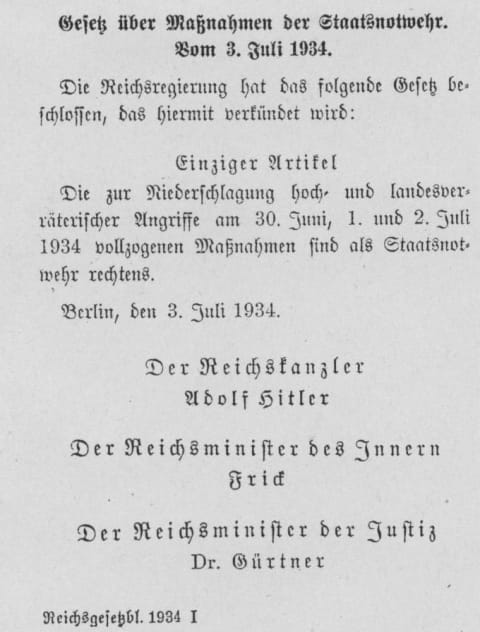
The printed text of the German law of 3 July 1934 declaring the killings of the previous week lawful

June to July 1934 · Month 17

The law of 3 July 1934, one article long: the killings of 30 June, 1 and 2 July are declared lawful defence of the state. At least eighty five people had been killed and none of them charged. It is signed by the chancellor, the interior minister and the justice minister.

Fully authoritarian

Photo: Reichsgesetzblatt 1934 I, page 529, Public domain, Wikimedia Commons

The people and the votes

Three people who did the most to end the republic, three who warned earliest and kept warning, and the four national votes of these eighteen months.

Who ended it

Ranked by what their decisions made possible, not by how well known they are. Alfred Hugenberg, who joined the cabinet but did not arrange it, and Kurt von Schleicher, who tried in December 1932 to split the party by offering Gregor Strasser office and failed, are left out.

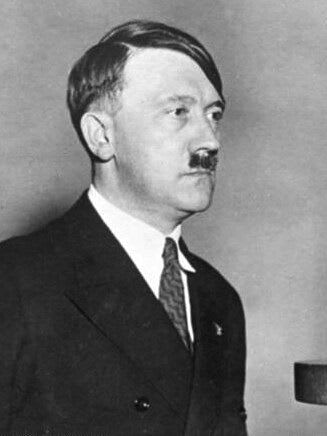
  1. Adolf Hitler in a dark suit, head and shoulders, February 1933

    1 · Most responsible

    Adolf Hitler

    Leader of the NSDAP; Reich Chancellor from 30 January 1933

    Governed under the emergency decree of 28 February 1933 and the Enabling Act of 23 March, made his party the only legal one on 14 July 1933, and merged the presidency into his own office when Hindenburg died on 2 August 1934.

    Why firstHe set out to end the republic and took each step himself.

    30 January 1933 to 2 August 1934

    Photo: Heinrich Hoffmann, 1 February 1933, Bundesarchiv, CC BY-SA 3.0 de, Wikimedia Commons
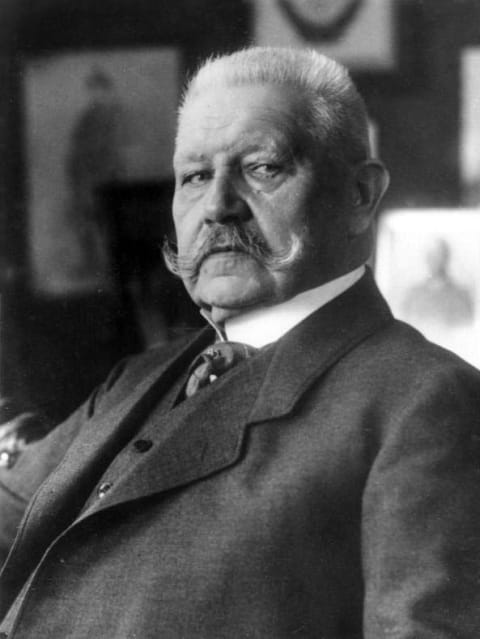
  2. Paul von Hindenburg in uniform, head and shoulders

    2

    Paul von Hindenburg

    Reich President, 1925 until his death in 1934

    Refused to make Hitler chancellor on 13 August 1932 and again in November, then appointed him on 30 January 1933, and on 28 February signed the decree that suspended the constitution's basic rights.

    Why secondUnder the constitution only the president could appoint a chancellor or issue an emergency decree.

    30 January and 28 February 1933

    Photo: Unknown author, between 1919 and 1928, Bundesarchiv, CC BY-SA 3.0 de, Wikimedia Commons
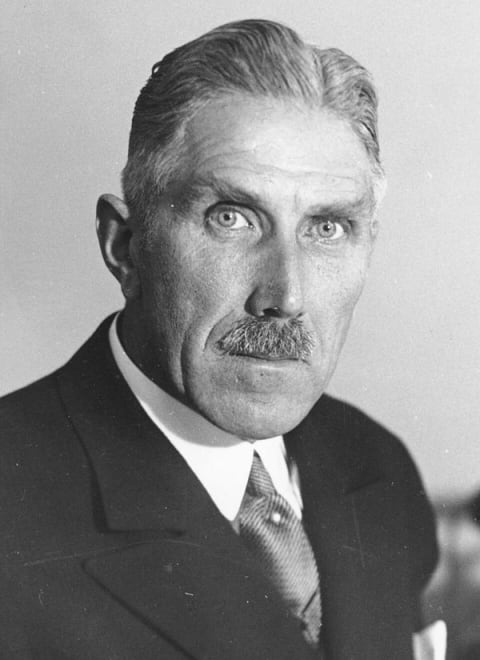
  3. Franz von Papen, head and shoulders, as Vice Chancellor, 1933

    3

    Franz von Papen

    Chancellor June to November 1932; Vice Chancellor under Hitler from 30 January 1933

    Removed the Social Democratic led government of Prussia by decree on 20 July 1932, met Hitler in Cologne on 4 January 1933, and urged Hindenburg to appoint him in a cabinet where three of the eleven members were Nazis.

    Why thirdHe brokered the appointment. Hugenberg only joined it.

    20 July 1932 to 30 January 1933

    Photo: Unknown author, 1933, Bundesarchiv, CC BY-SA 3.0 de, Wikimedia Commons

Who warned first

The earliest three who raised the alarm and kept raising it for years, chosen by how early they started and how long they held on.

  1. No free photograph

    Warned from 1921

    Emil Julius Gumbel

    Statistician; taught at Heidelberg from 1923

    Counted the political murders committed since 1919 in Zwei Jahre Mord (1921) and Vier Jahre politischer Mord (1922): 354 by the right, 22 by the left, and he showed how lightly the courts treated the right's killers.

    What it costNationalist and Nazi students campaigned against him for years. He lost his licence to teach in August 1932, stayed in exile in France, and was on the first list of Germans stripped of citizenship, 25 August 1933.

    1921 to 1932

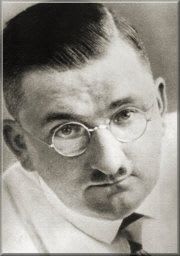
  2. Fritz Gerlich, head and shoulders, wearing round glasses, 1929

    Warned from 1923

    Fritz Gerlich

    Munich journalist; editor of the Münchner Neueste Nachrichten 1920 to 1928, then of the weekly Der gerade Weg

    Had backed the Nazis until the putsch of November 1923, then turned against them and attacked Hitler in print for almost ten years, from 1932 in his own weekly.

    What it costSA men stormed his newspaper's office and arrested him on 9 March 1933. He was killed in Dachau in the night of 30 June to 1 July 1934.

    November 1923 to March 1933

    Photo: Markus Siedler, 1929, Public domain, Wikimedia Commons
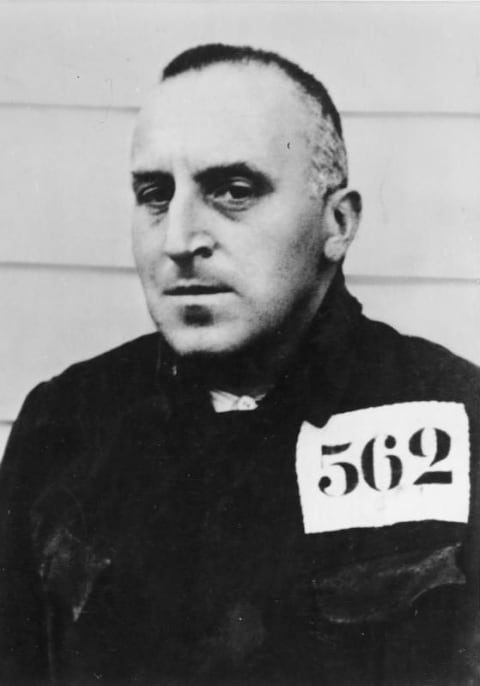
  3. Carl von Ossietzky in prisoner's clothes with the number 562 on his chest

    Warned from 1927

    Carl von Ossietzky

    Editor of the Berlin weekly Die Weltbühne from 1927

    Wrote against the NSDAP and published the report on the army's secret air force. Convicted for it in November 1931, he refused to leave the country and served his sentence from May to December 1932.

    What it costArrested in the night of the Reichstag fire, 28 February 1933, and held in the Sonnenburg and Esterwegen camps. Awarded the 1935 Nobel Peace Prize in November 1936, he died under police guard in a Berlin hospital on 4 May 1938.

    1927 to February 1933

    Photo: prisoner in Esterwegen camp, Bundesarchiv, CC BY-SA 3.0 de, Wikimedia Commons

The votes that let it happen

The four national votes of these months. In the two free elections the party won the most votes but never a majority. The third was held under terror, and the last two after the NSDAP had been made the only legal party.

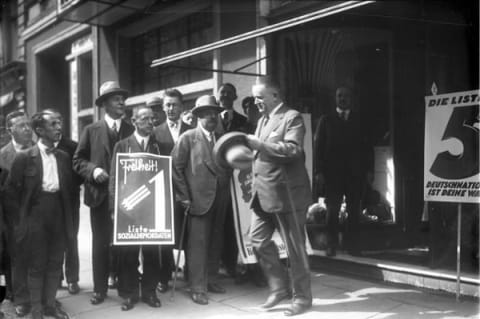
  1. Men holding party list placards outside a Berlin polling place on election day

    31 July 1932

    Reichstag election

    37.4 percentNSDAP, 230 of 608 seats. Turnout 84.1 percent.

    The NSDAP became the largest party. On 13 August Hitler demanded the chancellorship and was refused. At the next election, on 6 November 1932, it fell to 33.1 percent, and he was appointed twelve weeks later anyway.

    Most votes, not a majority

    Photo: outside a Berlin polling place on election day. Unknown author, Bundesarchiv, CC BY-SA 3.0 de, Wikimedia Commons
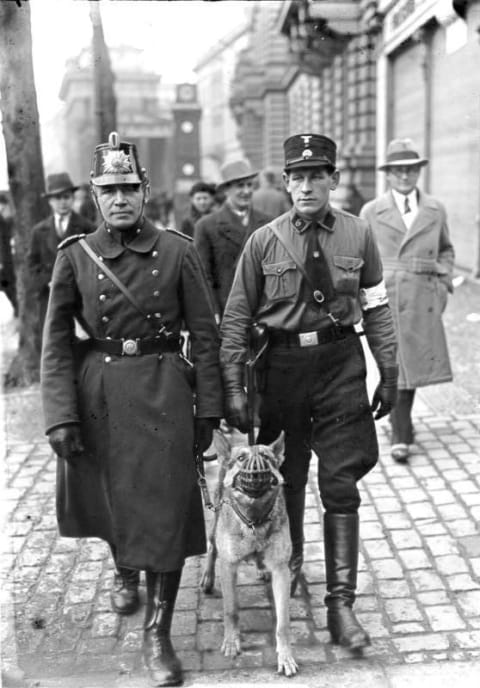
  2. A police officer and an SA man with an armband and a dog patrol a Berlin street on election day

    5 March 1933

    Reichstag election

    43.9 percentNSDAP, 288 of 647 seats: short of a majority on its own, 51.9 percent with its coalition partner's list. Turnout 88.7 percent.

    Held a week after the decree suspending basic rights, with communist leaders under arrest. The Reichstag it elected passed the Enabling Act eighteen days later.

    Held under terror

    Photo: SA auxiliary police patrol with regular police in Berlin on election day. Georg Pahl, Bundesarchiv, CC BY-SA 3.0 de, Wikimedia Commons
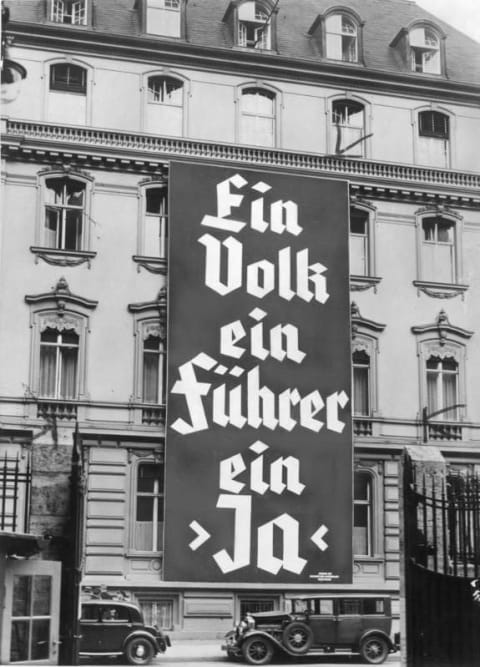
  3. A tall banner on a Berlin building reading Ein Volk ein Fuehrer ein Ja

    12 November 1933

    One list election and a plebiscite on leaving the League of Nations

    92.1 percentfor the only list, turnout 95.2 percent. Plebiscite: 95.1 percent yes, turnout 96.3 percent.

    No other party could stand. The law of 14 July 1933 had made the NSDAP the only legal one.

    Not a free vote

    Photo: "One people, one leader, one Yes" on the party's building in the Voßstraße, Berlin, November 1933. Bundesarchiv, CC BY-SA 3.0 de, Wikimedia Commons
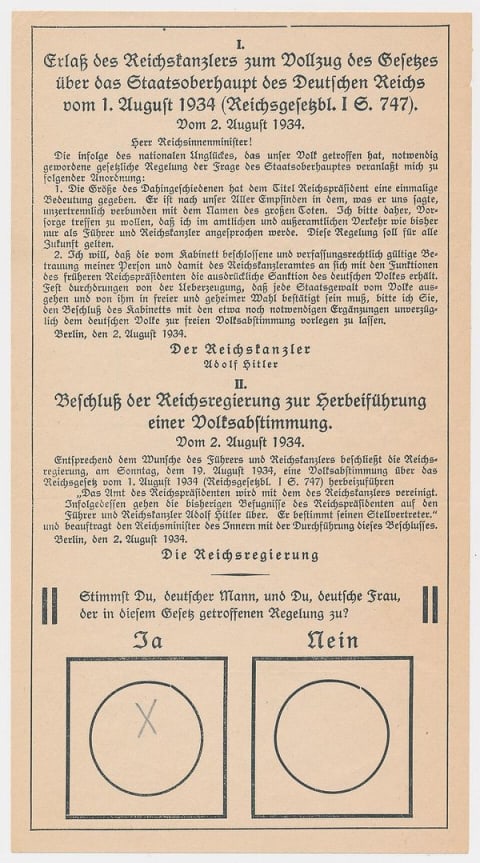
  4. The printed ballot of August 1934: the text of the law, and two circles marked Ja and Nein

    19 August 1934

    Plebiscite on merging the offices of president and chancellor

    89.9 percentyes. Turnout 95.7 percent.

    It approved after the fact a merger already made by the law of 1 August and in force since Hindenburg died on 2 August.

    Not a free vote

    Photo: the ballot paper, the law's text above two circles, Yes and No. Public domain, Wikimedia Commons
Reading the rows across

Nothing had to be discovered. Read the column before he took office: four of the five rows are already at serious or worse, in public, six months early. The party had said it would end the republic once it was inside it. It called its opponents criminals to be destroyed rather than beaten at an election. It ran a private army that killed eighteen people in one afternoon in Altona that July, and in August he put his name to a message of support for five men sentenced to death for a political murder. That is the record the men who arranged 30 January had in front of them, and they appointed him anyway, on the theory that office would tame him and that three cabinet seats would hold him. So this table has almost no ramp in it, which is the whole difference from the slow cases. Rows one to four are as dark as they go within a month of the appointment, because the man did not change on taking power; only his means did. The row that moves is row five, and it moves one way: from a president who had twice refused him and a cabinet that outnumbered him eight to three, to the unions, to the states, to the army, to nobody, in eighteen months. He never won a majority at the ballot box. He did not need to. He needed the people already holding the doors to open them, and they did.

Claude's scoring

The numbers are not in the book. Levitsky and Ziblatt supply the four indicators and the argument, and they use Germany as their case of gatekeeping failure; the four steps of shading here are Claude applying that framework to the historical record, one cell at a time, and they are open to argument. The events named in each cell are the evidence, so you can disagree with a score rather than take it on trust. Indicator 5 is not in the book at all: it asks who could still make them answer for something at that point, and it is shaded the same way, where the darkest cell means answerable to nobody. The columns here are months, not years, because this death took about eighteen of them; the first column sits before he held any office at all, and is there on purpose. Dates in a cell are the dates of the event, which sometimes sit slightly outside the column that holds them.

Framework from How Democracies Die by Steven Levitsky and Daniel Ziblatt, 2018. Part of the melting pot.

This case does not score one man. The erosion runs on both sides and it runs before the coup, so every cell says whose behaviour it is scoring.

Chile on its own page

Chile, from the 1970 election to the 1973 coup

1970 to 1973
Darker means further gone
Norm holding Testing the limits Serious and repeated violation Fully authoritarian

The darker the cell, the further gone the indicator at that moment. Events set in bold are the turning points: the moment in that cell where something stopped being possible to undo. Months are counted from 3 November 1970, when Salvador Allende took office.

Scroll the table sideways for the later months
Indicator Sept to Dec 1970Elected, and month 0 1971Months 2 to 13 Jan to July 1972Months 14 to 20 Oct to Nov 1972Months 23 to 24 March to April 1973Months 28 to 29 May to June 1973Months 30 to 31 July to Aug 1973Months 32 to 33 Sept to Nov 1973Months 34 to 36
Indicator 1 Rejection of the democratic rules of the game Score 2 of 3
  • The losing side, not the winner. Allende comes first on 4 September 1970 with 36.6 percent and no majority, so the choice passes to Congress. General René Schneider, who held that the army's job was to accept whatever Congress decided, is shot in a kidnap attempt on 22 October and dies on 25 October
  • Nixon had ordered the CIA on 15 September to keep Allende out of office. The agency was backing officers plotting a coup and had withdrawn from General Viaux's group days before his men shot Schneider
  • The legal version of the same plan: have Congress elect Alessandri, who would then resign, forcing an election that Frei could contest. Congress instead elects Allende on 24 October by 153 votes to 35, after he agrees to a Statute of Constitutional Guarantees demanded by the Christian Democrats as their price and drafted by a joint commission of both sides
Score 1 of 3
  • The largest thing the government does all year is done by the book: the copper mines are nationalised by constitutional amendment, approved by Congress on 11 July 1971 with nobody voting against
  • The rest goes round Congress. Firms are requisitioned or put under state administration using a decree law of 1932, and when the Comptroller General refuses to register a decree, the president and every minister sign an insistence decree that overrides him
  • Popular Unity takes 49.7 percent at the municipal elections in April, its best result, and treats it as a mandate for a programme it cannot get through the chambers
Score 2 of 3
  • The constitution stops having an agreed meaning. Congress passes a reform to halt the takeovers, Allende vetoes most of it on 6 April 1972, and the two sides then disagree for more than a year over whether Congress needs two thirds or a simple majority to beat his veto. There is no arbiter both accept
  • From 1973 he says he will settle it with a plebiscite and never calls one. The thirty day window article 109 allows runs out on 6 June 1973, and in May 1973 he asks the Constitutional Tribunal instead
  • The opposition has been accusing his ministers before the constitution since January 1971 and now succeeds for the first time. The interior minister José Tohá is moved to defence on 7 January 1972, the day after the Chamber lets the accusation through, and the Senate removes him from Interior on 22 January anyway
Score 2 of 3
  • Both sides go outside the chamber. The lorry owners stop the country in the second week of October and the professional associations join them. On 22 October they publish El pliego de Chile, a list of demands issued by bodies that had won no election, whose central demand is that the government obey Congress and the courts
  • Allende declares a state of emergency province by province and answers with the army. On 2 November the commander in chief of the army, Carlos Prats, becomes interior minister, with a rear admiral at public works and transport and an air force general at mining
  • The strike ends on 5 November. A dispute between civilians has been settled by putting the army's commander in chief, and two officers under the other two service chiefs, in the cabinet
Score 2 of 3
  • The one column where the votes work. The congressional election of 4 March 1973 is held, counted and accepted by both sides at the time. Popular Unity takes about 44 percent of the vote for the Chamber, more than Allende won in 1970, though almost exactly what the same parties had won in the congressional election of 1969
  • The opposition takes 55.6 percent of the valid votes and misses the two thirds of the Senate it would have needed to remove the president. Both sides had treated the vote as the way out of the deadlock, and neither gets what it came for
  • The constitutional fight runs on underneath it. In April the Chamber rejects his vetoes to the Hamilton Fuentealba reform on the three areas of the economy by simple majority. He will not promulgate it and will not call the plebiscite article 109 allows, holding that two thirds is required, and in May he takes the quorum question to the Constitutional Tribunal. It is still unresolved on 11 September
  • The next presidential election is not due until 1976
Score 3 of 3
  • On 29 June an armoured regiment drives on the palace. Sixteen armoured vehicles, among them M41 tanks, and about eighty soldiers under Lieutenant Colonel Roberto Souper attack La Moneda and the defence ministry. About twenty two people are killed. General Prats puts the rising down in person
  • Allende asks Congress the same day, 29 June, for a state of siege, and the Senate rejects the bill in special session on 3 July
  • On 26 May the President of the Supreme Court had already sent him an oficio transcribing an agreement of the full court, saying the country was heading for a breakdown of the rule of law because his government was not enforcing its judgments
Score 3 of 3
  • On 22 August the Chamber of Deputies votes 81 to 47 for a resolution declaring a grave breakdown of the constitutional and legal order, addressed to the president and to the ministers drawn from the armed forces and Carabineros, and telling those ministers that ending it is what would make their presence in the cabinet worth anything to the republic
  • The day after the vote, on 23 August, Prats resigns the ministry of defence and the command of the army, and recommends his own successor. Allende appoints Augusto Pinochet
  • It is not an impeachment and it removes nobody. Allende answers on 24 August that the only way Congress may judge him is a constitutional accusation, that the opposition failed in March to win the Senate votes for one, and that the Chamber is asking soldiers to become deliberative and break their duty of obedience to the government, which he calls promoting a coup
Score 3 of 3
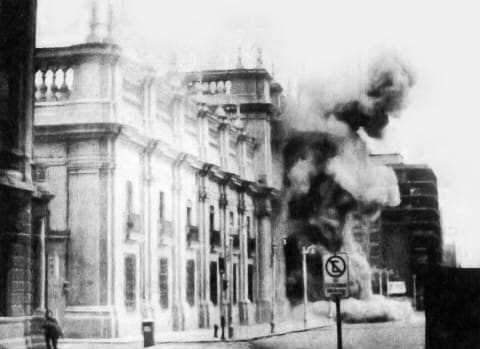
  • 11 September 1973. The navy takes Valparaíso at dawn, the armed forces broadcast a joint ultimatum, air force jets bomb La Moneda, and the president dies inside it
  • Congress is closed by Bando 29 on 14 September and formally dissolved by Decree Law 27, dated 21 September and published on the 24th. The Constitutional Tribunal is abolished by Decree Law 119 of 5 November, published on the 10th, on the ground that with Congress gone it is unnecessary
  • The junta's own first decree, of 11 September, promises to respect the constitution and the laws of the republic to the extent that the present situation of the country permits
Indicator 2 Denial of the legitimacy of political opponents Score 2 of 3
  • The winner is treated as illegitimate before he takes office. On 15 September Nixon tells the director of the CIA to make the Chilean economy scream. The notes of that meeting record ten million dollars available and more if needed
  • The seven weeks between the vote and the congressional session are spent trying to stop the result taking effect, by an argument that 36.6 percent is not a mandate
  • Against that, the price Allende pays is an explicit promise of the other side's rights: party pluralism, freedom of information, freedom of education and university autonomy, written into the constitution as Law 17,398 on 9 January 1971
Score 1 of 3
  • The land is taken faster than the law hands it over, and not to anyone's plan. In Cautín province alone one study counts 221 farm occupations between October 1970 and the end of 1971, only a third of them organised by revolutionary groups and two fifths with no party or union behind them at all
  • Fidel Castro spends most of November touring the country as the government's guest, which the opposition reads as a statement of intent
  • The parties still argue with each other in Congress, and the copper amendment passes without a vote against, so this is not yet a cell about enemies
Score 2 of 3
  • The argument stops being about policy and becomes about whether the government is lawful at all. The decrees are renamed resquicios legales, legal loopholes. The government's own paper La Nación uses the phrase in an editorial on 21 February 1972, El Mercurio takes it up in August and never gives it back
  • Ministers become the target instead of bills. Over the government's three years at least ten of them are accused before the constitution and seven are removed
  • On the other flank, groups inside and outside the coalition argue openly that the road through Congress is finished
Score 2 of 3
  • El pliego de Chile, 22 October 1972. The trade and professional associations present their demands as the demands of the country, and El Mercurio prints them
  • The government calls the stoppage sedition, and the strikers call the government unlawful: on 25 October the opposition majority in the Chamber signs a text declaring it illegal. Neither description leaves room for the other side to win an election
Score 2 of 3
  • The election is fought over whether the government should exist. The opposition runs as one bloc with the stated aim of the two thirds of the Senate that would let it remove the president
  • It does not get them. Allende says so himself in August: the opposition tried in March to win the votes for a constitutional accusation and failed
Score 2 of 3
  • The Supreme Court tells him in writing that his administration is acting unlawfully. Its oficio of 26 May 1973, transcribing an agreement of the full court, says the acts of the political authority are producing a crisis of the rule of law and an imminent breakdown of the legal order. Allende answers the President of the Court in writing on 12 June
  • After the failed rising of 29 June the government's supporters occupy more than 350 factories, and the armed forces take it that the cordones are arming themselves with the government's tolerance
Score 3 of 3
  • The 22 August resolution says the government is trying to conquer total power and install a totalitarian system, and it is passed by a chamber the same voters elected in March
  • The navy asks the courts to lift the parliamentary immunity of the Socialist Party's leader, Carlos Altamirano, and of the MAPU deputy Óscar Guillermo Garretón, for sedition among sailors. The hearing is listed in Valparaíso for 11 September
Score 3 of 3
  • Decree Law 77, of 8 October, declares the Communist, Socialist, Radical, MAPU, Christian Left and Independent Popular Action parties unlawful associations, along with the Unión Socialista Popular and any body holding Marxist doctrine, and takes their property. Decree Law 78, a week later, puts the remaining parties into recess, including the Christian Democrats who had voted for the 22 August resolution
  • On 30 October the junta presents a Libro Blanco setting out Plan Z, an alleged plot by the left to murder the officer corps, as the reason for the coup. It was later described as a psychological warfare operation, including by the junta's own first press secretary
Indicator 3 Toleration or encouragement of violence Score 2 of 3
  • The commander in chief of the army is killed for refusing to intervene. Schneider is shot on 22 October 1970 and dies on 25 October
  • The army as an institution does not follow the plotters, and the courts try them. Viaux is sentenced to twenty years in June 1972, reduced to two that December on appeal by the military court
Score 2 of 3
  • A far left group machine guns a former interior minister in the street. Edmundo Pérez Zujovic is killed on 8 June 1971 by the VOP. Eight days later one of the killers shoots three officers dead at the headquarters of the detective police and blows himself up with dynamite. The government hunts the group down and destroys it
  • Patria y Libertad, formed the previous September to stop Congress electing Allende, is refounded as a standing nationalist front on 1 April 1971 and organises for force from the start
  • The march of the empty pots on 1 December ends in street fighting. A state of emergency is declared in Santiago province and the officer commanding the garrison, Augusto Pinochet, bans demonstrations
Score 2 of 3
  • Both sides start organising outside the state. Workers build the first cordón industrial, Cerrillos Maipú, on 19 June 1972 after the Perlak cannery is taken over, and the rest of Santiago's cordones follow in October; the nationalist right builds a paramilitary front. Neither is a party and neither answers to one
  • Farm and factory occupations carry on through the year, and the police lists of them become the opposition's evidence
Score 2 of 3
  • The country is stopped by blocking it. Main roads are cut for most of a month, food and fuel barely move, and shortages that were already bad get much worse
  • The government answers by requisitioning lorries, and workers answer by taking over plants their employers have shut and asking the state to take them on, which is the mechanism the whole quarrel was about
Score 2 of 3
  • The copper mine strikes against the government that nationalised it. Four of the five white collar unions at El Teniente and one of the four workers' unions stop on 18 April 1973, about 13,000 join within a week, and they stay out for 76 days, led by a Christian Democrat union leader
  • In May the government decrees a state of emergency in O'Higgins on the 10th and Carabineros clash with the strikers' supporters in Rancagua on the 25th. The miners' march reaches Santiago in June
  • José Ricardo Ahumada Vásquez, a sewer worker and communist, is shot dead on 27 April at a trade union march on the Alameda
Score 3 of 3
  • Soldiers fire on the presidential palace for hours. About twenty two people are killed in the rising of 29 June, among them the Argentine cameraman Leonardo Henrichsen, who filmed the soldier who shot him
  • Patria y Libertad fighters take part, and its leaders take refuge in the Ecuadorean embassy afterwards
  • Luis Bravo Meneses, an El Teniente worker, is shot dead by troops in Rancagua on 30 May when his car fails to stop
Score 3 of 3
  • The president's naval aide is shot at his own house. Captain Arturo Araya is shot in the early hours of 27 July 1973. A Patria y Libertad militant was convicted of firing the shot in 1980 and pardoned the following year
  • The lorry owners begin a second indefinite strike on 26 July and are still out on 11 September
  • Patria y Libertad blows up a bridge at the entrance to Concepción on 23 August and attacks railway lines and electrical installations on 25 August, then stops on 27 August to wait for the coup
  • Under the Arms Control Act that Congress passed in October 1972, the armed forces search factories and workplaces for weapons through the winter
Score 3 of 3
  • The National Stadium becomes a prison camp from 12 September to 9 November 1973. The Red Cross counted about 7,000 people held there on 22 September, with two to three hundred foreigners among them
  • The commission that counted the dead after the dictatorship, chaired by Raúl Rettig, documented 2,279 people killed for political reasons across the sixteen and a half years that followed, from 11 September 1973 to 11 March 1990
Indicator 4 Readiness to curtail civil liberties and the press Score 0 of 3
  • The price of the presidency is a guarantee of the things a government could take away. The Statute of Constitutional Guarantees writes party pluralism, freedom of information, freedom of education and university autonomy into the constitution, and he signs it to get the votes
  • Nothing is closed and nothing is censored in these months. This cell is cream and it should be
  • The money already moving is foreign: American covert funding of Chilean newspapers had been running for years before the 1970 vote
Score 1 of 3
  • The state moves into publishing. The purchase of the Zig-Zag printing house is signed on 12 February 1971 and the state publisher Quimantú is created in the same operation and starts printing that year. It tries and fails to take the newsprint monopoly as well: the bill for a state paper institute is thrown out in May 1971 and La Papelera's shareholders refuse to sell a share. State advertising it does control, and the opposition press says it is being squeezed out
  • The other side answers with money. The 40 Committee in Washington deadlocks on 9 September 1971 over a request for a million dollars, and Nixon personally approves 700,000 dollars for El Mercurio four days later, on condition it run a campaign on press freedom
Score 1 of 3
  • Another 965,000 dollars for El Mercurio is approved on 11 April 1972. The largest opposition newspaper in the country is being kept open by a foreign government, and it goes on printing every day
  • Through 1972 and 1973 the government's weapon is the courts: it sues newspapers, magazines and radio stations under the internal security law, and the courts sometimes grant the suspension, so the padlock comes through them rather than instead of them
Score 2 of 3
  • Every radio station in the country, and television with them, is put into a compulsory national chain by government decree under the state of emergency, the broadcast produced by the state information office and enforced by the military zone commanders. From 12 October they carry it from 07.30 to 23.30, and from 15 October nothing else at all. The strikers list it among their grievances on 22 October
  • The opposition parties answer with a day of silence, a total stoppage of activity, on 24 October, and the stations answer by unhooking from the chain and being closed for it
Score 1 of 3
  • The plan for a unified national school is shelved. Published in the Revista de Educación in February 1973 and released publicly in March, it is read by the bishops and by officers as a scheme to teach one ideology. The plenary assembly of the bishops, meeting at Punta de Tralca, rejects it again on 11 April, the same day about 150 officers tell the education minister to his face that they are against it, and he writes to Cardinal Silva Henríquez the next day accepting a postponement. It is never revived
  • The campaign of March 1973 is run against a hostile press that nobody stops
Score 2 of 3
  • Radio Agricultura is ordered off the air for six days on 30 May 1973 over its reporting of a death at El Teniente. It defies the order and keeps broadcasting on emergency equipment, a court orders the service restored, and it is back to normal on 5 June. It is the fourth time the government has suspended that station
  • Nothing is shut for good on either side. The opposition papers and radios are still working in June
Score 2 of 3
  • Attacks on freedom of expression are among the charges in the resolution of 22 August. The Chamber is describing real suspensions and real pressure, and its remedy is to ask soldiers to fix them
  • On the morning of 11 September the whole press is still printing, El Mercurio and the Communist El Siglo alike
Score 3 of 3
  • Books are burned in the street. Photographs of soldiers burning left wing literature date from the end of September 1973. A curfew and prior censorship are imposed, the whole press is suspended, and only El Mercurio and La Tercera are let back. The press of the left never returns
  • El Mercurio, kept alive with American money since September 1971 in order to oppose the government, goes on publishing
Indicator 5 Who could still hold the government to account Added, not from the book Score 0 of 3
  • He is president because 153 members of Congress voted for him, and he got those votes only by agreeing to a constitutional amendment first
  • An opposition majority in both chambers, a Comptroller General who can refuse to register his decrees, a bench he cannot pack because he may appoint Supreme Court judges only from a list of five the Court itself draws up, most of the press against him though the largest daily, Clarín, and the state's La Nación are for him, and scheduled elections in 1971 and 1973 that he cannot postpone
  • The one man killed in these months was killed for insisting that the result be respected
Score 1 of 3
  • Going round the Comptroller General becomes routine. When the Comptroller refuses to register a decree, the president and the whole cabinet sign an insistence decree and it takes effect anyway. The first of them, No. 2092, is dated 28 December 1970
  • It is still a real check. The mechanism is public, and the Comptroller records every insistence in his annual public account
  • Voters give the coalition 49.7 percent in April, and the copper amendment passes without a vote against
Score 1 of 3
  • He moves his interior minister out before the Senate can remove him. José Tohá goes to defence on 7 January 1972, the day after the Chamber lets the accusation through, and the Senate removes him from Interior on 22 January anyway. The mechanism works and is then made to mean nothing
  • The Senate throws out his vetoes to the reform that would have stopped the takeovers on 6 July, and the reform can then be neither promulgated nor killed, because nobody can agree what majority beats a veto. Being answerable to Congress and being governed by it turn out to be different things
Score 1 of 3
  • He cannot end the strike by governing, so he ends it by taking the army's commander in chief and two other officers into his cabinet. The body he is now most answerable to has not been elected by anybody
  • Congress, the courts and the Comptroller all still function. Congress accuses four of his ministers, and a court strikes down his radio chain on 27 October and he obeys it
Score 1 of 3
  • The voters answer on 4 March and the answer holds. He is neither confirmed nor removed, and no one alleges the count was false until July
  • In April he shelves his school plan after the bishops reject it and about 150 officers tell his education minister to his face that they are against it
Score 1 of 3
  • In five weeks the Supreme Court tells him he is breaking the rule of law, part of the army tries to remove him by force, and the Senate throws out the state of siege bill he asks for, on 3 July. He is answerable to everybody and can get nothing from anybody
  • The institution still holding to the constitution is the army command, and it holds because of one general
Score 1 of 3
  • The Chamber addresses itself to the president and to the officers in his cabinet, but the thing it asks for it asks of the officers. Accountability is being asked for from the one body that does not owe it
  • On the night of 13 August the party directorate of the Christian Democrats flatly refuses Prats, who has come on the president's behalf to ask them to back a state of siege bill
  • On 23 August the general who had put down the June rising resigns and recommends the successor Allende then appoints. From then on the only force that can compel the president is the one preparing to remove him
Score 3 of 3
  • Congress dissolved, the Marxist parties dissolved and the rest put into recess, the Constitutional Tribunal abolished by Decree Law 119 of 5 November 1973 because with Congress gone it was held to be unnecessary. There is no competitive national vote again until the plebiscite of October 1988
  • The two institutions that had spent three years declaring the government unlawful stay where they are. The president of the Supreme Court publicly welcomes the new government the day after the coup

The same 36 months, five photographs

Scroll inside the box
El día que ganó Allende Edificio de la FECH

Sept to Dec 1970 · Elected, and month 0

Santiago on the night of 4 September 1970. The banner over the crowd reads Chilean, the right lies to go on exploiting you and your family. Allende has come first with 36.6 percent and no majority, so the choice passes to Congress, which will take seven weeks and cost him a written guarantee of the other side's rights.

Serious and repeated violation

Photo: Paul Lowry, CC BY 2.0, Wikimedia Commons
Salvador Allende en Rancagua por nacionalización del cobre

1971 · Months 2 to 13

Rancagua, 11 July 1971, the day Congress approved the nationalisation of the copper mines with nobody voting against. It was the one large thing the government achieved by the ordinary route, and the reason the rest of the programme went round Congress is that nothing else could pass it.

Testing the limits

Photo: Biblioteca del Congreso Nacional, Chile, CC BY-SA 3.0 cl, Wikimedia Commons
Articles-38931 imagen

Jan to July 1972 · Months 14 to 20

A queue for food along a street in Calbuco, in the far south, photographed in 1972 and held by the Chilean national archive, which titles it Fila para abastecerse de alimentos. Shortages turned the constitutional quarrel about who could requisition a firm into an argument people stood in every day.

Serious and repeated violation

Photo: Archivo Nacional de Chile, CC BY-SA 4.0, Wikimedia Commons
Allende vota elección parlamentarias 1973

March to April 1973 · Months 28 to 29

Allende posting his ballot in a plain wooden urn at the congressional election of 4 March 1973, among helmeted troops guarding the polling place. The count was accepted by both sides at the time. His coalition took about 44 percent, more than he had won in 1970, and the opposition took 55.6 percent of the valid votes and missed the two thirds of the Senate that would have let it remove him.

Serious and repeated violation

Photo: Biblioteca del Congreso Nacional, Chile, CC BY-SA 3.0 cl, Wikimedia Commons

The people and the votes

Three people whose decisions did the most to end the democratic process, from three different sides, three who warned early and kept at it, and the two national votes of these three years. No popular vote chose the coup.

Who ended it

Ranked by what their decisions made possible, not by how well known they are: one from the armed forces, one from the opposition in Congress, one from the United States. Admiral José Toribio Merino and General Gustavo Leigh, who sat on the junta beside Pinochet, and Henry Kissinger, who was at the meeting of 15 September 1970 but took the orders rather than gave them, are left out, and so is Allende: his decrees and the reform he would not promulgate are scored in the table above, but he stayed answerable to Congress and the courts until the day he died (row 5), and the decision to remove him by force was not his.

  1. Augusto Pinochet in dress uniform with the presidential sash, official photograph, about 1974

    1 · Most responsible

    Augusto Pinochet

    Commander in chief of the army from 23 August 1973; president of the junta from 11 September 1973

    Appointed to command the army on Prats's recommendation. On 11 September he was one of the four commanders who signed the first edict and the ultimatum to Allende, and he presided over the junta that dissolved Congress by Decree Law 27 of 21 September. He governed until 11 March 1990.

    Why firstHe brought the army into the coup and led the regime that replaced the republic.

    23 August 1973 to 11 March 1990

    Photo: Ministerio de Relaciones Exteriores de Chile, about 1974, CC BY 2.0 cl, Wikimedia Commons
  2. Salvador Allende, left, and Patricio Aylwin, right, in 1973

    2

    Patricio Aylwin

    President of the Christian Democratic Party from May 1973

    Met Allende privately at the cardinal's house on 17 August 1973. By his own account he then proposed the Chamber resolution declaring a grave breakdown of the constitutional and legal order, and corrected its final text himself. It passed on 22 August, 81 to 47, with every Christian Democrat deputy voting for it. He wrote later that it was never meant as a call for a coup.

    Why secondHis party held 50 of the opposition's 87 seats in the Chamber; without them the resolution could not have passed.

    17 to 22 August 1973

    Photo: Biblioteca del Congreso Nacional de Chile, 1973, CC BY 3.0 cl, Wikimedia Commons
  3. Richard Nixon, official presidential portrait, 1972

    3

    Richard Nixon

    President of the United States

    On 15 September 1970 he told the director of the CIA to prevent Allende from taking office. On 13 September 1971 he approved 700,000 dollars for El Mercurio. A Senate committee found that the CIA spent eight million dollars covertly in Chile between 1970 and the coup.

    Why thirdHis orders put United States money behind the opposition for three years, though the same Senate report found no hard evidence of direct United States help with the coup itself.

    15 September 1970 to 11 September 1973

    Photo: United States Army Audiovisual Center, 1 June 1972, Public domain, Wikimedia Commons

Who warned first

The earliest three who raised the alarm and kept raising it, chosen by how early they started and how long they held on. Schneider held for five months, not years, because he was killed for it.

  1. General René Schneider in uniform and cap

    Warned from 1970

    René Schneider

    Commander in chief of the army from October 1969

    Said in El Mercurio on 8 May 1970, during the campaign, that if no candidate won an absolute majority, Congress was free to choose and the army's mission was to see its choice respected. He said it again in public on 12 October, while officers and the CIA were working to stop Allende taking office.

    What it costMen trying to kidnap him shot him in his car on 22 October 1970. He died on 25 October, the day after Congress elected Allende.

    May to October 1970

    Photo: Biblioteca del Congreso Nacional de Chile, date unknown, CC BY 3.0 cl, Wikimedia Commons
  2. General Carlos Prats in uniform and peaked cap

    Warned from 1972

    Carlos Prats

    Commander in chief of the army, October 1970 to August 1973; minister of the interior, then of defence

    Held the army to Schneider's line. In the Senate in December 1972 he said another stoppage like October's could lead to chaos and a civil war the country would not recover from in fifty years. He put down the armoured rising of 29 June 1973, and resigned on 23 August rather than, in his words, serve as a pretext for those seeking to overthrow the government.

    What it costHe left for Argentina on 15 September 1973. He and his wife, Sofía Cuthbert, were killed by a car bomb in Buenos Aires on 30 September 1974. The former head of the DINA, Manuel Contreras, was among those later convicted.

    February 1972 to August 1973

    Photo: Biblioteca del Congreso Nacional de Chile, date unknown, CC BY 3.0 cl, Wikimedia Commons
  3. Radomiro Tomic in glasses and a dark suit, seated at a table, about 1970

    Warned from 1972

    Radomiro Tomic

    Christian Democratic candidate for president in 1970

    Went to Allende's house to congratulate him in the early hours after the vote, and said on 14 September 1970 that his party would not vote for Alessandri in Congress. On 31 October 1972, during the stoppage, he called publicly for a democratic truce until the March election, so that the people could decide. In August 1973 he argued against his own party's leadership that it should back the officers Allende had brought into the cabinet.

    What it costAfter the coup he lived outside Chile, for a time in Geneva.

    October 1972 to August 1973

    Photo: Biblioteca del Congreso Nacional de Chile, about 1970, CC BY 3.0 cl, Wikimedia Commons

The votes that let it happen

Two free national votes, both counted and accepted at the time. In the first Allende won the most votes but not a majority. In the second the opposition won a majority but not the two thirds of the Senate it needed to remove him. No popular vote chose the coup. The municipal elections of April 1971 are left out: they chose councils, not a government.

  1. The 1970 presidential ballot paper listing the three candidates

    4 September 1970

    Presidential election

    36.6 percentSalvador Allende, Popular Unity, ahead of Jorge Alessandri and Radomiro Tomic. Turnout 83.7 percent.

    With no absolute majority the choice passed to Congress, which elected Allende on 24 October by 153 votes to 35, after he accepted the Statute of Constitutional Guarantees.

    Most votes, not a majority

    Photo: a ballot paper from the 1970 presidential election. Sfs90, CC BY 3.0, ballot public domain, Wikimedia Commons
  2. A Communist Party meeting in a hall with banners, shortly before the March 1973 election

    4 March 1973

    Election of the Chamber of Deputies and half the Senate

    55.6 percentfor the opposition alliance, 87 of 150 deputies; Popular Unity 44.1 percent, 63 deputies. Turnout 81.2 percent.

    The opposition won a majority of the Chamber but fell short of the two thirds of the Senate needed to remove the president. The Chamber elected that day passed the resolution of 22 August.

    Opposition majority, short of two thirds

    Photo: a Communist Party meeting shortly before the election, March 1973. Biblioteca del Congreso Nacional de Chile, CC BY 3.0 cl, Wikimedia Commons
Reading the rows across

Read the columns before the rows. Two thirds of this table is light, and the light part is not an error. For most of these thirty six months Chile went on holding elections, counting them honestly, publishing an opposition press that called the government unlawful every morning, and removing ministers by vote. Then one column at the far right goes black all the way down. That shape is the case: this democracy did not have its checks worn away year by year, which is what the other pages in this series show. It kept nearly all of them and lost the argument about who they were for. Row 5 is the row to read. It sits at one from 1971 to August 1973 and never rises, because Allende never stopped being answerable to somebody. He was voted down, sued, audited, impeached by proxy through his ministers, refused a state of siege by the Senate and told in writing by the Supreme Court that he was breaking the law, and he could not stop any of it. What he also could not do was govern, and the two facts are the same fact. Row 1 makes the point from the other direction. It opens at two before he has taken office, because the losing side and a foreign government were already trying to prevent the result, and a commander in chief was shot for saying the result should stand. Its one light year is 1971, when the largest thing the government did it did by constitutional amendment. March 1973 is the column where the votes still worked, an election held, counted and accepted, and it settled nothing: it gave the government more votes than 1970 and the opposition less than the two thirds it needed, while underneath it the two sides were still refusing each other's reading of the constitution over a reform he would neither promulgate nor put to a plebiscite. After that the only instruments left were ones nobody had voted for. On 22 August a chamber elected five months earlier voted 81 to 47 to tell the president, and the officers sitting in his cabinet, that ending the government was what would make those officers worth anything to the republic. It was not an impeachment, it removed nobody, and the opposition knew it did not have the Senate votes for the real thing. Three weeks later the palace was bombed.

Claude's scoring

The four indicators are written for one leader, and this case has three actors. Rows 1 to 4 here score the behaviour visible in Chilean politics at that moment, from whichever side it came, and every cell names who did what: the government, the opposition and the associations behind it, the armed forces, or the United States. Scoring only Allende would produce a much lighter table and a false one; scoring only the plotters would leave out the decrees, the requisitions and the reform he vetoed and would not promulgate. Row 5 is the one row that keeps the framework's original shape, because it asks about the government of the day, and its flatness is the finding. The numbers are not in the book. Levitsky and Ziblatt supply the four indicators and the argument, and use Chile as their long example of the collapse of mutual toleration and forbearance; the four steps of shading here are Claude applying that framework to the historical record, one cell at a time, and they are open to argument. Indicator 5 is not in the book at all. Dates in a cell are the dates of the event, which sometimes sit slightly before or after the column that holds them. Three columns carry no photograph. Wikimedia Commons appears to hold no freely licensed picture of the October 1972 strike or of the Chilean winter of 1973. It holds one picture of the rising of 29 June 1973, and that file is tagged public domain in Argentina but possibly still restricted in the United States, so it has been taken off this page; the two other pictures of the day on Commons are 1973 press photographs relabelled with a Creative Commons licence by whoever uploaded them, which is not a licence the photographer gave. A portrait would not have been a picture of any of the three.

Framework from How Democracies Die by Steven Levitsky and Daniel Ziblatt, 2018. Part of the melting pot.

This case does not shade in steps: most of the table goes dark on one dated night, and the man who did it was more popular the week after than the week before.

Peru on its own page

Peru under Alberto Fujimori

1990 to 2000
Darker means further gone
Norm holding Testing the limits Serious and repeated violation Fully authoritarian

The darker the cell, the further gone the indicator that year. Events set in bold are the turning points: the moment in that cell where something stopped being possible to undo.

Scroll the table sideways for the later years
Indicator 1990 to 1991Years 0 to 1 1992Year 2 1993 to 1994Years 3 to 4 1995Year 5 1996 to 1997Years 6 to 7 1998 to 1999Years 8 to 9 2000Year 10
Indicator 1 Rejection of the democratic rules of the game Score 1 of 3
  • He wins the runoff of June 1990 as an outsider with no majority in either chamber, and governs by delegated decree: given powers by Congress in June 1991, he issues 126 legislative decrees, 79 of them in November alone
  • Congress votes to repeal six of the thirty-seven decrees on counter-insurgency before the session closes on 15 December 1991, and he refuses to promulgate the repeals. It then passes a law subjecting his decrees to parliamentary control; he vetoes that too, both chambers re-enact it over his veto on 31 January 1992, and he names it in his coup address as proof that Congress was handcuffing the presidency
Score 3 of 3
  • On the night of Sunday 5 April 1992 he goes on television, dissolves both chambers of Congress and sends the army to the building. Decree Law 25418, signed the next day, gives the executive all legislative power, suspends every article of the constitution that contradicts it, and decrees the wholesale reorganisation of the courts, the public prosecutor, the judicial council, the comptroller and the tribunal of constitutional guarantees. Within three days separate decrees sack the comptroller, thirteen Supreme Court judges and the judicial council, and on 8 April a decree of a single article sacks every member of the tribunal of constitutional guarantees
  • The dissolved Congress meets anyway, declares the presidency vacant and swears in the first vice president, Máximo San Román. The armed forces do not obey and San Román never governs
  • Under pressure from the Organization of American States he announces on 18 May an election for a constituent congress, held on 22 November
Score 2 of 3
  • The constituent congress elected on 22 November 1992, with Acción Popular, APRA and the left staying out of the vote, gives his alliance 44 of the 80 seats. On 6 January 1993 its first constitutional law puts the 1979 constitution back in force except where it conflicts with what he had done since the coup, takes the legislative power to itself, and declares him constitutional president
  • The constitution that body writes is approved by referendum on 31 October 1993 with about 52 percent. It replaces the two chambers with one, and lets a president be re-elected once
Score 2 of 3
  • He stands again under the re-election clause his own assembly had written, the national elections board having ruled in 1994 that his standing in 1995 would count as a re-election, and on 9 April he takes about 64 percent against Javier Pérez de Cuéllar
  • His alliance wins a majority of the 120 seats in the single chamber, and the parties that had governed Peru in the 1980s are left with a few percent each
Score 3 of 3
  • On 23 August 1996 his majority passes Law 26657, an "authentic interpretation" of article 112 declaring that terms begun before the 1993 constitution took effect are not counted, which takes his 1990 term out of the calculation and leaves him free to stand in 2000
  • Three of the seven judges of the Constitutional Tribunal rule in January 1997 that the law cannot be applied to him. On 28 May Congress votes, by a simple majority of those present, to remove all three
Score 3 of 3
  • As many as 1.4 million signatures are gathered for a referendum to repeal that law. The elections board rules that under a 1996 statute a referendum needs 48 votes in Congress; on 27 August 1998 it gets 45, and a right written into the constitution is closed off by a vote with no judicial review left to appeal to
  • In May 1998 Congress raises the number of elections board votes needed to uphold a challenge to a candidacy from three of five to four, and in July 1999 the government declares that Peru is leaving the contentious jurisdiction of the Inter-American Court of Human Rights with immediate effect, which the Court itself held could not be done
Score 3 of 3
  • He runs for a third term. On 9 April he is credited with 49.87 percent of the valid votes, 45.8 percent of all the ballots cast, short of an outright win, and the Organization of American States observation mission led by Eduardo Stein withdraws its observers before the second round rather than watch it
  • Alejandro Toledo refuses to contest the runoff of 28 May and asks voters to spoil their ballots. 29.9 percent of the ballots cast are spoiled and another 1.2 percent are blank, and Fujimori is sworn in on 28 July
Indicator 2 Denial of the legitimacy of political opponents Score 1 of 3
  • He runs and then governs against the parties as a class rather than against their policies. The Truth Commission dates the shift to July 1991, when his own bench lost the presidencies of both chambers and he set about discrediting Parliament in public, questioning what its functions were for and calling it inoperative. Apoyo's polling has his own approval at 60 percent in December 1990 and a little above 30 percent by the end of 1991
  • He spends September and October 1991 attacking what he calls pseudo human rights organisations for what he says is their silence about the insurgency, and in November names Amnesty International and Americas Watch, the Americas arm of Human Rights Watch
Score 3 of 3
  • On the night of the coup soldiers detain the president of the Chamber of Deputies, Roberto Ramírez del Villar, the congressman César Barrera Bazán and the journalist Gustavo Gorriti
  • Troops go to the house of the former president Alan García. He gets over a wall, hides for eight weeks and enters the Colombian embassy on 31 May
  • A court convicted Fujimori in 2009 of the kidnapping of Gorriti, taken that night, and of the businessman Samuel Dyer, seized at Lima airport on 27 July as he tried to fly out
Score 2 of 3
  • General Rodolfo Robles names Vladimiro Montesinos and a special operations detachment inside the army, the squad later known as Colina, in an open letter of 6 May 1993 as the authors of Barrios Altos and La Cantuta. He and his two sons, both serving officers, are prosecuted in the military courts for insulting the nation and the armed forces; he is expelled from the army and takes asylum in Argentina
  • When a congressional commission takes evidence on La Cantuta in April 1993, the army answers by running tanks and troops through Lima on 21 April. The high command and the heads of every military region gather at the Pentagonito to back the commanding general, and a communiqué from the armed forces high command is enough to make Fujimori, who had criticised the tanks, turn round and criticise Congress instead
Score 2 of 3
  • His former wife Susana Higuchi, who had called his government corrupt and been stripped of the title of first lady in 1994, is kept off the 1995 ballot when the elections board refuses to register her group's presidential ticket and then its list of candidates for Congress. The Inter-American Commission found in October 1999 that Peru had violated her right to political participation
  • Three retired officers are charged in April with insulting the nation and the armed forces after criticising in public how the war with Ecuador had been fought, and two of them are jailed. They are out by 30 May, and the June amnesty wipes the charges
Score 3 of 3
  • On 13 July 1997 the immigration authorities publish a resolution, signed two days earlier, revoking the Peruvian citizenship of Baruch Ivcher thirteen years after he was naturalised, on the ground of irregularities in the original application. It is his channel that had been running the stories about the intelligence service
  • The United States human rights report for 1997 records harassment of journalists severe enough to create the perception of an organised campaign of intimidation by the armed forces and the intelligence services
Score 3 of 3
  • Four tabloids run front page attacks in near identical language, calling the investigative reporters of La República traitors, Ecuadorian spies and terrorist sympathisers, and the reporters and their families are sent death threats by telephone
  • Ivcher, by then abroad, is tried in his absence for customs fraud and sentenced to twelve years. José Arrieta, who ran the investigations unit at his channel, leaves the country in January 1998 on learning that he is about to be arrested; he is charged in his absence in March and tax officials call on his family in May
Score 3 of 3
  • Alberto Kouri and enough other members elected on opposition lists cross to the government benches, in the days before the new Congress meets, to give it the majority the election had denied it. The majority shows itself on 26 July, when the government's slate for the Mesa Directiva, headed by Martha Hildebrandt, is elected by 70 votes to 46 in a chamber of 120. Kouri was later sentenced for taking the money
  • When the march of 26 to 28 July ends in rioting and a fatal fire, the government blames the organisers and uses the violence against Toledo
Indicator 3 Toleration or encouragement of violence Score 2 of 3
  • On the night of 3 November 1991 six hooded men walk into a fundraising barbecue at Jirón Huanta 840 in Barrios Altos, order everyone to the floor and fire for about two minutes, killing fifteen people including an eight year old boy and wounding four. The gunmen were later identified as members of Grupo Colina, a death squad made up of army personnel
  • In 2009 a court found that Fujimori had ordered the Colina squad to carry out this killing and the one at La Cantuta
Score 3 of 3
  • On 18 July 1992, two days after Shining Path car bombs in Tarata street in Miraflores killed twenty five people, the Colina squad takes nine students and a professor out of their rooms at La Cantuta university at night. They are not seen again
  • Nine people are taken and killed in Santa province on 2 May, and the killers paint Shining Path slogans afterwards
Score 3 of 3
  • Congress passes Law 26291, the Cantuta law, in the small hours of 8 February 1994 with no committee report and immediate effect; Fujimori signs it the next day and it is published on 10 February. It lets a jurisdiction dispute in the Supreme Court be settled by a simple majority instead of four votes of five. The criminal chamber had split three to two for the military courts on 4 February and was one vote short; on 11 February the same three send the case across. The prime minister, Alfonso Bustamante, resigns over it a week later
  • Burnt fragments of at least five of the La Cantuta victims had been found at Cieneguilla on 8 July 1993, in two of four clandestine graves, by reporters working from a map, not by the state. The graves where all ten were first buried, at Huachipa, were found in November 1993, again after the magazine had reported them
Score 3 of 3
  • On 14 June 1995 the outgoing constituent Congress passes Law 26479, an amnesty for the military, the police and civilian state personnel involved in the counter-insurgency since May 1980, except those charged with drug trafficking, terrorism or treason. It reaches the men convicted of La Cantuta and the killers at Barrios Altos
  • Judge Antonia Saquicuray rules on 16 June that the amnesty cannot apply to Barrios Altos. Within a fortnight Congress passes a second law, 26492, putting the amnesty beyond judicial review, and on 14 July the Eleventh Criminal Chamber of the Lima Superior Court revokes her ruling and closes the case
Score 3 of 3
  • The national family planning programme begins sterilising women in numbers: fewer than 15,000 a year before it, about 82,000 in 1996 and about 110,000 in 1997, with quotas for health workers and bonuses of four to ten dollars a case, concentrated on poor and indigenous women
  • Leonor La Rosa, an army intelligence agent, is tortured by her own service, and the dismembered body of another agent, Mariela Barreto, is found on 23 March 1997. Nobody was convicted for twenty-six years; in 2023 a Lima court found that Montesinos had ordered her killed under Plan Tigre, the counter-intelligence protocol for leakers, and sentenced him and Santiago Martín Rivas to twenty-three years each
  • Commandos retake the Japanese ambassador's residence on 22 April 1997 after four months, killing all fourteen of the hostage takers; one hostage and two commandos also die, and a freed hostage, the Japanese diplomat Hidetaka Ogura, later said captors were killed after surrendering; in 2015 the Inter-American Court found that one of them, Eduardo Cruz Sánchez, had been executed
Score 2 of 3
  • In February 1998 two of the four officers jailed over the torture of Leonor La Rosa are quietly released
  • Police beat students at the first of five protest rallies in central Lima, and on 30 September 1998, after about two hundred demonstrators break into the presidential palace, the security forces use tear gas and fire some shots
Score 2 of 3
  • Six security guards die in a fire at the Banco de la Nación in central Lima during the march of 28 July. The government blamed the marchers and the organisers blamed the state. In 2009 a Lima court convicted Montesinos of the attack as its indirect author and gave him ten years, and the former national police chief six, though it acquitted him of the guards' deaths for want of direct proof
  • The march is broken up with tear gas and water cannon, and more than two hundred are detained, about twice the number the police admitted to
Indicator 4 Readiness to curtail civil liberties and the press Score 1 of 3
  • Among the counter-insurgency decrees of November 1991 is decree 762 of 8 November, which writes a new article into the penal code: five to ten years in prison for anyone who by any means reveals, reproduces, exhibits or circulates secret information or activities of the National Defence System. Congress votes to repeal it before the session closes on 15 December and he refuses to promulgate the repeal
  • Nearly half the territory and more than half the twenty-two million population are under emergency rule, where constitutional protections are suspended and military commands supersede the civilian authorities
Score 3 of 3
  • From half past ten on the night of 5 April the military occupy newspapers, radio and television for about forty hours. Every paper comes out under supervision and none is allowed to print the word coup
  • The anti-terrorism decrees that follow let civilians be tried for treason in closed military courts, by judges whose names and faces are hidden
Score 2 of 3
  • The emergency system stays: civilians tried for treason by military courts and for terrorism by faceless civilian ones, and enough wrongful convictions that an ad hoc pardons commission created in 1996 had 360 people pardoned and released by the end of 1997
  • The press is free enough to break the state's biggest secret. It is reporters from the magazine Sí, following a map they were sent, who dig at Cieneguilla on 8 July 1993 and find the first bones, and only then call the prosecutors. The state answers with a criminal complaint against the magazine's editor and a taxi driver paraded on television as the map's author, whom the courts found innocent months later
Score 2 of 3
  • During the January and February border war with Ecuador the army lets journalists to the front only on official trips and keeps the foreign press away for the first week. In the week after the ceasefire unidentified men search Peruvian reporters' hotel rooms at the border and go through their videotapes
  • The press itself is still broadly free, and on 9 June Law 26470, a constitutional amendment the constituent Congress had voted on 31 May, takes out of the media's reach the habeas data clause that journalists had feared would be used to force rectifications on them
Score 3 of 3
  • Channel 2 broadcasts the torture of an army intelligence agent, the wiretapping of journalists and politicians, and Montesinos's tax return. Its owner then loses his citizenship, and with it his control of the station, under a law that bars foreigners from owning a broadcaster: a newly appointed judge suspends his rights as majority shareholder and hands the company to his minority partners
  • His minority partners take the channel over, much of the news and administrative staff resign, and very few stories critical of the government appear on it afterwards
  • The pressure is not all one way: on 15 October 1997 the faceless tribunals lapse, military treason trials go on with named judges, and civilian terrorism trials are suspended until new specialised courts can be built
Score 3 of 3
  • The intelligence service is buying the news. From the payment records recovered later, the economists John McMillan and Pablo Zoido counted bribes of mostly 5,000 to 10,000 dollars a month for Supreme Court and Superior Court judges, two or three times their official salaries, and 5,000 to 20,000 for politicians, against 1.5 million dollars a month for the biggest television channel
  • A United States embassy cable from Lima of 30 April 1998 reports mounting evidence of a smear campaign using Peruvian tabloids against reporters whose stories are seen as threatening to the government, with bribes, death threats and accusations of treason
Score 3 of 3
  • One of the recordings, released the following February, has Montesinos saying of the broadcast channels that they are all lined up, and that he meets them every day to plan what goes out on the evening news
  • The one television channel he had not bought was Canal N, a small cable news channel, and it was Canal N that put the Kouri tape on air on 14 September
Indicator 5 Who could still hold him to account Added, not from the book Score 1 of 3
  • A Congress of two chambers that he does not control, which votes to repeal six of his decrees, sees him refuse to promulgate the repeals, and then legislates to limit his power to issue them
  • A tribunal of constitutional guarantees, a Senate commission opening an investigation into Barrios Altos, a first vice president elected on his own ticket, and a press still free enough to print the army's own plan for the Barrios Altos block a week after the killings, though journalists were among those the security forces harassed that year
Score 2 of 3
  • In one night all of it goes. The dissolved Congress votes him out and swears in Máximo San Román, the armed forces ignore it, and San Román never governs
  • What still bites is outside the country. The United States suspends aid and other donors follow, Venezuela breaks off relations, Washington rejects his plan for a referendum to ratify the coup, the OAS presses for an elected assembly instead, and he calls a constituent election
  • Inside it, the answer is approval. An Apoyo poll on 7 April found 71 percent for the closing of Congress and 89 percent for the remaking of the courts, and a counter-coup on 13 November led by General Jaime Salinas Sedó fails
Score 2 of 3
  • Voters are still a real obstacle. The constitution he had ordered written is approved on 31 October 1993 by about 52 percent against 48, carrying ten departments and losing fourteen, a margin narrow enough to be a warning
  • Everything else has moved. The assembly elected under the boycott declares him constitutional president, and the ordinary courts lose the Cantuta case to the military ones, three votes of the Supreme Court's criminal chamber being enough once Congress had lowered the majority it needed
Score 2 of 3
  • A judge still refuses him. Antonia Saquicuray rules on 16 June 1995 that the amnesty cannot cover Barrios Altos, Congress answers within a fortnight by putting the amnesty beyond the reach of any court, and on 14 July the appeal chamber revokes her ruling, closes the case and orders her investigated for interpreting the law wrongly
  • The ballot box is not refusing him either: about 64 percent in April and a majority of the single chamber
Score 3 of 3
  • On 28 May 1997 Congress removes the three judges of the Constitutional Tribunal who had ruled against a third term, on the stated ground of an irregularity in a procedural clarification. The four who are left can no longer strike down a law, which needs six votes of seven, though they go on rejecting the amparos brought against him, including the three judges' own
  • Twenty-seven members of Congress take the case to the Inter-American Commission, which finds it admissible and in December 1998 gives Peru sixty days to put the judges back. They are not put back
Score 3 of 3
  • In March 1998 the power to dismiss Supreme Court judges and prosecutors moves from the independent judiciary council to commissions run by his allies, and all seven members of the council resign in protest. By the end of that year 19 of the 33 judges of the Supreme Court hold their seats provisionally
  • The 1.4 million signatures die on 45 votes in August, and in July 1999 the government announces that it is leaving the contentious jurisdiction of the Inter-American Court, so even the bench outside the country is one he says he need not answer to
Score 3 of 3
  • Nothing institutional refuses him until September. The elections board clears the third candidacy, the observers leave rather than watch the runoff, he is sworn in on 28 July, and the Congress the election had not quite given him becomes his when enough members elected on opposition lists cross the floor
  • What ends it is a videotape. A secretary took cassettes out of the intelligence service, opposition politicians bought one, and on 14 September Canal N broadcast Montesinos counting 15,000 dollars into the hand of a congressman he was buying
  • He resigns by fax from the New Otani hotel in Tokyo on 19 November. Congress never puts the resignation to a vote, and on 21 November it declares the presidency vacant for permanent moral incapacity by 62 votes to nine, with nine abstentions

Four of the seven columns, in the pictures that exist

Scroll inside the box
A museum timeline card headed 1992, above a reproduced newspaper front page reading Cierran el Congreso

1992 · Year 2

The card for 5 April 1992 on the Lugar de la Memoria's timeline of the Fujimori government, in Lima, with the front page La República ran after the broadcast: Fujimori announces a plebiscite, the armed forces back the measure, they close Congress. The paper's own summary of what was to be reorganised names the judiciary, the judicial council, the tribunal of constitutional guarantees and the public prosecutor, which is what the decree of the following day said too.

Fully authoritarian

Photo: RodrigoVC1, CC BY-SA 4.0, Wikimedia Commons
The cover of the magazine Sí, Historia de las fosas, on a museum wall

1993 to 1994 · Years 3 to 4

The cover of the magazine Sí, published the following week, on the graves at Cieneguilla, with the map it was sent and the photograph of its own reporters finding the first bone at 7:01 in the morning on Thursday 8 July 1993. What lay in the graves were burnt fragments of at least five of the nine students and the professor taken from La Cantuta the previous July; the graves holding the rest were found at Huachipa in November. The state had not been looking. Photographed at the Lugar de la Memoria in Lima.

Fully authoritarian

Photo: KELVIN PAUL FISICA, CC BY-SA 4.0, Wikimedia Commons
The first page of a declassified United States embassy cable from Lima, April 1998

1998 to 1999 · Years 8 to 9

The first page of a United States embassy cable from Lima, sent to Washington on 30 April 1998 and released, in part, by the State Department in February 2002; the blacked out passages are still redacted. Its subject line is press versus press, a new campaign to harass journalists. Its summary reads that evidence is mounting of a smear campaign using Peruvian tabloids against investigative reporters whose stories are perceived as threatening to the Fujimori government, and that bribes, death threats and accusations of treason round out the tactics.

Fully authoritarian

Photo: United States Department of State, Public domain, Wikimedia Commons
The Banco de la Nación tower in Lima with its lower floors gutted by fire

2000 · Year 10

The Banco de la Nación in central Lima, its lower floors burnt out. Six of the bank's security guards died in the fire on 28 July 2000, during the march against Fujimori's third swearing in. The government blamed the marchers and the organisers blamed the state. In 2009 a Lima court convicted Montesinos of the attack as its indirect author.

Serious and repeated violation

Photo: Sergio Urday, CC BY-SA 4.0, Wikimedia Commons

The people and the votes

Three people who did the most to end Peru's democracy in the 1990s, three who warned earliest and kept warning, and the four national votes of the decade.

Who ended it

Ranked by what their decisions made possible, not by how well known they are. The members of Congress who passed the 1996 re-election law and removed the three Constitutional Tribunal judges in 1997 are left out: they voted as a bloc, and no one of them decided the result.

  1. Alberto Fujimori in a dark suit and glasses, head and shoulders, on a visit to the European Commission in October 1991

    1 · Most responsible

    Alberto Fujimori

    President of Peru, 28 July 1990 to November 2000

    Dissolved Congress and put the courts under intervention on 5 April 1992, stood again in 1995 under the constitution his assembly had written, and ran for a third term in 2000 after his majority passed the law of August 1996 that did not count his first. In 2009 the Supreme Court sentenced him to 25 years for the Barrios Altos and La Cantuta killings and two kidnappings.

    Why firstHe took each step himself: the coup, the re-election law, the third candidacy.

    5 April 1992 to November 2000

    Photo: Christian Lambiotte, 21 October 1991, European Commission Audiovisual Service, CC BY 4.0, Wikimedia Commons
  2. No free photograph

    2

    Vladimiro Montesinos

    Fujimori's adviser from 1990; ran the National Intelligence Service without being its formal head

    Prepared the security decrees of November 1991 from the intelligence service, and in December 1991 had General Hermoza made commander of the army on terms that included the coup. Through the 1990s he paid judges, television channel owners and members of Congress. On 14 September 2000 a channel broadcast a tape of him handing a congressman 15,000 dollars.

    Why secondThe army command, the courts, the channels and the 2000 majority in Congress were bought or placed through him.

    1990 to September 2000

  3. No free photograph

    3

    Nicolás de Bari Hermoza

    Commander of the army from December 1991 and head of the armed forces' Joint Command from early 1992, both until August 1998

    Minutes after Fujimori's broadcast of 5 April 1992 the chiefs of the Joint Command announced their full backing, and troops occupied Congress and the courts. In April 1993, when Congress investigated La Cantuta, he said some opposition members seemed to be in collusion with terrorism, and on 21 April the high command gathered to back him while tanks moved through Lima.

    Why thirdThe dissolved Congress swore in another president, and the armed forces he commanded did not obey it.

    December 1991 to August 1998

Who warned first

The earliest three who raised the alarm and kept raising it for years, chosen by how early they started and how long they held on. Gustavo Gorriti, taken from his home by soldiers on the night of the coup, is left out because he was forced to leave Peru that year and worked abroad for the rest of the decade.

  1. No free photograph

    Warned from 1991

    Enrique Zileri

    Director of the Lima weekly Caretas

    On 10 June 1991 Caretas put Montesinos on its cover under the line "Beware of this adviser", when he had been advising Fujimori for a year without an official post. By 2000 the magazine had put him on its cover more than twenty times.

    What it costMontesinos took him to court for calling him a Rasputin in print. In 1992 three Supreme Court judges appointed after the coup upheld the charge, and he was fined 40,000 dollars and had his movements restricted.

    June 1991 to 2000

  2. No free photograph

    Warned from 1992

    Ricardo Uceda

    Editor of the weekly Sí; from August 1994 head of the investigations unit of the daily El Comercio

    In December 1992 Sí published evidence tying senior military intelligence officers to the Barrios Altos killings. In July 1993 the magazine, acting on a tip, found the graves of the La Cantuta students and their professor.

    What it costThe ministers of defence and the interior and the head of the intelligence service filed a criminal complaint against him, dropped in April 1993. He and his family were threatened, and officials accused him of complicity with the Shining Path.

    December 1992 to 2000

  3. No free photograph

    Warned from 1993

    Rodolfo Robles

    Army general, third in the army's line of command in 1993

    In a letter his wife gave to the press on 6 May 1993 he named Montesinos and the army command as running the squad that carried out Barrios Altos and La Cantuta. On 21 November 1996 he said army intelligence men had carried out the attack on a television network's station in Puno.

    What it costExpelled from the army the next day, he took asylum in Argentina with his family, and he and his sons, serving officers, were tried by the military's supreme court. On 26 November 1996 army intelligence agents seized him; after public protest Fujimori amnestied him on 7 December.

    May 1993 to December 1996

The votes that let it happen

The four national votes of the decade. The 1990 and 1995 elections gave him majorities of the valid votes. The 1993 constitution passed narrowly, under the government that had closed Congress, and the 2000 runoff was held after his rival refused to contest it and the observers left. The approval of the closing of Congress in April 1992, 71 percent, was a poll, not a vote. There is no free photograph of any of these days.

  1. No free photograph

    10 June 1990

    Presidential runoff

    About 62 percentof valid votes for Fujimori against Mario Vargas Llosa, after 29.1 percent in the first round. Turnout about 80 percent.

    An outsider won the presidency with no majority in either chamber. Less than two years later he closed the Congress elected with him.

    A majority in the runoff

  2. No free photograph

    31 October 1993

    Referendum on the new constitution

    52.3 percentyes of valid votes, 47.6 percent of all ballots cast. Turnout 70.4 percent.

    It approved the constitution written by the assembly elected under a boycott, which let him stand again in 1995. Fraud was reported in parts of Puno, Arequipa and Trujillo, and a member of the elections board resigned over lost tally sheets.

    Narrow, and after the coup

  3. No free photograph

    9 April 1995

    Presidential and congressional election

    64.4 percentof valid votes for Fujimori, 21.8 percent for Javier Pérez de Cuéllar; his alliance won 67 of 120 seats. Turnout 73.9 percent.

    Re-elected in the first round. The majority it gave him passed the 1996 law that let him run a third time and removed the judges who ruled against it.

    A majority, first round

  4. No free photograph

    28 May 2000

    Presidential runoff for a third term

    74.3 percentof valid votes, 51.2 percent of all ballots cast; 29.9 percent were spoiled. Turnout 81.0 percent.

    In the first round on 9 April he had 49.9 percent of valid votes, short of an outright win. Alejandro Toledo refused to contest the runoff and asked voters to spoil their ballots, and the OAS observers left.

    Rival boycotted, observers left

Reading the rows across

This one has a date. Every other case in this series is a slope. Peru is a step. Four of the five rows are at one or two on 4 April 1992 and at three the next morning, because on the night of 5 April an elected president dissolved his own Congress, put the courts and the prosecutor under intervention, sent soldiers to detain the speaker of the lower house and a journalist, and had the newspapers printed under military supervision with the word coup forbidden. Then read the third column, because it is the part people forget. The indicators come back down. He held an election for a constituent assembly, wrote a constitution, put it to a referendum and nearly lost it, and in 1995 won a clean enough election with 64.4 percent of the valid vote. The forms were restored. What was not restored was anybody who could say no: the assembly that wrote the rules was elected under a boycott, and when the Constitutional Tribunal finally used the rules against him in 1997, Congress removed the judges who had. After that the only refusals left were arithmetic, and they were arranged away one at a time: a referendum that fell three votes short of the number Congress had decided it needed, an international court walked out of, a judiciary council resigning in a body. Look at row 5 in the last column. Nothing in the state stopped him. The count was not overturned, the swearing in was not blocked, the new Congress was bought rather than beaten. He was brought down by a videotape that a secretary carried out of an intelligence building and somebody else sold, and he sent his resignation from a hotel in Tokyo by fax. The thing that finally held him to account was not an institution.

Claude's scoring

The numbers are not in the book. Levitsky and Ziblatt supply the four indicators and the argument; the four steps of shading here are Claude applying that framework to the historical record, one cell at a time, and they are open to argument. The events named in each cell are the evidence, so you can disagree with a score rather than take it on trust. Indicator 5 is not in the book at all: it asks who could still make them answer for something that year, and it is shaded the same way, where the darkest cell means answerable to nobody. Dates in a cell are the dates of the event, which sometimes sit slightly before or after the column that holds them. Three of the seven columns carry no photograph, because Wikimedia Commons has no free picture of what happened in them, and a portrait of the man is not a picture of an event.

Framework from How Democracies Die by Steven Levitsky and Daniel Ziblatt, 2018. Part of the melting pot.

This is the case the book opens with.

Venezuela on its own page

Venezuela under Hugo Chávez and Nicolás Maduro

1999 to 2026
Darker means further gone
Norm holding Testing the limits Serious and repeated violation Fully authoritarian

The darker the cell, the further gone the indicator that year. Events set in bold are the turning points: the moment in that cell where something stopped being possible to undo.

Scroll the table sideways for the later years
Indicator 1999Year 0 2001 to 2003Years 2 to 4 2004 to 2007Years 5 to 8 2009 to 2010Years 10 to 11 2013 to 2014Years 14 to 15 2015 to 2016Years 16 to 17 2017Year 18 2018 to 2020Years 19 to 21 2021 to 2024Years 22 to 25 2025 to 2026Years 26 to 27
Indicator 1 Rejection of the democratic rules of the game Score 1 of 3
  • Wins the December 1998 election cleanly, with 56 percent
  • A constituent assembly that the constitution does not provide for is called, and his Patriotic Pole wins 121 of its 131 seats, 125 counting the indigenous delegates and others who sided with it; it declares itself above every other power
  • The elected Congress is suspended in August 1999 and the courts are purged by an emergency commission
Score 2 of 3
  • Forty nine laws are issued by decree in November 2001 under powers the Assembly voted him, with no debate on any of them
  • A coup removes him for 47 hours in April, and the officer corps is purged when he returns
  • The Supreme Tribunal declines to try the coup officers, and the government starts planning how to replace its judges
Score 2 of 3
  • The Supreme Tribunal is enlarged from 20 seats to 32 in May 2004 and the new places are filled by simple majority
  • He submits to a recall vote in August 2004 and wins it, after the electoral council has spent a year disqualifying signatures
  • In December 2007 voters reject his constitutional reform and he accepts the result on television that night
Score 3 of 3
  • Term limits are abolished by referendum in February 2009, fourteen months after voters rejected the same measure inside a larger package
  • The opposition takes just under half the vote in September 2010 and 65 of 165 seats
  • The outgoing Assembly votes him 18 months of decree powers in December 2010, before the new one can sit
Score 3 of 3
  • Chávez dies in March 2013 and Maduro wins by a point and a half; the receipts are recounted but the check against the voter registers is refused
  • Maduro is voted decree powers in November 2013, as Chávez was four times before him
  • Two mayors elected in opposition cities are removed and jailed in March 2014 for not clearing the barricades
Score 3 of 3
  • The opposition wins two thirds of the Assembly in December 2015; the outgoing chamber appoints 13 new Supreme Tribunal justices in its last days, and that court voids the supermajority and rules the Assembly in contempt
  • The recall referendum against Maduro is stopped by regional judges in October 2016
  • Governors' elections due in 2016 are simply postponed
Score 3 of 3
  • The Supreme Tribunal takes the National Assembly's powers for itself in March 2017
  • A constituent assembly is elected in July on rules written to guarantee a government majority, and sits above every elected body in the country
  • Opposition governors elected in October are made to swear before it, and the one who refuses loses the state
Score 3 of 3
  • The 2018 presidential election is brought forward, the main parties are barred, and the result is recognised almost nowhere
  • In 2020 the courts hand the opposition parties, their names and their symbols to leaderships the courts appoint
  • December 2020: the Assembly is taken back in a vote the opposition boycotts, on about 30 percent turnout
Score 3 of 3
  • Under the Barbados agreement of 17 October 2023 the government promises a presidential election in the second half of 2024 with foreign observers invited
  • The electoral council declares Maduro the winner of the 28 July 2024 election with 51.2 percent and never publishes results by polling station; the opposition publishes the tally sheets it collected, which it says cover 82 percent of machines and give Edmundo González 67 percent
  • The Supreme Tribunal certifies Maduro's victory on 22 August 2024
Score 3 of 3
  • Maduro is sworn in for a third term on 10 January 2025
  • The main opposition boycotts the parliamentary and regional elections of 25 May 2025; the electoral council gives turnout as 42.66 percent, which opposition figures and independent analysts put far lower, and the government party takes 23 of 24 governorships
  • After Maduro is taken by United States forces, the Supreme Tribunal orders Vice President Delcy Rodríguez on 3 January 2026 to act as president, and she is sworn in on 5 January by the president of the National Assembly, her brother Jorge Rodríguez. By September 2026 no date has been set for a presidential election
Indicator 2 Denial of the legitimacy of political opponents Score 1 of 3
  • The parties that governed for forty years are named a rancid oligarchy and written out of public life
  • Opponents can still organise, publish and campaign, though congressmen are shut out of the chamber in August and the editor of El Mundo is pushed out in December
Score 2 of 3
  • After the April coup the opposition is routinely called golpistas, and escuálidos, Chávez's word for them since 2001, hardens into the standard one
  • The union and business leaders who called the oil strike are prosecuted; one is arrested, the other leaves the country
Score 2 of 3
  • The Tascón list puts the names and identity numbers of 2.4 million people who signed the recall petition on the internet
  • Signatories are refused public jobs, contracts and documents; ministries check the list before hiring
Score 3 of 3
  • Judge María Lourdes Afiuni is arrested in her own courtroom hours after granting a defendant bail in December 2009, and the president asks on television the next day for the maximum sentence
  • Manuel Rosales, who ran against him in 2006, leaves for Peru in 2009 ahead of a corruption trial
  • A former governor is jailed in 2010 over what he said on a television talk show
Score 3 of 3
  • Leopoldo López hands himself in on 18 February 2014 and is later sentenced to almost 14 years for the speeches he gave
  • María Corina Machado is stripped of her seat in the Assembly in March 2014
  • Protesters are called fascists, and the shortages are blamed on an economic war run from abroad
Score 3 of 3
  • Four deputies from Amazonas are suspended, three of them opposition, which is what removes the two thirds majority
  • The elected Assembly is declared to be in contempt, and from 2016 every law it passes is annulled as a matter of course
  • A chamber the voters have just filled is treated as an illegitimate body from the day it is sworn in
Score 3 of 3
  • Henrique Capriles, twice a presidential candidate, is barred from public office for 15 years in April 2017
  • Luisa Ortega Díaz, the attorney general who called the takeover a rupture of the constitution, is removed by the constituent assembly the day after it opens, and leaves the country
  • Five opposition mayors are sentenced to 15 months over the protests, and four of them leave the country
Score 3 of 3
  • Twenty three elected deputies lose their immunity in 2019 alone, and are jailed, take refuge in embassies or leave
  • The deputy Juan Requesens is held for two years without a verdict after a confession filmed in custody
  • The leadership of the Assembly is prosecuted while fifty governments abroad recognise it
Score 3 of 3
  • María Corina Machado wins the opposition primary of October 2023 with 92 percent, and on 26 January 2024 the Supreme Tribunal upholds the 15 year ban on her holding office
  • The substitute she names, Corina Yoris, cannot register in March 2024, and Edmundo González, a retired diplomat, runs in her place
  • A warrant for González's arrest is issued on 2 September 2024, and he leaves for Spain on 7 September
Score 3 of 3
  • The amnesty law approved on 19 February 2026 covers offences tied to the protests of 2014 and 2017 and the elections of 2024 and 2025, but Human Rights Watch reports that key opposition figures are excluded
  • Foro Penal counts 1,196 political prisoners in February 2025 and 344 on 18 September 2026; releases continue after government and opposition talks in September
  • María Corina Machado, outside the country since December 2025, is stopped from returning three times within 24 hours in September 2026; reports disagree about who stopped her
Indicator 3 Toleration or encouragement of violence Score 1 of 3
  • The failed coup he led in February 1992, in which soldiers and civilians died, stays the founding act of the movement and is never disowned
  • Rival crowds fight outside Congress in August and dozens are hurt, but there is no sustained campaign of political violence, and the new constitution widens rights on paper
Score 2 of 3
  • At least 19 people are shot dead around the Llaguno overpass in central Caracas on 11 April 2002, with gunmen firing from both sides
  • Bolivarian Circles, neighbourhood groups organised and paid for from the presidency, are formed the year before and some of them are armed
Score 2 of 3
  • The February 2004 protests over the stalled recall petition are put down with buckshot and tear gas, and about a dozen people are killed
  • Gunmen ride into the Central University of Venezuela on 7 November 2007 and shoot at students back from a march against the constitutional reform
Score 2 of 3
  • In August 2009 an armed group led by a pro-government activist attacks the Globovisión studios with tear gas
  • Colectivos operate openly in Caracas neighbourhoods the police leave to them
  • Killings of trade unionists and peasant leaders go unpunished year after year
Score 3 of 3
  • Forty three people are killed between February and July 2014: protesters, bystanders and members of the security forces
  • Armed men on motorbikes ride into marches while the National Guard fires tear gas canisters straight into crowds
  • Beatings and torture of detainees are documented by human rights groups in Caracas and in states across the country
Score 3 of 3
  • The police operation launched in July 2015 kills hundreds of people in raids on poor neighbourhoods, and almost nobody is prosecuted for any of it
  • Food queues turn into riots through 2016 and are answered by the National Guard
  • Armed men shoot dead the opposition's local leader Luis Manuel Díaz at a campaign rally in November 2015
Score 3 of 3
  • More than 120 people are killed in four months of protest between April and July 2017
  • Colectivos storm the National Assembly on 5 July 2017 and beat deputies inside the building
  • Civilians are tried in military courts, and torture in detention is documented by Human Rights Watch
Score 3 of 3
  • A United Nations report in July 2019 counts more than five thousand killings by the security forces in 2018 alone, recorded as resistance to authority
  • A United Nations fact finding mission concludes in September 2020 that crimes against humanity have been committed
  • Armed colectivos are the effective authority in whole neighbourhoods
Score 3 of 3
  • Human Rights Watch counts 24 protesters and bystanders killed after the July 2024 election, and more than 2,000 people detained
  • Maduro says in public that the protesters are going to Tocorón and Tocuyito, maximum security prisons
Score 3 of 3
  • The United Nations fact finding mission reports on 16 September 2026 64 new cases of torture after 3 January alone, and says the reduction in the harshest repression does not amount to a change in the system that produced it
  • Víctor Quero Navas, a street vendor arrested in January 2025, dies in custody while the authorities conceal where he is held
  • Human Rights Watch reports in September 2025 that dozens of political prisoners have been held with no contact with the outside world for weeks, months and in some cases over a year
Indicator 4 Readiness to curtail civil liberties and the press Score 1 of 3
  • Private television and the big papers criticise him freely, but he leans on El Mundo's owners and its editor Teodoro Petkoff is out by December 1999
  • Aló Presidente starts in May 1999, and the mandatory broadcast, which takes every channel at once, becomes a routine instrument
Score 2 of 3
  • The private channels take a side in the April coup, and broadcasting is treated as a battlefield by both sides from then on
  • Mandatory nationwide broadcasts take up 73 hours of air time in 2002, and about 195 a year across the decade
  • Reporters covering marches are attacked in the street
Score 3 of 3
  • RCTV, the oldest and most watched channel in the country, goes off air on 27 May 2007 when its licence is not renewed
  • The broadcasting law of December 2004 lets the regulator fine or suspend a station over its content
  • A 2005 change to the penal code makes insulting the president punishable by prison
Score 3 of 3
  • Thirty two radio stations and two television channels are closed in a single week in the summer of 2009
  • RCTV, still on cable, is taken off cable too in January 2010
  • The broadcasting law is extended to the internet in December 2010
Score 3 of 3
  • Globovisión, the last critical television channel, is sold in 2013 to owners close to the government and changes its line within weeks
  • Newspapers run out of newsprint because the state controls the imports, and dozens shrink or stop
  • The Colombian channel NTN24 is pulled off cable in February 2014 for showing the protests
Score 3 of 3
  • The state stops publishing inflation and health figures, so the collapse cannot be measured from inside the country
  • El Carabobeño, a daily of 82 years, prints its last paper edition in March 2016 for want of newsprint
  • Foreign reporters are detained and deported
Score 3 of 3
  • CNN en Español is taken off the air in February 2017 after an investigation the government disliked
  • The constituent assembly passes a law against hatred in November 2017, with up to 20 years in prison for what people say online
  • Websites and broadcasts are cut while the Assembly is sitting
Score 3 of 3
  • El Nacional prints its last paper edition in December 2018, 75 years after its first, and survives only as a website
  • Radio stations are closed by the dozen every year, and the internet is cut during opposition broadcasts
  • Reporting on the pandemic in 2020 brings arrests under the hate law
Score 3 of 3
  • A law bringing non governmental organisations under state oversight is passed in August 2024 and enacted on 15 November
  • Foro Penal counts 129 adolescents among those detained after the election by 18 August 2024; 86 teenagers are released between 29 August and 1 September
Score 3 of 3
  • At least 14 journalists and media workers are detained on 5 January 2026, the day Rodríguez is sworn in, and a CNN correspondent is deported
  • By 26 February 2026 all 28 detained journalists and press workers have been released, most on conditions such as reporting to a court every 15 days
  • Amnesty International counts at least 485 people still arbitrarily detained for political reasons in April 2026
Indicator 5 Who could still hold him to account Added, not from the book Score 1 of 3
  • A Congress and a Supreme Court elected under the old constitution, four private national channels, a union federation, the church and an oil company run by its own managers
  • Congress and the courts are overridden by the constituent assembly inside the first year; the unions, the church, the channels and the oil company hold out longer
Score 1 of 3
  • Business, the unions, the oil managers and part of the officer corps remove him for 47 hours in April, and he comes back
  • From December the oil strike shuts off most of the country's income for two months
  • He is, at this point, still a man who can be forced out of the building
Score 2 of 3
  • By early 2003 about 18,000 oil company staff have been dismissed, and the company that funds the state can no longer refuse anything
  • Voters are still a check: 3.5 million sign the recall petition, well past the 2.4 million needed, and in December 2007 they defeat his constitutional reform
  • His own former defence minister breaks with him publicly over that reform, and is jailed within two years
Score 2 of 3
  • After Judge Afiuni is jailed for a ruling he did not like, lower court judges say openly that nobody wants to be the next Afiuni
  • Voters are still a hurdle: the seat map is redrawn in 2009, which is why almost half the vote in 2010 buys the opposition only 65 seats
  • The oil price falls and the economy shrinks in both 2009 and 2010, so the money that pays for the programmes is the constraint he cannot legislate away
Score 2 of 3
  • The April 2013 election is almost lost, so the electorate is still within reach of removing the government
  • The oil price collapses at the end of 2014, and foreign bondholders become the creditor that has to be paid first
  • The street answers back for three months, and 43 are killed by July
Score 2 of 3
  • In December 2015 the voters hand the opposition two thirds of the National Assembly, the last national election it is allowed to win
  • Within a month the court has voided the majority, and within a year the recall referendum is stopped and the governors' elections postponed
  • Losing an election has stopped costing the government anything
Score 3 of 3
  • The constituent assembly installed in August 2017 sits above every elected body, and removes the attorney general who challenged it as unconstitutional
  • Nothing inside the country can now say no: not the Assembly, not the courts, not the prosecutors, not the ballot
  • Sanctions and the price of a barrel are the only constraints left, and both come from outside
Score 3 of 3
  • December 2020 takes back the National Assembly, the last elected body the government did not hold
  • Fifty governments recognise a rival president who controls no ministry, no barracks and no border post
  • The army, kept loyal with ministries and oil contracts, is the only institution that could still decide anything
Score 3 of 3
  • By the opposition's tally sheets the voters reject Maduro by more than two to one in July 2024, and the result stands anyway: the count is never published and the court certifies it
  • In the November 2021 regional elections the Supreme Tribunal disqualifies the opposition candidate for governor of Barinas and orders a rerun; the opposition wins the rerun in January 2022 with another candidate
  • Outside pressure comes and goes: the United States eases oil sanctions the day after the Barbados agreement and lets the licence expire in April 2024, and the Carter Center says on 30 July that the election cannot be considered democratic
Score 3 of 3
  • On 3 January 2026 United States forces strike targets in and around Caracas and take Maduro and his wife Cilia Flores to New York, where they plead not guilty on 5 January to narco-terrorism and drug trafficking charges. What removed him came from outside the country; no court, assembly, election or army unit inside it did
  • The government around him stays in office: his vice president governs, her brother leads the Assembly, and when the defence minister Vladimir Padrino López is replaced on 18 March 2026 it is by her decision
  • President Trump says the United States will run the country until a transition, and that the proceeds of the oil the interim authorities hand over will be under United States control; at the United Nations in September 2026 Rodríguez says the people will decide the right moment for an election

The same 27 years, one photograph per column

Scroll inside the box
Venezuela said NO to Hugo Chavez

2004 to 2007 · Years 5 to 8

Venezuela said no. Voters defeat his constitutional reform in December 2007 and he concedes it the same night. Six months earlier the most watched channel in the country was taken off air.

Serious and repeated violation

Photo: Guillermo Esteves, CC BY 2.0, Wikimedia Commons
Escasez en Venezuela, Central Madeirense 8

2015 to 2016 · Years 16 to 17

An empty supermarket aisle. The opposition wins two thirds of the National Assembly in December 2015 on the back of this, and the court voids the majority within a month.

Fully authoritarian

Photo: Wilfredor, CC0, Wikimedia Commons
Manuel Ferreira en el Palacio de Justicia de Barcelona durante las protestas de 20217

2017 · Year 18

Riot police hold the steps of a court building during the protests of 2017. More than 120 people are killed in four months, and a new assembly is elected to sit above the elected one.

Fully authoritarian

Photo: Vanealeee, CC BY-SA 4.0, Wikimedia Commons
Manifestación en el Día de la Juventud en Caracas, 2019 09

2019 to 2020 · Years 20 to 21

A Caracas avenue fills behind Juan Guaidó in February 2019. Fifty governments recognise him; the following year the government takes the National Assembly back in a vote the opposition boycotts.

Fully authoritarian

Photo: Proveaong, Public domain, Wikimedia Commons
A crowd with Venezuelan flags and photographs outside the federal court in Manhattan, one handwritten sign reading Maduro te espero en mi celda

2025 to 2026 · Years 26 to 27

A crowd with Venezuelan flags outside the federal court in Manhattan on 5 January 2026, where Maduro pleads not guilty two days after United States forces took him from Caracas. The sign reads: Maduro, I am waiting for you in my cell.

Fully authoritarian

Photo: SWinxy, CC BY 4.0, Wikimedia Commons

The people and the votes

Three people who did the most to end Venezuela's democracy, three who warned earliest and kept warning, and four national votes, from 1998 to 2009, that carried the process forward.

Who ended it

Ranked by what their decisions made possible, not by how well known they are. Tibisay Lucena, head of the electoral council from 2006 to 2020, and the defence minister Vladimir Padrino López are left out: they carried out decisions that the three below took.

  1. Hugo Chávez in a dark suit, smiling, during a visit to Tokyo in October 1999

    1 · Most responsible

    Hugo Chávez

    President, February 1999 until his death in March 2013

    On his first day in office, 2 February 1999, called a referendum on a constituent assembly that the 1961 constitution did not provide for. His majority enlarged the Supreme Tribunal from 20 seats to 32 in 2004, RCTV's licence was not renewed in May 2007, and in February 2009 he won the referendum that removed term limits.

    Why firstHe began each change that removed a check on the presidency, and won the votes that made them legal.

    2 February 1999 to 5 March 2013

    Photo: Cabinet Public Relations Office of Japan, 13 October 1999, Public Data License 1.0, Wikimedia Commons
  2. Nicolás Maduro in a dark suit, seated, during a visit to Moscow in October 2017

    2

    Nicolás Maduro

    President from 2013 until United States forces took him on 3 January 2026

    After the opposition won two thirds of the Assembly in December 2015, the electoral council halted the recall petition against him on 20 October 2016. On 1 May 2017 he called by decree a constituent assembly that sat above the elected one. In July 2024 the electoral council declared him the winner without publishing results by polling station.

    Why secondHe kept power after losing the Assembly, by moving its powers to bodies his side held.

    December 2015 to January 2026

    Photo: Press Service of the President of Russia, 4 October 2017, Kremlin.ru, CC BY 4.0, Wikimedia Commons
  3. Diosdado Cabello in a suit and red striped tie, March 2013

    3

    Diosdado Cabello

    President of the National Assembly 2012 to January 2016; president of the constituent assembly 2018 to 2020

    Presided over the outgoing Assembly that, from 21 to 23 December 2015, appointed 13 Supreme Tribunal justices and 21 alternates. On 30 December that court suspended the deputies elected in Amazonas, which removed the opposition's two thirds majority, and from 2016 it annulled the new Assembly's laws.

    Why thirdThe court his Assembly filled is the one that took the powers of the Assembly elected next.

    December 2015, and 2018 to 2020

    Photo: Luigino Bracci, 15 March 2013, CC BY 2.0, Wikimedia Commons

Who warned first

The earliest three who raised the alarm and kept raising it for years, chosen by how early they started and how long they held on.

  1. Teodoro Petkoff in glasses at his desk in the Tal Cual office, 2002, black and white

    Warned from 1999

    Teodoro Petkoff

    Editor of the daily El Mundo in 1999; founder and editor of Tal Cual from 2000

    Left the MAS party in July 1998 over its support for Chávez. His front page editorials in El Mundo were the first sustained criticism of the new president; the government pressed the paper's owners and he left on 21 December 1999. He founded Tal Cual in 2000 and edited it until his death in 2018.

    What it costDiosdado Cabello brought two criminal defamation suits against him and the paper, the second in 2015 over a report from the Spanish daily ABC. Barred from leaving the country, he could not collect the Ortega y Gasset prize in Madrid in 2015.

    1999 to 2018

    Photo: Francis Payne, 2002, CC BY-SA 4.0, Wikimedia Commons
  2. No free photograph

    Warned from 1999

    Allan Brewer-Carías

    Constitutional lawyer; elected to the 1999 constituent assembly as an independent

    Held one of the six seats in the constituent assembly not won by Chávez's supporters, and criticised it from inside. He kept writing about the dismantling of the constitution, in La crisis de la democracia venezolana (2002) and Dismantling Democracy in Venezuela (2010).

    What it costCharged in January 2005 with conspiring to change the constitution by violent means, over the decree of the April 2002 coup government, which he says he opposed. He left for the United States in September 2005 and could not return. In 2021 the UN Human Rights Committee found he had been denied an independent tribunal.

    1999 to at least 2021, in exile from 2005

  3. María Corina Machado shaking hands with George W. Bush in the Oval Office, 31 May 2005

    Warned from 2002

    María Corina Machado

    Co-founder of the vote monitoring group Súmate in 2002; deputy 2011 to 2014

    Súmate led the petition drive that forced the recall vote of August 2004. She led protests in 2014, won the opposition primary of October 2023, and campaigned for Edmundo González in 2024 after she was barred. She was awarded the Nobel Peace Prize in October 2025.

    What it costIn July 2005 a court ordered her tried for treason over a grant from the US National Endowment for Democracy, with up to 16 years in prison possible. She lost her seat in March 2014, was banned from office for 15 years in 2023, went into hiding after the 2024 election, and left the country in secret in December 2025.

    2002 to 2026

    Photo: Machado with President George W. Bush in the Oval Office, 31 May 2005. Chávez's foreign minister called the meeting a provocation and his interior minister called her a puppet of the CIA. Eric Draper, White House, Public domain, Wikimedia Commons

The votes that let it happen

Four votes that carried the process forward, each won by a majority of those who voted. In both votes of 1999 fewer than half of registered voters took part. Left out: the recall vote of August 2004, which kept Chávez in office, and the election of 28 July 2024, whose declared result the electoral council never backed with results by polling station.

  1. No free photograph

    6 December 1998

    Presidential election

    56.2 percentHugo Chávez, against 40.0 percent for Henrique Salas Römer. Turnout 63.5 percent.

    He had campaigned on replacing the 1961 constitution through a constituent assembly, and called the referendum on it the day he took office.

    A majority

  2. No free photograph

    25 April 1999

    Referendum on calling a national constituent assembly

    87.8 percentyes, counting spoiled ballots; 92.4 percent of valid votes. Turnout 37.7 percent.

    The assembly elected in July declared itself above every other power and suspended the elected Congress in August.

    Fewer than two in five voted

  3. No free photograph

    15 December 1999

    Referendum on the new constitution

    71.8 percentyes. Turnout 44.4 percent.

    It replaced the constitution of 1961 with one that let a president serve two consecutive six year terms, and the presidency was contested again on 30 July 2000.

    Fewer than half voted

  4. A street in Mérida filled with marching students, some holding signs, January 2009

    15 February 2009

    Referendum on the amendment removing term limits

    54.9 percentyes. Turnout about 70 percent.

    It removed the limit on terms for the president, governors, mayors and deputies, fourteen months after voters had rejected the same change inside the larger reform of December 2007.

    A majority

    Photo: students march against the amendment in Mérida, January 2009. Jorge Andrés Paparoni Bruzual, CC BY-SA 2.0, Wikimedia Commons
Reading the rows across

The press went first here too. Indicator 4 is as dark as it gets by year 8, when the licence of the most watched channel in the country is not renewed, while the formal rules of elections in indicator 1 stay survivable for another two years. What makes this case different from Russia is row 5. Chávez lost a national referendum in December 2007 and conceded it the same night, and the opposition won two thirds of the National Assembly in December 2015. Those are real defeats delivered by voters in year 8 and again in year 16. This democracy did not die because the voting stopped. It died because after 2016 the bodies those votes filled were emptied of power: an assembly ruled in contempt, a recall stopped by judges, a second assembly elected to sit above the first. The five rows read together show a government losing elections and keeping everything anyway. The last two columns carry that to its end. In July 2024 the opposition's own tally sheets showed Maduro losing by more than two to one, the electoral council never published its count, and the court certified him anyway. When he was removed, in January 2026, it was by United States forces, and his vice president, his Assembly and his courts stayed in office. Row 5 stays at its darkest in that column because it measures who inside the country could make the government answer, and nobody inside the country removed him.

Claude's scoring

The numbers are not in the book. Levitsky and Ziblatt supply the four indicators and the argument; the four steps of shading here are Claude applying that framework to the historical record, one cell at a time, and they are open to argument. The events named in each cell are the evidence, so you can disagree with a score rather than take it on trust. Indicator 5 is not in the book at all: it asks who could still make them answer for something that year, and it is shaded the same way, where the darkest cell means answerable to nobody. It scores accountability from inside the country; pressure from outside, including the removal of Maduro by United States forces in January 2026, is written into the cells rather than counted in the shade. Dates in a cell are the dates of the event, which sometimes sit slightly before the column that holds them. The last column runs to September 2026, when no date for a presidential election had been set, and it will need re-reading as events move.

Framework from How Democracies Die by Steven Levitsky and Daniel Ziblatt, 2018. Part of the melting pot.

Russia on its own page

Russia under Vladimir Putin

2000 to 2026
Darker means further gone
Norm holding Testing the limits Serious and repeated violation Fully authoritarian

The darker the cell, the further gone the indicator that year. Events set in bold are the turning points: the moment in that cell where something stopped being possible to undo.

Scroll the table sideways for the later years
Indicator 2000Year 0 2004Year 4 2008Year 8 2012Year 12 2014 to 2016Years 14 to 16 2020 to 2022Years 20 to 22 2023 to 2024Years 23 to 24 2025 to 2026Years 25 to 26
Indicator 1 Rejection of the democratic rules of the game Score 1 of 3
  • Wins a manipulated but genuinely competitive election
  • Managed democracy begins: federal envoys placed over elected governors
Score 2 of 3
  • Direct elections for governors abolished after Beslan
  • Duma election rules rewritten to favor United Russia
Score 2 of 3
  • The term limit is worked around by a swap with Medvedev
  • Medvedev signs the six year presidential term into law in December 2008, first applied in 2012
Score 3 of 3
  • The 2011 Duma vote, marked by fraud, sparks mass protest
  • A prearranged swap returns Putin to the presidency
Score 3 of 3
  • Crimea annexed through an unrecognized referendum
  • Navalny's party is struck off the register in 2015, and signature and municipal filters keep others off
Score 3 of 3
  • The 2020 constitutional vote resets his term clock to 2036
  • Golos is put on the foreign agent register in 2021 and ENEMO is declared undesirable
Score 3 of 3
  • Re-elected on an official 87 percent; the anti-war candidate Nadezhdin is barred
  • Voting staged in occupied Ukrainian territory
Score 3 of 3
  • The Supreme Court strikes Yabloko's party list off the ballot on 10 August 2026, on a lawsuit brought by the Rodina party
  • United Russia wins 349 of 450 seats in the Duma election of September 2026, its largest majority, on an official turnout of 59.8 percent that includes voting staged in occupied Ukrainian territory
Indicator 2 Denial of the legitimacy of political opponents Score 1 of 3
  • Gusinsky and Berezovsky, the oligarchs who own the television networks, are prosecuted and driven into exile as criminals
Score 2 of 3
  • Khodorkovsky jailed in 2003 after funding the opposition
  • After the color revolutions, opponents are framed as Western plots
Score 2 of 3
  • Kasparov's Dissenters' Marches broken up and activists jailed
  • Critics called enemies of Russia on state television
Score 2 of 3
  • Protesters cast as agents of the US State Department
  • The foreign agent law brands civic groups as hostile actors
Score 3 of 3
  • The national traitors and fifth column speech, March 2014
  • The undesirable organizations law makes taking part in one a crime, 2015
Score 3 of 3
  • Navalny's network ruled extremist, 2021
  • Memorial, which had documented Soviet era repression since 1989, liquidated in 2021
Score 3 of 3
  • The opposition is exiled, imprisoned or dead
  • Navalny dies in an Arctic penal colony, February 2024
Score 3 of 3
  • Lev Shlosberg of Yabloko is sentenced on 17 August 2026 to 11 years and one month for discrediting the army and spreading false information about it
  • Memorial counts 1,217 political prisoners in 2025, up from 805 at the end of 2024
  • Navalny's Anti-Corruption Foundation is declared a terrorist organization, November 2025
Indicator 3 Toleration or encouragement of violence Score 1 of 3
  • The second Chechen war normalizes mass state violence
  • Attacks on journalists go uninvestigated
Score 2 of 3
  • Forbes editor Paul Klebnikov murdered in Moscow, 2004
  • Kadyrov's paramilitaries empowered in Chechnya
Score 2 of 3
  • Anna Politkovskaya shot in the lift of her apartment block, 2006
  • Litvinenko poisoned with polonium in London, 2006
Score 2 of 3
  • Riot police beat and clear protesters, and pro-Kremlin youth groups run counter rallies against them
  • The Bolotnaya Square prosecutions make protest a crime
Score 3 of 3
  • Boris Nemtsov assassinated on a bridge beside the Kremlin, 2015
  • An armed proxy war in the Donbas, fought through militias and by Russian troops Moscow denied sending
Score 3 of 3
  • Navalny poisoned with Novichok, 2020
  • Torture documented across the prison system
Score 3 of 3
  • Political killing is routine: Prigozhin's plane falls out of the sky in 2023, Navalny dead in 2024
Score 3 of 3
  • Five European governments state on 14 February 2026 that analyses of samples from Navalny found the toxin epibatidine, and that poisoning was highly likely the cause of his death in 2024
Indicator 4 Readiness to curtail civil liberties and the press Score 2 of 3
  • NTV seized through Gazprom debt claims, 2000 and 2001
  • TV-6 shut down; independent national television is gone by 2003
Score 2 of 3
  • The three national channels are all state controlled; REN TV, the last with independent news, is sold in 2005
  • NTV cuts an interview with Yandarbiyev's widow and drops Parfyonov and Namedni, 2004
Score 2 of 3
  • Extremism statutes stretched to cover ordinary criticism
  • The internet and a few surviving papers stay freer than television, the last open valve
Score 3 of 3
  • Ruinous fines for protest; libel made a crime again
  • The first internet blacklist law, 2012
Score 3 of 3
  • Opposition sites blocked; the bloggers law registers popular authors
  • The Yarovaya surveillance package, 2016
Score 3 of 3
  • The sovereign internet infrastructure is switched on
  • Wartime censorship: up to 15 years for fakes about the army, Ekho Moskvy liquidated and Novaya Gazeta stripped of its licence in 2022
Score 3 of 3
  • YouTube throttled and VPNs targeted
  • Thousands prosecuted over social media posts
Score 3 of 3
  • Voice calls on WhatsApp and Telegram are blocked in August 2025, and WhatsApp itself is blocked in February 2026
  • Searching for extremist material becomes a fineable offence in July 2025, and mobile internet outages are reported in 79 regions that month
  • Treason convictions in the first half of 2025 almost double on the year before, 115 against 55
Indicator 5 Who could still hold him to account Added, not from the book Score 1 of 3
  • Answerable to the Yeltsin circle that installed him and to the oligarchs whose television made him
  • Elected governors sit in the upper house and can still block a law
  • No party of his own in the Duma, and one national channel he does not own
Score 2 of 3
  • Khodorkovsky's arrest ends the oligarchs' power to fund anyone who says no
  • Governors are appointed now, and the upper house they left in 2000 to 2002 is no longer a check
  • Voters are still a real hurdle, so the vote is worth rigging
Score 2 of 3
  • The two consecutive term limit still binds enough to require a stand in president
  • Accountable to his own circle from the security services, and to nobody elected
Score 3 of 3
  • The 2011 and 2012 street protests are the last force he has to answer to
  • Courts, parliament and the election commission no longer refuse him
Score 3 of 3
  • The elite bargain holds because Crimea makes him popular
  • Sanctions and the oil price are the only constraints left, and both come from outside the country
Score 3 of 3
  • The televised Security Council of February 2022 shows the system in one shot: officials asked to agree, on camera
  • A war decided by a handful of men, with the Federation Council voting 153 to nil to approve it
Score 3 of 3
  • The only real challenge comes from an armed mutiny, and Prigozhin dies two months later
  • The 2020 reset lets him stand again in 2030 and stay to 2036, and impeachment stays on paper
Score 3 of 3
  • Memorial's movement is banned as extremist on 9 April 2026 and OVD-Info is added to the extremists list on 4 June, so the groups that counted political prisoners are outlawed themselves
  • The formal challenges come from abroad: the five governments write to the chemical weapons watchdog in February 2026 that Russia broke the Chemical Weapons Convention

The same 26 years, one photograph per column

Scroll inside the box
A crowd holding up phones around a black hearse outside Borisovskoye cemetery in Moscow at Alexei Navalny's funeral, 1 March 2024

2023 to 2024 · Years 23 to 24

Alexei Navalny dies in an Arctic penal colony in February 2024. At his funeral in Moscow on 1 March, a crowd holds up phones as the hearse reaches Borisovskoye cemetery.

Fully authoritarian

Photo: Акутагава, CC BY 4.0, Wikimedia Commons
Part of a printed federal ballot for the 2026 State Duma election in Samara region: line 1, United Russia, is followed by line 3, LDPR, and line 4; there is no line 2

2025 to 2026 · Years 25 to 26

A federal ballot for the Duma election of September 2026. Line 2 was Yabloko's until the Supreme Court struck its list off in August, so the ballot goes from United Russia at 1 straight to 3. United Russia wins 349 of 450 seats.

Fully authoritarian

Photo: Мудря, CC0, Wikimedia Commons

The people and the votes

Three people who did the most to end competitive elections in Russia, three who warned earliest and kept warning, and four national votes of the Putin years.

Who ended it

Ranked by what their decisions made possible, not by how well known they are. Vladislav Surkov, first deputy head of the presidential administration from 1999 to 2011 who promoted the idea of "sovereign democracy", is left out: he designed how the system was managed, but he could not appoint a president or sign a law.

  1. Vladimir Putin at a lectern taking the presidential oath in the Kremlin, 7 May 2000

    1 · Most responsible

    Vladimir Putin

    Prime minister from 9 August 1999, acting president from 31 December 1999, president 2000 to 2008 and from 2012

    In his first term NTV, the largest independent national channel, was taken from its owner through Gazprom's debt claims, and in December 2004, after the Beslan school siege, he signed the law that ended the direct election of governors. He came back to the presidency in 2012, and on 14 March 2020 signed the constitutional amendments that reset his count of terms and let him stand twice more, to 2036.

    Why firstHe held power throughout and took each of these steps himself.

    1999 to 2026

    Photo: Presidential Press and Information Office, 7 May 2000, kremlin.ru, CC BY 4.0, Wikimedia Commons
  2. Boris Yeltsin speaking at a meeting in the Kremlin, 13 September 1999

    2

    Boris Yeltsin

    President of Russia, 1991 to 31 December 1999

    Dissolved parliament by decree on 21 September 1993, and troops loyal to him stormed the parliament building on 4 October. The constitution approved on 12 December 1993 greatly expanded the president's powers. He appointed Putin prime minister on 9 August 1999, named him his preferred successor, and resigned on 31 December 1999, which made Putin acting president three months before the election.

    Why secondHe chose Putin and handed him the office early, and his 1993 constitution gave that office the powers Putin later used.

    September 1993 to 31 December 1999

    Photo: ITAR-TASS, 13 September 1999, kremlin.ru, CC BY 4.0, Wikimedia Commons
  3. Dmitry Medvedev at a lectern, official photograph, January 2008

    3

    Dmitry Medvedev

    President 2008 to 2012; prime minister 2012 to 2020

    Took office on 7 May 2008 and made Putin prime minister. On 30 December 2008 he signed the amendment that lengthened the presidential term from four years to six, first applied in 2012. On 24 September 2011 he proposed Putin as the ruling party's candidate for president and said the two had agreed on it long before.

    Why thirdHe held the seat for one term and handed it back, so the limit of two terms in a row did not end Putin's rule.

    7 May 2008 to 7 May 2012

    Photo: Presidential Press and Information Office, 22 January 2008, kremlin.ru, CC BY 4.0, Wikimedia Commons

Who warned first

The earliest three who raised the alarm and kept raising it for years, chosen by how early they started and how long they held on. Lyudmila Alexeyeva is left out because in 2000 she joined the commission advising Putin on human rights; her open protests came later.

  1. Anna Politkovskaya in a red sweater and glasses, speaking in an interview at the Leipzig Book Fair, March 2005

    Warned from 1999

    Anna Politkovskaya

    Special correspondent of the Moscow paper Novaya Gazeta from June 1999

    Reported on abuses by Russian forces in the second Chechen war, and set out her case against the state Putin was building in the book Putin's Russia (2004).

    What it costHeld by military security in Chechnya for three days in February 2001 and threatened with shooting. Fell ill after drinking tea on a flight to Beslan in September 2004. Shot dead in the lift of her Moscow apartment block on 7 October 2006. Five men were convicted in 2014; no one was tried for ordering the killing.

    1999 to 2006

    Photo: Blaues Sofa, 17 March 2005, CC BY 2.0, Wikimedia Commons
  2. Sergei Kovalev, close-up, in glasses, January 2011

    Warned from 2000

    Sergei Kovalev

    Soviet political prisoner 1974 to 1984; Duma deputy 1993 to 2003; for many years a co-chairman of Memorial

    On 10 February 2000, six weeks before the election, he wrote in The New York Review of Books that Putin would most likely build "an authoritarian-police regime that will preserve the formal characteristics of democracy". In 2002 he set up a public commission on the 1999 apartment bombings, in March 2010 he signed the appeal "Putin must go", and in 2014 he spoke against the annexation of Crimea.

    What it costHis commission stopped working after one member, Sergei Yushenkov, was shot dead on 17 April 2003 and its lawyer, Mikhail Trepashkin, was arrested. Kovalev died in Moscow on 9 August 2021. The Supreme Court ordered Memorial closed on 28 December 2021.

    2000 to 2021

    Photo: Skilpaddle, 15 January 2011, CC BY 3.0, Wikimedia Commons
  3. Boris Nemtsov in a dark winter coat at the Moscow rally against election fraud, 10 December 2011

    Warned from 2004

    Boris Nemtsov

    First deputy prime minister 1997 to 1998; from 2008 a leader of the opposition movement Solidarnost

    In January 2004 he co-wrote a newspaper article warning of an impending Putin dictatorship, and that month helped found the opposition group Committee 2008. On 13 December 2008 he founded Solidarnost with Garry Kasparov, and in December 2011 he took part in the rallies against fraud in the Duma election.

    What it costArrested at a rally on 31 December 2010 and jailed for 15 days. Shot dead from behind on the Bolshoy Moskvoretsky Bridge beside the Kremlin on 27 February 2015. Five men born in Chechnya were convicted in June 2017.

    2004 to 2015

    Photo: Evgeniy Isaev, 10 December 2011, CC BY 2.0, Wikimedia Commons

The votes that let it happen

Four national votes. Putin won each with a majority of the ballots cast. International observers reported unequal access to television in 2000, a process that did not meet democratic principles in 2004, and a campaign skewed toward one candidate in 2012. The 2020 vote came after the amendments had been signed into law, and its count is disputed.

  1. Vladimir Putin putting his ballot in the box at a Moscow polling station, watched by cameramen, 26 March 2000

    26 March 2000

    Presidential election, held three months early after Yeltsin resigned

    52.9 percentPutin, elected in the first round. Turnout 68.6 percent.

    Observers from the Council of Europe found that unequal access to television made the campaign partly unfair. The vote turned the acting president into an elected one.

    Majority, unequal campaign

    Photo: Putin votes at polling station 2026, Gagarinsky district, Moscow, on election day. Presidential Press and Information Office, kremlin.ru, CC BY 4.0, Wikimedia Commons
  2. The printed ballot of the 2004 presidential election: seven candidates, one name struck through, and a line against all, each with a box

    14 March 2004

    Presidential election

    71.3 percentPutin, re-elected. The Communist and LDPR party leaders did not stand. Turnout 64.3 percent.

    OSCE observers said the process did not adequately reflect the principles of a healthy democratic election, and that state media showed clear bias for the incumbent. Later that year, after Beslan, the election of governors was abolished.

    Not a fair contest

    Photo: the ballot paper of 14 March 2004. Central Election Commission of Russia, Public domain, Wikimedia Commons
  3. A voter holding her ballot beside a translucent ballot box at a Severodvinsk polling station, 4 March 2012

    4 March 2012

    Presidential election, the first for a six year term

    63.6 percentPutin, back after four years as prime minister. Turnout 65.3 percent.

    OSCE observers found the conditions clearly skewed in favour of one candidate, with state resources mobilised in his support. It came three months after the protests against fraud in the Duma election.

    Majority, skewed campaign

    Photo: a polling station in Severodvinsk on election day. Schekinov Alexey Victorovich, CC BY-SA 3.0, Wikimedia Commons
  4. A mobile voting tent on a pavement in Lyubertsy, near Moscow, during the week of voting on the amendments, June 2020

    25 June to 1 July 2020

    Nationwide vote on constitutional amendments, including the reset of Putin's terms

    77.9 percentyes. Turnout 68.0 percent.

    Putin had signed the amendments into law on 14 March. Voting ran from 25 June to 1 July, also at home and at outdoor points, with no minimum turnout. The election monitor Golos called it rigged from the start, and the statistician Sergei Shpilkin estimated that up to 22 million votes may have been fraudulent.

    Count disputed

    Photo: a mobile voting point in Lyubertsy, 27 June 2020. DocVinnik, CC BY-SA 4.0, Wikimedia Commons
Reading the rows across

The press went first. Indicator 4 hits a score of 2 inside the first year, while the formal rules of elections in indicator 1 were taken apart slowly enough to keep the whole thing deniable for more than a decade. Referees and newsrooms early, elections last, is exactly the sequence Levitsky and Ziblatt describe. Row 5 tells the same story from the other side: the list of people who could still make him answer for something gets shorter every column, from the oligarchs and the governors, to voters, to the street, to nobody at all. Nothing in a single row looks like the death of a democracy. The five rows read together do.

Claude's scoring

The numbers are not in the book. Levitsky and Ziblatt supply the four indicators and the argument; the four steps of shading here are Claude applying that framework to the historical record, one cell at a time, and they are open to argument. The events named in each cell are the evidence, so you can disagree with a score rather than take it on trust. Indicator 5 is not in the book at all: it asks who could still make them answer for something that year, and it is shaded the same way, where the darkest cell means answerable to nobody. Dates in a cell are the dates of the event, which sometimes sit slightly before the column that holds them.

Framework from How Democracies Die by Steven Levitsky and Daniel Ziblatt, 2018. Part of the melting pot.

This case does not shade evenly: the first years were reforming ones, and the page scores them that way.

Turkey on its own page

Turkey under Recep Tayyip Erdoğan

2003 to 2026
Darker means further gone
Norm holding Testing the limits Serious and repeated violation Fully authoritarian

The darker the cell, the further gone the indicator that year. Events set in bold are the turning points: the moment in that cell where something stopped being possible to undo.

Scroll the table sideways for the later years
Indicator 2003 to 2007Years 0 to 4 2010 to 2011Years 7 to 8 2013Year 10 2015 to 2016Years 12 to 13 2017 to 2018Years 14 to 15 2019Year 16 2023 to 2024Years 20 to 21 2025 to 2026Years 22 to 23
Indicator 1 Rejection of the democratic rules of the game Score 0 of 3
  • Wins the 2002 election, is barred from office over a poem he recited, and becomes prime minister in March 2003 only after parliament lifts the ban
  • In 2007 the General Staff posts a warning on its website on the night of the first presidential vote, and four days later the Constitutional Court blocks Abdullah Gül's election; he answers by calling an early election and winning it with 47 percent
Score 1 of 3
  • The referendum of 12 September 2010 rewrites how the Constitutional Court and the judicial council are staffed, and passes with 58 percent
  • The same package ends the immunity of the 1980 coup leaders, so one vote does two opposite things
Score 2 of 3
  • A corruption investigation on 17 December 2013 detains the sons of serving ministers, and three ministers resign while a fourth is dropped in the reshuffle
  • The case is killed by moving the prosecutors and thousands of police officers who were running it
Score 3 of 3
  • The June 2015 election takes his majority away; after a failed coalition and a wave of bombings, a rerun in November hands it back
  • Parliament strips MPs of immunity in May 2016 and the third largest party starts losing its members to prison
  • After the coup attempt of 15 July the country is run by emergency decree until 2018
Score 3 of 3
  • The referendum of 16 April 2017 abolishes the office of prime minister and folds the executive into the presidency, on 51.4 percent
  • It is held under the state of emergency, and the electoral board decides in the middle of the count to accept ballots with no official stamp
Score 3 of 3
  • The Istanbul mayoral election of 31 March is annulled by the electoral board after his party asks for it
  • The rerun on 23 June is lost by a much wider margin, and that result is allowed to stand
Score 3 of 3
  • He runs again in 2023 although his own constitution allows two terms, on the argument that the clock restarted in 2018
  • Monitors find a vote that is free to cast and not fair to contest, with the state's money and airtime on one side
Score 3 of 3
  • Istanbul University annuls his 1994 degree on 18 March 2025 over a transfer he made in 1990, and since the constitution requires a president to have finished higher education, the leading challenger is barred five days before his party names him
  • An Ankara appeal court annuls on 21 May 2026 the congress that elected the main opposition party's leadership, and puts back the leader its own members had voted out
Indicator 2 Denial of the legitimacy of political opponents Score 1 of 3
  • The pressure runs the other way: it is his own party that the courts and the army treat as illegitimate, and in 2008 it comes one vote short of being banned
  • The Ergenekon case opens after an arms cache is found in June 2007: and the file grows to hold journalists and academics; the verdicts are annulled in 2016 for want of proof the network existed
Score 2 of 3
  • Hundreds of officers are arrested and tried in these years on evidence courts later found to be fabricated, with the verdicts in 2012 and 2013
  • Ahmet Şık is jailed in March 2011 over a book about police infiltration that has not been published yet
Score 2 of 3
  • The Gezi protesters are called çapulcu, looters, and blamed on an interest rate lobby and on foreign hands
  • The corruption file is recast as a coup staged by a parallel state inside the bureaucracy
Score 3 of 3
  • By December 2017 at least 152,000 public servants have been dismissed under the emergency decrees for alleged links to the Gülen movement, most with no hearing
  • The HDP is treated as a wing of an armed group, and its co-leaders Demirtaş and Yüksekdağ are arrested in November 2016
Score 3 of 3
  • Voting No in the referendum is described from the platform as siding with terrorists
  • Osman Kavala is arrested in October 2017 and held for years without a conviction
Score 3 of 3
  • Elected HDP mayors in Diyarbakır, Mardin and Van are removed within months of the vote and replaced by state appointed trustees
  • İmamoğlu is later prosecuted for insulting the officials who annulled his election, and given a prison sentence and a political ban
Score 3 of 3
  • Kavala is still serving aggravated life, four years after the European Court of Human Rights ordered his release
  • Demirtaş stays in prison for years after the European Court of Human Rights orders his release
Score 3 of 3
  • The indictment of 11 November 2025 runs to about 3,900 pages, names 402 suspects and asks 2,352 years for İmamoğlu on 142 counts, the charge at the head of them being that he ran a criminal organisation
  • He is jailed on 23 March 2025, the same day an opposition primary names him its presidential candidate with 14.85 million votes cast for him
  • An Istanbul court sentences him on 11 September 2026 to two years and one month in prison, with a ban from political office, for insulting a public official, the then mayor of Tuzla, in 2022; he had been acquitted of it twice before, and the sentence takes effect only if upheld on appeal
Indicator 3 Toleration or encouragement of violence Score 1 of 3
  • Safeguards against torture in police custody are tightened as part of the accession reforms, and he has no party militia
  • Hrant Dink is shot outside his newspaper in January 2007, and police officers are later photographed posing with his teenage killer
  • Three Christian publishers have their throats cut in Malatya in April 2007
Score 2 of 3
  • Thirty four villagers, most of them teenagers, are killed by an air strike at Roboski in December 2011, and nobody is ever prosecuted for it
  • The Kurdish opening of 2009 tries to end a twenty five year war by talking, and stalls
Score 2 of 3
  • Police clear Gezi Park with tear gas and water cannon; seven people are killed over the summer, and Berkin Elvan, a boy hit in the head by a gas canister in June, dies after nine months in a coma
  • Erdoğan praises the police response and tells reporters he is barely keeping at home the half that voted for him
Score 3 of 3
  • Kurdish towns are put under round the clock curfew in 2015 and 2016, and much of Cizre and the old centre of Diyarbakır is destroyed
  • Soldiers who surrender on the night of the coup are beaten on camera, and torture in detention is documented by United Nations investigators
Score 2 of 3
  • His bodyguards beat protesters outside the Turkish ambassador's residence in Washington in May 2017, and are indicted for it
  • Two Gezi deaths have brought convictions, in 2014 and 2015, and the rest have brought none
Score 2 of 3
  • The Saturday Mothers, who have gathered at Galatasaray Square since 1995 apart from a ten year break, were cleared from it with gas at their 700th vigil in 2018 and kept out of it for five years; since November 2023 up to ten are let in each week, and the square is still fenced off
  • The Istanbul pride march is banned every year and broken up with gas and rubber bullets
Score 2 of 3
  • May Day marches to Taksim are banned and broken up year after year
  • The nationalist politician Sinan Ateş is shot dead in Ankara in December 2022, and the trial reaches into a party allied to the government
Score 2 of 3
  • Police break up the largest protests since Gezi with gas and rubber bullets in March 2025, and about two thousand people are detained
  • Police enter the main opposition party's own headquarters on 24 May 2026 with tear gas and rubber bullets, to remove the leadership the court had voided three days earlier
  • Parliament passes a law on 10 August 2026 that suspends prosecutions and sentences of PKK members for five or ten years, once the state confirms the PKK has disbanded and handed over its weapons; intentional killings are excluded
Indicator 4 Readiness to curtail civil liberties and the press Score 1 of 3
  • The death penalty is written out of the constitution in 2004 and the state security courts are abolished in 2004, and broadcasting in Kurdish is legalised
  • The internet law of 2007 lets an agency block a website with no court behind it, and insulting Turkishness is still a crime that Orhan Pamuk and Hrant Dink were both charged with
Score 2 of 3
  • Journalists start being arrested in numbers under anti-terror law, and by the 2012 count Turkey is the largest jailer of journalists in the world, most of them held under anti-terror law
  • The Doğan group is served a tax penalty of billions of dollars in 2009 and sells Milliyet and Vatan in 2011
Score 2 of 3
  • One of the main news channels runs a cookery show while the square is being cleared, and the penguin documentary at one in the morning, and hundreds of journalists lose their jobs over the coverage
  • Twitter is blocked in March 2014 as recordings from the corruption file spread, and YouTube days later over a leaked security meeting
Score 3 of 3
  • Zaman, the country's biggest newspaper, is taken over by court appointed trustees on 4 March 2016 and comes out pro-government two days later
  • More than 150 outlets are shut by decree after July, and Cumhuriyet's editors are arrested in November
Score 3 of 3
  • Wikipedia is blocked in April 2017 and stays blocked for nearly three years
  • The Doğan group, the last large independent broadcaster, is sold to a pro-government conglomerate in 2018
Score 3 of 3
  • Insulting the president, a charge barely used before 2014, now produces more than a hundred thousand investigations in six years
  • Close to nine in ten national outlets are owned by people close to the government
Score 3 of 3
  • The disinformation law in force since October 2022 makes spreading false information a crime of up to three years, and is used against journalists through the 2023 campaign
  • State television gives him hours of campaign coverage and his main opponent minutes
Score 3 of 3
  • Eleven journalists covering the March 2025 protests are among those detained, and the BBC's correspondent is held for seventeen hours and deported
  • The broadcasting council takes Sözcü TV off the air for ten days over its live coverage, and orders programmes off Halk TV and Tele 1
  • Police raid seven LGBT rights groups, two HIV support groups, bars and activists' homes from 12 and 13 September 2026, on orders from prosecutors in Istanbul, Ankara, İzmir, Aydın and Mersin; Human Rights Watch counts at least 112 people arrested by 18 September
Indicator 5 Who could still hold him to account Added, not from the book Score 1 of 3
  • The army tries to veto a presidency in April 2007 and loses; the voters back him in July instead
  • A Constitutional Court that can dissolve his party, a president who vetoes his bills, and accession talks whose conditions he wants to meet
  • Not all of the things holding him to account are elected, which is why this cell is not a zero
Score 2 of 3
  • The chief of the general staff and the land, naval and air commanders resign together in July 2011, and the gendarmerie commander is promoted over them and nothing follows: the army has stopped being a veto
  • The Gülen network inside the police and the courts is now the only power in the state he does not control
  • Voters still count, which is why the referendum has to be won
Score 2 of 3
  • The street stops him for a fortnight in June, and then it does not
  • The prosecutors who could have charged his ministers and his son in December are moved before they can
  • Voters are still the real hurdle, and he clears it: elected president directly in August 2014
Score 3 of 3
  • The coup attempt is beaten by crowds in the street, and the emergency that follows removes what the crowds had saved
  • Dismissal is by decree, and for months there is nobody left to appeal to
  • The Gülen network, his ally and then his rival, is gone from the state
Score 3 of 3
  • Parliament loses the interpellation and the oral question, and may put only written ones to ministers, and the presidency gains the power to legislate by decree
  • The main opposition answers with a 450 kilometre march from Ankara to Istanbul, because a march is what is left
Score 2 of 3
  • The ballot box still bites: Istanbul, Ankara and İzmir go to the opposition, and Istanbul goes twice
  • Nothing inside the state refuses him. The courts, the electoral board and parliament do not
Score 2 of 3
  • He loses the local elections of March 2024, his party comes second nationwide for the first time since it was founded, and the national result stands even though two Kurdish mayoralties do not
  • When the Constitutional Court orders an elected MP released in 2023, the court of cassation refuses and files criminal complaints against the constitutional judges instead
Score 3 of 3
  • The man who beat his party at the ballot box in 2019 and 2024 spends the whole period in prison, and a court hands the opposition party back to a leader its members had removed
  • Ninety one members of parliament leave to found a new party in July 2026, so an opposition still sits in the chamber, but it got there without an election
  • The Grand Chamber of the European Court of Human Rights rules on 25 August 2026 that Kavala's conviction is null and void and that he must be released at the earliest possible date; on 11 September he is still in prison

The same 23 years, one photograph per column

Scroll inside the box
Protect Your Republic Protest, 6 (2007-04-14) edit

2003 to 2007 · Years 0 to 4

April 2007 at Atatürk's mausoleum in Ankara: crowds demand that the army stop an elected government. He answers by calling an early election and winning it. These are also the years the death penalty is abolished and the state security courts are shut.

Testing the limits

Photo: Selahattin Sonmez, edited by Dsmurat, CC BY-SA 2.5, Wikimedia Commons
Turkish protesters in Istanbul

2016 · Year 13

Crowds fill the squares night after night after the failed coup of 15 July 2016. Under the emergency declared five days later, at least 152,000 public servants had been dismissed by the end of 2017, by the UN human rights office's count.

Fully authoritarian

Photo: Maurice Flesier, CC BY-SA 4.0, Wikimedia Commons
Beşiktaş, March 2017, Hayır campaign for Turkish referandum 2

2017 · Year 14

No posters over a street in Beşiktaş, March 2017. The referendum on 16 April abolished the office of prime minister and moved the executive into the presidency, on 51.4 percent.

Fully authoritarian

Photo: MHIRM, CC BY-SA 3.0, Wikimedia Commons
İmamoğluJune2019CampaignSilivri (73)

2019 · Year 16

The rerun campaign in Silivri, June 2019. Ekrem İmamoğlu had already won Istanbul in March, the electoral board annulled that result, and he won the second vote by a far wider margin.

Fully authoritarian

Photo: CeeGee, CC BY-SA 4.0, Wikimedia Commons
Ekrem İmamoğlu Istanbul 2024 local election celebration 02

2023 to 2024 · Years 20 to 21

Outside the Istanbul municipality on the night of 31 March 2024. He kept the presidency in 2023 and then lost the local elections, and that result was allowed to stand.

Fully authoritarian

Photo: Mehmet Sümer, Public domain, Wikimedia Commons
Saraçhane’de direniş

2025 to 2026 · Years 22 to 23

Saraçhane at night, March 2025. A crowd faces the police line outside the Istanbul municipality after the mayor who won the city twice is jailed. About two thousand people are detained in the protests that follow, the largest since Gezi.

Fully authoritarian

Photo: Mellonsapka, CC BY 4.0, Wikimedia Commons

The people and the votes

Three people who did the most to end Turkey's democratic process, three who warned earliest and kept warning, and four national votes from 2002 to 2018.

Who ended it

Ranked by what their decisions made possible, not by how well known they are. Süleyman Soylu, interior minister from 2016 to 2023, is left out: his police carried out the purge, but the emergency and its decrees were decided above him.

  1. Recep Tayyip Erdogan in a dark suit and red tie, head and shoulders, 2004

    1 · Most responsible

    Recep Tayyip Erdoğan

    Prime minister from 14 March 2003 to 28 August 2014; president since

    Governed by decree under the state of emergency declared on 20 July 2016, in which at least 152,000 civil servants were dismissed. The 2017 amendments abolished the office of prime minister, and its powers passed to him when he was sworn in as president on 9 July 2018.

    Why firstEvery step was taken by his government, and from 2018 the executive was his office alone.

    20 July 2016 to 9 July 2018

    Photo: European Commission, 23 September 2004, CC BY 4.0, Wikimedia Commons
  2. Devlet Bahceli speaking at a rally, May 2015

    2

    Devlet Bahçeli

    Chairman of the Nationalist Movement Party (MHP) since 6 July 1997

    In October 2016 he told the government to bring the presidential system to parliament. His party's votes carried the amendments by 339 to 142 in January 2017, over the 330 needed for a referendum. On 17 April 2018 he called for an early election, and Erdoğan set it the next day for 24 June.

    Why secondThe AKP held 317 seats, short of 330. Without his party there would have been no referendum.

    October 2016 to June 2018

    Photo: Yıldız Yazıcıoğlu, VOA, 7 May 2015, Public domain, Wikimedia Commons
  3. Fethullah Gulen at his home in Pennsylvania, July 2016

    3

    Fethullah Gülen

    Preacher and head of the Gülen movement; lived in Pennsylvania from 1999 until his death on 20 October 2024

    While his movement was allied with the government, police officers and prosecutors linked to it drove the Ergenekon and Sledgehammer trials of officers and critics; the convictions were overturned in 2015 and 2016. After the two sides split in December 2013, the government blamed his movement for the coup attempt of 15 July 2016, in which about 250 people were killed. He denied any part in it.

    Why thirdThe trials ended the army's veto, and the coup attempt was the reason given for the emergency.

    2007 to 15 July 2016

    Photo: VOA, July 2016, Public domain, Wikimedia Commons

Who warned first

The earliest three who raised the alarm and kept raising it for years, chosen by how early they started and how long they held on.

  1. Ahmet Sik, head and shoulders, against a pale wall

    Warned from 2011

    Ahmet Şık

    Investigative journalist

    Wrote The Imam's Army, on followers of Fethullah Gülen inside the police, at a time when they were allied with the government. He was detained on 3 March 2011 before it was published, and on 23 March a court ordered the draft seized.

    What it costHeld from March 2011 to 12 March 2012 before trial. Detained again on 29 December 2016 as a reporter for Cumhuriyet and held until 9 March 2018. Elected to parliament in June 2018.

    2011 to 2026

    Photo: Hilmi Hacaloğlu, VOA, 30 December 2016, Public domain, Wikimedia Commons
  2. Can Dundar in glasses and a dark jacket, November 2015

    Warned from 2013

    Can Dündar

    Journalist; editor in chief of Cumhuriyet from 8 February 2015

    Lost his column at Milliyet in August 2013 over what he wrote about the Gezi protests. On 29 May 2015 Cumhuriyet published footage of weapons in trucks of the national intelligence agency, and Erdoğan said whoever reported it would pay a heavy price.

    What it costHeld for 92 days from 26 November 2015, until the Constitutional Court ruled his detention a violation of his rights. Shot at outside the courthouse on 6 May 2016, the day he was sentenced to 5 years and 10 months. Left for Germany in June 2016 and was sentenced in his absence on 23 December 2020 to 27 years and 6 months.

    August 2013 to June 2016 in Turkey, then from Germany

    Photo: Claude Truong-Ngoc, 17 November 2015, CC BY-SA 3.0, Wikimedia Commons
  3. Selahattin Demirtas at a press conference, December 2015

    Warned from 2015

    Selahattin Demirtaş

    Co-chair of the Peoples' Democratic Party (HDP) from 22 June 2014

    Told Erdoğan at his party's group meeting in parliament in March 2015, "We will not make you president". In the election of 7 June 2015 the HDP passed the 10 percent threshold with 13.1 percent, and the AKP lost its majority.

    What it costArrested on 4 November 2016 and held in Edirne prison since. He ran for president from prison in 2018 and won 8.4 percent. The European Court of Human Rights ruled on 22 December 2020 that his detention served to stifle pluralism, and he was still in prison in September 2026.

    March 2015 to 2026, in prison since November 2016

    Photo: Mahmut Bozarslan, VOA, 18 December 2015, Public domain, Wikimedia Commons

The votes that let it happen

Four national votes. The first turned a third of the vote into two thirds of the seats. The next three were won with majorities, the last two under a state of emergency.

  1. No free photograph

    3 November 2002

    General election

    34.3 percentAKP, 363 of 550 seats. Turnout 79.1 percent.

    Only the AKP and the CHP passed the 10 percent threshold, so 34.3 percent of the vote gave the AKP 66 percent of the seats. Erdoğan became prime minister on 14 March 2003.

    Most votes, not a majority

  2. Erdogan speaking in front of a wall of Evet, Yes, banners at a rally in Diyarbakir

    12 September 2010

    Referendum on 26 constitutional amendments

    57.9 percentyes. Turnout 73.7 percent.

    It enlarged the Constitutional Court from 11 to 17 members and the judges' council from 7 to 22 regular members, which changed who chose the judges. It also ended the 1980 coup leaders' protection from prosecution.

    A majority of votes cast

    Photo: Erdoğan at a rally for a Yes vote in Diyarbakır, 3 September 2010. Hedda Gabler (Commons user), CC BY-SA 3.0, Wikimedia Commons
  3. A hand puts an envelope into a ballot box at a polling station in Diyarbakir

    16 April 2017

    Referendum on the presidential system

    51.4 percentyes. Turnout 85.4 percent.

    It abolished the office of prime minister and moved executive power to the president from the 2018 election. The electoral board decided during the count to accept ballots without an official stamp, and observers found the two sides "did not have equal opportunities".

    Held under a state of emergency

    Photo: voting in Diyarbakır on referendum day. Mahmut Bozarslan, VOA, Public domain, Wikimedia Commons
  4. Officials counting ballots at classroom desks in an Ankara polling station

    24 June 2018

    Presidential and parliamentary elections

    52.6 percentfor Erdoğan, turnout 86.2 percent. The AKP won 295 of 600 seats, 344 with the MHP.

    The first vote under the new system gave him the office the 2017 referendum had created. Demirtaş campaigned from prison, and observers found that the president and his party "enjoyed a notable advantage".

    Held under a state of emergency

    Photo: the count at a polling station in Ankara on election day. E4024 (Commons user), CC BY-SA 4.0, Wikimedia Commons
Reading the rows across

This one does not run downhill. The first column is the lightest on the page, and honestly so. The death penalty was written out of the constitution in his second year, the state security courts went with it, and Kurdish came back on to the air, all of it pushed by an accession process he wanted to pass. The veto power he then broke, the army, was not elected either, and it had removed four governments before him. That is why row 5 opens at one rather than nothing: he was held to account in 2003, but partly by generals. The line turns at Gezi in the summer of 2013 and at the corruption file that December, and it snaps after the failed coup of July 2016, when a real attempt to seize the state by force becomes the reason to dismiss at least 152,000 public servants under emergency decrees by the end of 2017. Then look at row 5, because it is the only row that moves in both directions. The courts, the army, the press and his own party stopped refusing him years ago, but voters took Istanbul from him in 2019 and put his party first in the country in 2024, and both results were allowed to stand. The last column takes that back. The man who won both is in prison, named in a 3,900 page indictment as the head of a criminal organisation running the city he was elected to run, and in May 2026 a civil court voided the congress that chose the opposition's leader and handed the party to the man its members had replaced. Notice how it was done. In that column no election is cancelled and no count is falsified. The results are left standing and the winners are removed afterwards, one by a prosecutor and one by a judge hearing a dispute about a party congress. Nothing in a single row looks like the death of a democracy. The five rows read together do.

Claude's scoring

The numbers are not in the book. Levitsky and Ziblatt supply the four indicators and the argument; the four steps of shading here are Claude applying that framework to the historical record, one cell at a time, and they are open to argument. The events named in each cell are the evidence, so you can disagree with a score rather than take it on trust. Indicator 5 is not in the book at all: it asks who could still make them answer for something that year, and it is shaded the same way, where the darkest cell means answerable to nobody. Dates in a cell are the dates of the event, which sometimes sit slightly before or after the column that holds them.

Framework from How Democracies Die by Steven Levitsky and Daniel Ziblatt, 2018. Part of the melting pot.

This case is the contested one. Hungary under Orbán was usually called a hybrid regime rather than a dead democracy, and the shading here is meant to show why. The last column is the year he lost an election and handed over power.

Hungary on its own page

Hungary under Viktor Orbán

2010 to 2026
Darker means further gone
Norm holding Testing the limits Serious and repeated violation Fully authoritarian

The darker the cell, the further gone the indicator that year. Events set in bold are the turning points: the moment in that cell where something stopped being possible to undo.

Scroll the table sideways for the later years
Indicator 2010Year 0 2011 to 2012Years 1 to 2 2013 to 2014Years 3 to 4 2015 to 2016Years 5 to 6 2017 to 2018Years 7 to 8 2020 to 2021Years 10 to 11 2022 to 2024Years 12 to 14 2025 to 2026Years 15 to 16
Indicator 1 Rejection of the democratic rules of the game Score 1 of 3
  • A free election gives Fidesz 53 percent of the list vote and 263 of 386 seats, enough to rewrite the constitution alone
  • In November the Constitutional Court is barred from reviewing tax and budget law on all but four grounds, weeks after it struck down a retroactive 98 percent tax
  • The rule requiring cross party agreement on constitutional judges is dropped, so the majority can now fill the court by itself
Score 2 of 3
  • A new constitution, the Fundamental Law, is written and passed by the governing parties alone in April 2011 and takes effect on 1 January 2012
  • There is no referendum on it, and the Socialists and LMP boycott the vote while Jobbik votes against
  • Policy is locked into cardinal laws that need two thirds to change, so any future majority inherits these rules
Score 2 of 3
  • The Fourth Amendment of March 2013 repeals the whole body of Constitutional Court rulings made before 2012 and bars the court from judging the content of amendments
  • The electoral law Fidesz wrote alone in December 2011 is used for the first time, with redrawn constituencies and a winner's bonus
  • April 2014: two thirds of the seats on 44.9 percent of the vote
Score 2 of 3
  • The referendum of October 2016 on European migrant quotas draws 44 percent, short of the 50 percent needed to be valid, and is announced as a mandate anyway
  • Fidesz has lost its two thirds in by-elections, and the constitutional amendment meant to follow the referendum fails in parliament in November 2016
Score 2 of 3
  • April 2018 returns another two thirds on 49 percent of the vote. Observers from the OSCE report a campaign in which public money, state media and the governing party were hard to tell apart
  • A separate system of administrative courts under the justice minister is legislated in December 2018, then shelved a year later under European pressure
Score 2 of 3
  • March 2020: parliament hands the government the power to rule by decree with no end date. It is wound up in June and replaced by a state of emergency that is renewed again and again
  • December 2020: parties must stand in far more constituencies to file a national list, which prices out the small parties and anyone running alone
Score 2 of 3
  • April 2022 brings a fourth two thirds majority. The OSCE sends a full observation mission, its first to a member of the European Union, and finds the governing party had an undue advantage
  • September 2022: the European Parliament votes 433 to 123 that Hungary is no longer a full democracy but a hybrid regime of electoral autocracy
  • The ballots are still counted honestly. The argument is about everything that happens before polling day
Score 1 of 3
  • 12 April 2026: Fidesz loses. Tisza takes 141 of 199 seats on almost 80 percent turnout, Orbán concedes the same night, and parliament elects Péter Magyar prime minister on 9 May
  • The OSCE finds a genuine choice and an efficiently run election, but no level playing field: public money, government messaging and slanted public media all favoured the ruling party
  • The new two thirds changes the constitution without the losers, as the old one did: an eight year limit for prime ministers on 15 June, 135 to 50, and on 13 July, with Fidesz boycotting, an amendment ending the president's term, 139 to 6
Indicator 2 Denial of the legitimacy of political opponents Score 1 of 3
  • The win is declared a revolution at the ballot box, and a Declaration of National Cooperation is ordered to be hung in every ministry office, though the courts refuse it
  • The defeated government is described not as a rival but as a regime to be cleared away
Score 1 of 3
  • March 2012: the fight over the new constitution is cast as a war of independence against Brussels and the currency fund, with Hungarians told they will not live as foreigners dictate
  • Critics of the constitution are placed on the foreign side of that line rather than answered
Score 2 of 3
  • September 2014: police raid the offices of the groups handing out the Norwegian civic grants, and the government calls them paid political activists
  • July 2014: the illiberal state speech names foreign funded activists as agents working for other countries
Score 2 of 3
  • A national consultation questionnaire is posted to eight million people tying immigration to terrorism, and state billboards address migrants in Hungarian
  • Anyone against the fence is described as working for the smugglers or for Brussels
Score 3 of 3
  • April 2018: the pro-government weekly Figyelő prints a list of more than 200 named people at Amnesty, Transparency International, the universities and the newsrooms as Soros mercenaries
  • Billboards nationwide show George Soros laughing, and Jewish organisations in Hungary say the campaign has woken antisemitism
  • The Stop Soros laws of June 2018 make it a criminal offence to help an asylum seeker to lodge a claim
Score 3 of 3
  • July 2021: investigative journalists and a critical businessman are found on the target list of Pegasus spyware bought by the Hungarian state
  • The opposition's joint candidate is presented in state media as the instrument of Brussels and of Soros rather than as a rival
Score 3 of 3
  • December 2023: a Sovereignty Protection Office is created that can investigate parties, candidates, newsrooms and civic groups for foreign influence, helped by the secret services, with no appeal against its findings
  • Using foreign money in a campaign becomes a crime carrying up to three years
  • Opponents are named the war party, working for Kyiv
Score 1 of 3
  • 15 March 2025: Orbán says of the politicians, judges, journalists and civic groups he calls foreign funded that the bugs have overwintered, and promises an Easter cleaning
  • 30 June 2026: parliament abolishes the Sovereignty Protection Office, 135 to 44, with Fidesz voting against
  • The new prime minister calls the president an Orbán puppet and the old constitution the founding charter of a Fidesz Cosa Nostra
Indicator 3 Toleration or encouragement of violence Score 0 of 3
  • The Hungarian Guard, the uniformed militia of the far right, has been dissolved by the courts and the new government leaves the ban standing
  • Opponents are fought with laws, taxes and appointments, not with fists
Score 1 of 3
  • Spring 2011: uniformed far right groups patrol the Roma quarter of Gyöngyöspata for weeks while the police hold back, and families are taken out of the village
  • Parliament annuls convictions from the street clashes of 2006, when Fidesz was in opposition
  • A new law does outlaw unauthorised uniformed patrols, and the marches thin out
Score 0 of 3
  • August 2013: life sentences for the men who murdered six Roma, including a child. The prosecution is real and the courts work
  • The large protests of these years are policed without a crackdown
Score 2 of 3
  • 16 September 2015: tear gas and water cannon are used on people pressed against the closed crossing at Röszke
  • Climbing the fence is made a crime with a prison term, and the court in Szeged shelves its other cases to hand it down in fast trials
  • Aid organisations record beatings during pushbacks into Serbia
Score 1 of 3
  • A 2017 law lets anyone found anywhere in the country be walked back to the far side of the fence, and the beatings reported with it continue
  • December 2018: tear gas on the crowd outside parliament during the overtime law protests
Score 1 of 3
  • December 2020: the Court of Justice rules the pushbacks unlawful. They carry on
  • There is no political violence against opponents at home, and no militia attached to the governing party
Score 1 of 3
  • June 2024: Hungary is fined 200 million euros, plus a million a day, for still refusing asylum claims and pushing people over the border
  • Opposition politicians campaign, publish and stand without fear for their lives
Score 1 of 3
  • January to August 2025: 3,092 people are walked back across the fence into Serbia, up from 1,830 in the same months of 2024
  • The border regime outlasts the government that built it. Magyar promises to keep the border closed and the laws behind it, and the million euro a day fine for refusing asylum runs on: 910 million lost by September 2026
  • June 2025: the Budapest Pride the police had banned goes ahead, the largest in its history, without major incidents
Indicator 4 Readiness to curtail civil liberties and the press Score 2 of 3
  • The media laws of 2010 put a Media Council of governing party nominees on nine year terms in place by October, and in December arm it, able to fine any outlet, print and online included, for coverage it calls unbalanced
  • Public radio, television and the news agency are merged into a single state newsroom
  • Four weeklies come out with blank front pages and about 1,500 students march in December; the marches grow through 2011 and the law is amended at the edges
Score 2 of 3
  • December 2011: Klubrádió, the one critical talk station, loses its Budapest frequency in a tender to a company nobody had heard of
  • Two journalists at the public broadcaster go on hunger strike over doctored news footage
  • A church law strips more than 300 congregations of legal recognition, to be restored only by a vote of parliament
Score 2 of 3
  • June 2014: an advertising tax written so that the largest independent broadcaster pays the top rate
  • The editor of the biggest news site is removed after it reports the travel spending of the head of the prime minister's office, and the site passes to a government ally
  • State advertising money is steered to friendly outlets, the instrument of the next decade
Score 2 of 3
  • 8 October 2016: Népszabadság, the largest opposition daily, is suspended overnight and its journalists are locked out. The title is sold weeks later to a buyer close to the government
  • Consultation letters and state billboards put one message everywhere at public expense
Score 2 of 3
  • November 2018: nearly 500 pro-government outlets are handed to a single foundation, and the government exempts the merger from competition review by decree
  • April 2017: a higher education law sets conditions Central European University cannot meet, and it moves its teaching to Vienna
  • June 2017: foreign funded civic groups must register and label themselves. The Court of Justice strikes the law down in 2020
Score 3 of 3
  • July 2020: the editor of Index, the most read news site in the country, is sacked and more than seventy journalists walk out
  • February 2021: Klubrádió is taken off air over paperwork faults after twenty years, and continues online only
  • June 2021: a law bans any portrayal of homosexuality to under eighteens in media, advertising and schools
Score 3 of 3
  • State advertising, one of the biggest single spends in the market, goes overwhelmingly to allied outlets, and the public broadcaster runs as a party service
  • Reporters Without Borders puts Hungary near the bottom of the European Union throughout
  • Independent sites still publish every day. The pressure here is ownership and money, not prison
Score 1 of 3
  • March and April 2025: Pride is banned by law, 136 to 27, with facial recognition allowed to identify those who attend, and a constitutional amendment passed 140 to 21 writes the ban into the Fundamental Law
  • June 2026: parliament votes 145 to 39 to dissolve the state media holding and replace it with a new broadcaster and news agency under an independent council. The news channel M1 suspends its news on 7 July while it is rebuilt
  • Not yet undone in September 2026: the Pride ban in the assembly law and its footing in the constitution. A bill removing the 2021 limits on portraying homosexuality is only tabled on 14 September
Indicator 5 Who could still hold him to account Added, not from the book Score 1 of 3
  • The Constitutional Court, then one of the strongest in Europe, strikes down the retroactive tax. Parliament answers by putting tax and budget law almost beyond its reach
  • A president who signs everything replaces one who used to send laws back
  • Népszabadság, Origo, RTL Klub and Klubrádió, and a competitive election in four years
Score 1 of 3
  • April 2012: the president resigns after a newspaper shows his doctoral thesis was copied. The press can still remove a head of state
  • The European Commission opens cases over the central bank, the data protection authority and the forced retirement of judges, and wins the two that reach the Court
  • The Constitutional Court still annuls laws, including parts of the media package
Score 2 of 3
  • After the Fourth Amendment the Constitutional Court can only check how an amendment was passed, never what it says. The last domestic institution able to refuse him is gone
  • The street still works: the internet tax is dropped within days of a hundred thousand people on the streets of Budapest in October 2014
  • Prosecution service on nine years, audit office on twelve, media council on nine, and the budget council chair named by the president
Score 2 of 3
  • The two thirds is lost in by-elections in 2015, and in November 2016 his amendment on migrant quotas fails by two votes. Arithmetic still binds him
  • Voters decline to turn out for his own referendum, the one thing the government cannot arrange for them
Score 2 of 3
  • September 2018: the European Parliament triggers Article 7, the procedure for a member state at risk of breaking the Union's values. Nothing follows from it for years
  • The Court of Justice is the one body whose rulings he obeys, and only in part
  • Elections are still real enough to be worth winning by the methods in the rows above
Score 2 of 3
  • Budapest and ten other cities elected opposition mayors in 2019. The government answers by taking away their tax revenue and drawing a special economic zone around the money
  • Most public universities are handed to foundations whose boards include serving politicians and sit without a fixed term
  • A new lever appears: the European budget can now be made conditional on the rule of law
Score 2 of 3
  • December 2022: the Council suspends 6.3 billion euros. Money, from outside the country, is the lever that moves him: a law on judicial independence follows in 2023 and about 10 billion is released
  • February 2024: the president resigns over a pardon in a child abuse case, after independent reporting, and the biggest protests in years follow her out
  • A small party taken over and rebuilt by a defector from his own ranks takes 30 percent at the European election of June 2024
Score 0 of 3
  • 12 April 2026: the voters. Sixteen years end at the ballot box, and power changes hands on 9 May
  • August 2026: the Constitutional Court his majority filled turns down all of Fidesz's challenges to the amendment that removed the president, and parliament elects as president, 140 to 6, András Baka, the Supreme Court president removed early after criticising Orbán's judicial reforms
  • 29 May 2026: the European Union agrees to release 16.4 billion euros frozen under Orbán, tied to reform milestones the new government still has to meet

The same 16 years, one photograph per column

Scroll inside the box
2010 Fidesz fahaz MSZP sator

2010 · Year 0

The 2010 campaign in a park: a Fidesz hut on one side, a Socialist tent on the other. The election is free, and it hands him 263 of 386 seats, enough to rewrite the constitution alone.

Serious and repeated violation

Photo: Czank Máté, Public domain, Wikimedia Commons
Peace March for Hungary 2012.01.21 (4)

2011 to 2012 · Years 1 to 2

21 January 2012, three weeks after the new constitution takes effect: a march in support of the government answers European criticism of it. The banner reads We will not be a colony.

Serious and repeated violation

Photo: Derzsi Elekes Andor, CC BY-SA 3.0, Wikimedia Commons
Demonstration against the tax on internet 2014-10-26 (3)

2013 to 2014 · Years 3 to 4

Budapest, 26 October 2014. A crowd holds up lit phones against a tax on internet traffic. The tax is dropped within days, one of the last times the street wins outright.

Serious and repeated violation

Photo: Szilas, Public domain, Wikimedia Commons
Billboards of national consultation on the Soros plan in Zichyújfalu, Fejér County, Hungary 1

2017 to 2018 · Years 7 to 8

Government banners in a village in 2017: National consultation on the Soros plan. The next spring a pro-government weekly prints the names of more than 200 people it calls his mercenaries.

Fully authoritarian

Photo: ブルーエンジェル, CC0, Wikimedia Commons
Index.hu-demo-nohibrid

2020 to 2021 · Years 10 to 11

Budapest, 24 July 2020, after the editor of Index was sacked and the newsroom walked out. The sign reads that without Index the country does not even pass as a hybrid regime.

Fully authoritarian

Photo: SZERVÁC Attila, CC BY-SA 4.0, Wikimedia Commons
Liberty-march-still-2

2022 to 2024 · Years 12 to 14

A march through Budapest in March 2023, in the wave of teacher and student protests. He has a fourth two thirds majority and Brussels has frozen 6.3 billion euros of his funds.

Serious and repeated violation

Photo: SZERVÁC Attila, CC BY-SA 4.0, Wikimedia Commons
Budapest 20260412 223413

2025 to 2026 · Years 15 to 16

Budapest, election night, 12 April 2026. On the Danube embankment the crowd raises its phones as Péter Magyar walks through to his victory speech. Orbán conceded the same night.

Testing the limits

Photo: Vauia Rex, CC0, Wikimedia Commons

The people and the votes

Three people who did the most to take apart the checks on the government after 2010, three who warned earliest and kept warning, and the four elections that gave Fidesz two thirds of the seats. Voters removed the same government at the election of 12 April 2026.

Who ended it

Ranked by what their decisions made possible, not by how well known they are. Here that means removing the checks on the government, most of which a new majority began to restore in 2026. Lőrinc Mészáros, whose companies bought newspapers and television channels from 2016, is left out: he bought outlets under laws and a flow of state advertising that others arranged.

  1. Viktor Orbán in a dark suit and tie, head and shoulders, 2010

    1 · Most responsible

    Viktor Orbán

    Prime minister 2010 to 2026, and 1998 to 2002; leader of Fidesz

    His majority passed the Fundamental Law on 18 April 2011, 262 to 44, with no opposition party voting for it, and on 11 March 2013 the Fourth Amendment, which annulled the Constitutional Court's rulings made before 2012 and left the court able to review amendments only on procedure.

    Why firstHe led the government that took each step, and in July 2014 named the goal an illiberal state.

    2010 to 2026

    Photo: kormany.hu, the Hungarian government's website, 2010, CC BY-SA 2.5, Wikimedia Commons
  2. József Szájer, bearded, in a dark suit in the Hungarian parliament, 2016

    2

    József Szájer

    Founding member of Fidesz; member of the European Parliament 2004 to 2020; chair of the committee that drafted the constitution, 2011

    Led the drafting of the Fundamental Law and said in March 2011 that the text was being written on his iPad. He also headed the body that ran the national consultation on it by questionnaire. The Socialists and LMP boycotted both the drafting and the vote.

    Why secondThe constitution he drafted is the legal frame that every later step used.

    2010 to April 2011

    Photo: Elekes Andor, 17 October 2016, CC BY-SA 4.0, Wikimedia Commons
  3. Antal Rogán smiling, in a suit with a conference lanyard, 2017

    3

    Antal Rogán

    Leader of the Fidesz group in parliament 2012 to 2015; minister heading the Prime Minister's Cabinet Office, October 2015 to May 2026

    From autumn 2015 his office oversaw the National Communications Office, which coordinated the advertising and PR purchasing of the ministries and state companies. He held the post for more than ten years, through three elections.

    Why thirdOSCE observers found in 2018 and 2022 that government messaging and the ruling party's campaign overlapped, and the government's side of it was run from his office.

    October 2015 to May 2026

    Photo: European People's Party, April 2017, CC BY 2.0, Wikimedia Commons

Who warned first

The earliest three who raised the alarm and kept raising it for years, chosen by how early they started and how long they held on. The first two started within a day of each other, over the media law of December 2010.

  1. Péter Juhász speaking into a microphone at an outdoor demonstration, October 2013

    Warned from December 2010

    Péter Juhász

    Civic organiser; founder of Milla, One Million for the Freedom of the Press

    After a protest against the new media law on 20 December 2010 he started the Facebook group One Million for the Freedom of the Press. By 2012 it had about a hundred thousand supporters, and from 2011 it held protests in Budapest on national holidays. He took it into politics in 2012 and led the party Együtt in 2017 and 2018.

    What it costPro-government media published false claims about him. In 2019 a court ordered the site Pesti Srácok to pay him 5 million forints and to correct 14 false claims it had made about him during the 2018 campaign.

    December 2010 to 2018

    Photo: Tibor Végh, 23 October 2013, CC BY-SA 4.0, Wikimedia Commons
  2. Attila Mong in glasses, black and white portrait

    Warned from December 2010

    Attila Mong

    Presenter of the morning programme 180 perc on Kossuth Rádió, the public radio's main station

    On 21 December 2010, the day parliament passed the second media law, he and his editor Zsolt Bogár held a minute of silence on air in protest. He went on to investigative journalism, as deputy editor of the site Átlátszó from 2012.

    What it costHungarian Radio suspended both men and began disciplinary proceedings. The case was dropped because the employer missed its deadlines, but Mong left the radio in May 2011. Bogár was dismissed two months after the protest.

    From December 2010

    Photo: Déri Miklós, from the series Arcok, CC BY-SA 4.0, Wikimedia Commons
  3. Kim Lane Scheppele in a green jacket in front of a blackboard, 2016

    Warned by March 2012

    Kim Lane Scheppele

    Professor at Princeton; worked at Hungary's Constitutional Court and taught in Budapest from 1994 to 1998

    Wrote on Paul Krugman's New York Times blog about the media law on 14 March 2012 and about the Fourth Amendment on 1 March 2013, and told the US Helsinki Commission in 2013 that Hungary was moving towards authoritarianism and oligarchy. In 2022 she published How Viktor Orbán Wins.

    What it costNo personal cost is recorded. The president of the Media Council answered her in an open letter on 20 March 2012.

    From 2012

    Photo: Patar knight, October 2016, CC BY-SA 4.0, Wikimedia Commons

The votes that let it happen

The four elections that gave Fidesz and its partner KDNP two thirds of the seats. Two were majorities of the vote; in 2014 and 2018 less than half of the list vote became two thirds of the seats. OSCE observers found all four properly run, and from 2014 on found that the governing party was not competing on equal terms.

  1. Two women at a polling station in Solymár, one putting her ballot into the box

    11 and 25 April 2010

    Parliamentary election, two rounds

    52.7 percentFidesz and KDNP, of the list vote; 263 of 386 seats, more than two thirds. Turnout 64.4 percent in the first round.

    OSCE observers found a pluralistic election with high public confidence. Two thirds let the new majority change the constitution alone, and a year later it passed a new one.

    A majority, in a free election

    Photo: voters at a polling station in Solymár on 11 April 2010. Solymári, CC BY-SA 4.0, Wikimedia Commons
  2. Viktor Orbán in a crowd of party officials on election night, 2014

    6 April 2014

    Parliamentary election

    44.9 percentFidesz and KDNP; 133 of 199 seats, just enough for two thirds. Turnout 61.8 percent.

    OSCE observers found it efficiently run, but said the main governing party enjoyed an undue advantage from restrictive campaign rules, biased media coverage and campaign activity that blurred party and state.

    Most votes, not a majority

    Photo: Orbán, Antal Rogán and others after the victory speech at the Bálna, Budapest, election night. Derzsi Elekes Andor, CC BY-SA 3.0, Wikimedia Commons
  3. A long queue of voters along a street outside a school in Újbuda, Budapest

    8 April 2018

    Parliamentary election

    49.3 percentFidesz and KDNP; 133 of 199 seats, two thirds again. Turnout 69.7 percent.

    OSCE observers found a pervasive overlap between state and ruling party resources, and said intimidating and xenophobic rhetoric, media bias and opaque campaign financing hindered voters' ability to make a fully informed choice.

    Most votes, not a majority

    Photo: the queue outside a polling station at a school in Újbuda, Budapest, on election day. Globetrotter19, CC BY-SA 3.0, Wikimedia Commons
  4. Viktor Orbán at a lectern reading Peace and security, giving his victory speech at night

    3 April 2022

    Parliamentary election

    54.1 percentFidesz and KDNP; 135 of 199 seats, a fourth two thirds. Turnout 69.6 percent.

    A full OSCE observation mission found the vote well run but marred by the absence of a level playing field, with a pervasive overlap between the ruling coalition and the government.

    Majority, no level playing field

    Photo: Orbán's victory speech outside the Bálna, Budapest, on election night. Elekes Andor, CC BY-SA 4.0, Wikimedia Commons
Reading the rows across

Almost nothing here reaches the darkest step. Row 1 reaches a two in the second year and then stays there through 2024: the referee was captured in 2013 and the election law rewritten by one party, but the votes were counted honestly and the government could still lose seats, so the darkest step was never earned. Row 3 barely moves at all, and its one dark cell is at the border rather than against opponents. What does reach the bottom of the ramp is row 2, the treatment of opponents, once named individuals started appearing on published lists in 2018, and row 4 once the newsrooms were owned rather than censored. Row 5 tells the rest: the domestic checks were gone by 2013, and everything that still held him after that came from outside the state. Voters, the street, the courts in Luxembourg and the European budget. Through 2024 that was not a dead democracy on this scorecard. It was a system where you could vote, and where losing had been made very difficult and very expensive. The last column shows what that meant in practice: in April 2026 he lost anyway, conceded the same night and left office, and four of the five rows come down (row 3, violence, was already at 1 and stays there). The rows come down unevenly. The Sovereignty Protection Office and the state media holding were voted out of existence within three months, while the Pride ban, the 2021 law behind it and the border regime were still in place in September 2026, and the new government was using the same two thirds majority to change the constitution without its opponents.

Claude's scoring

The numbers are not in the book. Levitsky and Ziblatt supply the four indicators and the argument; the four steps of shading here are Claude applying that framework to the historical record, one cell at a time, and they are open to argument. The events named in each cell are the evidence, so you can disagree with a score rather than take it on trust. Indicator 5 is not in the book at all: it asks who could still make them answer for something that year. This case is contested, and it should be. Hungary is usually described not as a dead democracy but as a hybrid or competitive authoritarian system: elections are real and the count is clean, while the field is tilted by media ownership, constituency boundaries, public money and a constitution written by one side. Anyone who reads this table as a slow motion Russia has misread it. In April 2026 that tilt was not enough: Fidesz lost to Péter Magyar's Tisza party, which took 141 of 199 seats on almost 80 percent turnout, ending sixteen years in power. The last column is scored as things stood in September 2026, five months after the handover. Its 2025 events, from his last year in office, are listed because they belong to the record, but that year on its own would have shaded like the column before it. It is also the column most likely to go out of date: the reforms in it are months old, and some were still bills when it was written. Dates in a cell are the dates of the event, which sometimes sit slightly before the column that holds them.

Framework from How Democracies Die by Steven Levitsky and Daniel Ziblatt, 2018. Part of the melting pot.

This case is the pair to Hungary, and like Hungary it ends at the ballot box. The difference is how far each got first. Poland did not die, and the shading is meant to show both how far it went and where it stopped. The last column follows what happened after it lost power in 2023.

Poland on its own page

Poland under Law and Justice

2015 to 2026
Darker means further gone
Norm holding Testing the limits Serious and repeated violation Fully authoritarian

The darker the cell, the further gone the indicator that year. Events set in bold are the turning points: the moment in that cell where something stopped being possible to undo.

Scroll the table sideways for the later years
Indicator 2015Year 0 2016Year 1 2017Year 2 2018 to 2019Years 3 to 4 2020Year 5 2021 to 2022Years 6 to 7 2023Year 8 2024 to 2026Years 9 to 11, out of power
Indicator 1 Rejection of the democratic rules of the game Score 2 of 3
  • 25 October: Law and Justice takes 37.6 percent of the vote and 235 of the 460 seats in the Sejm, the first single party majority since the end of communism, on 50.9 percent turnout
  • On 25 November the new Sejm declares void the election of five Constitutional Tribunal judges by the outgoing one, and on 2 December elects five of its own. The president swears four of them in after midnight that same night and the fifth a week later, and never swears in the three the Tribunal then rules were lawfully chosen
  • That ruling of 3 December goes both ways: it upholds the election of three of the October judges and strikes down the other two, which was the new majority's own case. It is printed on 16 December, after the prime minister's office writes to ask whether it should be published at all. A law of 22 December raises the number of judges who must sit on a full bench case from nine to thirteen of fifteen
Score 2 of 3
  • 9 March: the Tribunal rules the December amendment unconstitutional. The government refuses to publish this judgment as well, on the ground that the court had not followed the procedure laid down in the December amendment, which required thirteen judges to sit when only twelve were available
  • 11 March: the Venice Commission finds that the amendments cripple the court and endanger the rule of law. Three judgments given in 2016, K 47/15, K 39/16 and K 44/16, stay out of the gazette until 5 June 2018 and are then printed stamped as issued in violation of law
  • 16 December: with the chamber occupied by opposition members, the 2017 budget is voted in the Column Hall. The opposition says it could not get in to vote and that the count cannot be checked. The vote is never rerun
Score 2 of 3
  • 24 July: after more than a week of protest the president vetoes two of the three judiciary bills, on the Supreme Court and on the National Council of the Judiciary. The next day he signs the third, on the ordinary courts
  • That third law gives the justice minister six months, from 12 August, to replace the president or deputy president of any ordinary court without stating a reason and with no appeal. He starts on 13 September, and by 20 December he has dismissed 24 court presidents and appointed at least 32. The window closes on 12 February 2018
  • In December he signs his own versions of the two he vetoed. The choice of the judicial council's fifteen judicial members still moves from the judges to parliament
Score 2 of 3
  • From 3 April 2018 a new Supreme Court law lowers the retirement age from 70 to 65, which would remove roughly a third of the court, the First President among them, nearly two years before her six year constitutional term ends in April 2020. She refuses to go and turns up for work
  • 6 March 2018: the Sejm elects the fifteen judicial members of the National Council of the Judiciary, which the judges had chosen themselves until then. The council nominates every judge in the country
  • October 2018: the Court of Justice orders the retirements suspended. A Polish law of November 2018 puts the judges back, and the Court rules against Poland in June 2019
Score 2 of 3
  • 10 May: the presidential election ordered for that day does not take place. No body cancels it. Ballot papers for a postal vote had been printed while the law authorising it was still unfinished, and that same day the National Electoral Commission resolves that there had been no possibility of voting for candidates
  • In September a Warsaw administrative court finds the prime minister's April instruction to the post office was issued without legal basis and in gross breach of the law
  • The vote is held on 28 June and 12 July. The incumbent wins 51.03 to 48.97 on 68.2 percent turnout, and the count is not disputed
Score 2 of 3
  • 7 October 2021: asked by the prime minister, the Constitutional Tribunal rules that parts of the Treaty on European Union are incompatible with the Polish constitution, in so far as they let Polish courts review how judges here are appointed, and in so far as European bodies act beyond the powers Poland conferred
  • The bench that rules it includes three judges elected to seats that were already filled. In May 2021 the European Court of Human Rights had held that a Tribunal panel including one of them was not a tribunal established by law
  • Poland refuses to pay the daily penalties imposed from Luxembourg, and the government's position is that the rulings fall outside the Union's competence
Score 1 of 3
  • 15 October: turnout is 74.4 percent, the highest of any Polish election since 1989. Law and Justice comes first with 35.4 percent and 194 seats, has no majority, and accepts the result
  • A government written referendum is put on the same day. Voters take the election ballot and decline the referendum one: it draws 40.9 percent, below the half needed to make it binding
  • In May a law had created a commission able to bar a person from handling public money for up to ten years for acting under Russian influence. That power was stripped out by an amendment in force from 8 August, three weeks before the Sejm appointed the commission's members on 30 August, and nobody is barred before the election
Score 1 of 3
  • 6 March 2024: the new Sejm majority resolves that the Constitutional Tribunal can no longer perform its constitutional tasks, and from then on the government declines to publish the Tribunal's rulings, on the ground that it seats judges who were unlawfully appointed
  • The presidential election is held on schedule. Karol Nawrocki, the candidate Law and Justice backs, wins the run off on 1 June 2025 with 50.9 percent. More than 53,000 protests are filed, and on 1 July the Supreme Court chamber the government regards as unlawful confirms the result. The justice minister calls that chamber illegitimate, the Speaker of the Sejm accepts its ruling, and Nawrocki is sworn in on 6 August
  • 13 March 2026: the Sejm elects six Constitutional Tribunal judges. On 1 April the president swears in two of them. The other four take their oath before a notary in the Sejm on 9 April, and the Tribunal's chief justice refuses to admit them
Indicator 2 Denial of the legitimacy of political opponents Score 1 of 3
  • 11 December, on a friendly television channel: the party leader says that national betrayal runs in the genes of some people, that these are the worst sort of Poles, and that this sort is unusually active just now
  • A court later throws out a suit brought by an activist of Obywatele RP, holding that it cannot be established who the words were aimed at, so no one person's rights were infringed
Score 2 of 3
  • 16 December: opposition members occupy the chamber of the Sejm after the Marshal throws a member out for holding up a Free Media card, in a row over a plan to move the press out of the main building and cap each newsroom at two correspondents. The party leader calls it an attempted putsch. The occupation runs to 12 January 2017
  • The press plan is dropped in January 2017. The people who stopped it are by then established in government language as an enemy rather than an opposition
Score 2 of 3
  • 18 July, in the Sejm, during the first reading of the Supreme Court bill: the party leader turns on the opposition benches, calls them traitors to their faces and tells them they murdered his brother. The Sejm ethics committee reprimands him and he does not appeal
  • The brother is the president killed in the Smolensk air crash of 2010, which the 2011 Polish and Russian investigations both found was an accident
  • The bills themselves are sold as a fight against a caste of privileged judges, rather than as a change to who appoints them
Score 3 of 3
  • Between April and October 2019 the phone of the member of the Sejm running the opposition's parliamentary campaign, who wins a Senate seat at that election, is broken into 33 times with Pegasus spyware bought by the Polish state. Messages taken from it are altered and broadcast by state television during the campaign. Citizen Lab establishes this and it becomes public in December 2021
  • From the spring of 2019 the party fights on LGBT rights as an import that threatens Polish identity and the nation
  • From April 2019 municipalities and counties begin adopting resolutions against LGBT ideology or a family charter. By mid 2020 about a hundred of them and five of the sixteen regions have done so, covering roughly a third of the country by area. Polish courts later annul several as unconstitutional
Score 3 of 3
  • 13 June, at a campaign rally: the president says his parents' generation spent forty years getting communist ideology out of the schools and did not fight so that a new and even more destructive one could take its place. He is talking about LGBT rights
  • A member of his campaign staff says the same day, on the state news channel, that people should stop listening to idiocies about human rights and equality, because these people are not equal to normal people
  • 15 June: the state broadcaster's main news programme tells viewers that money for Polish families will dry up if the opposition candidate wins and satisfies Jewish claims. The Media Ethics Council says the broadcast incited hatred, and OSCE observers find the public broadcaster frequently portrayed the main challenger as a threat to Polish values and national interests
Score 2 of 3
  • December 2021: Citizen Lab confirms the spyware was also used against a lawyer acting for opposition politicians and against a prosecutor who had looked into the abandoned postal election. The party leader confirms Poland bought the system, and the government's answer is that no surveillance is possible without a court's consent
  • The Senate, which the opposition holds, opens an inquiry in January 2022. The Sejm, which the government holds, refuses to open one
  • The opposition leader, a former president of the European Council, is run in government media as Berlin's man rather than as a rival
Score 2 of 3
  • 29 May: the president signs a law creating a state commission on Russian influence that can bar a person from handling public money for up to ten years. Critics call it lex Tusk. The European Commission opens an infringement case, the president then asks parliament to amend the law, and the commission bars nobody before the vote
  • Two of the referendum's four questions ask voters whether they want thousands of illegal immigrants let in under a European mechanism and whether they want the border wall taken down
  • The last weeks are fought on migration and on Brussels, with the opposition cast as the side that would open the border
Score 1 of 3
  • 9 January 2024: police enter the presidential palace and detain two former Law and Justice ministers to serve two year sentences for abuse of power. A former prime minister of the party calls them the first political prisoners of Tusk's regime. The president pardons them on 23 January
  • 11 January 2024: Law and Justice leads a March of Free Poles in Warsaw against the takeover of public media and the jailing of the two ministers. City hall puts the crowd at 35,000
  • The government side answers in kind: the justice minister calls the Tribunal's 12 May 2026 ruling a political setup, and the prime minister says the president vetoes blindly, just to cause harm
Indicator 3 Toleration or encouragement of violence Score 0 of 3
  • There is no militia, no party street wing and no political killing. Opponents are fought with laws, appointments and the official gazette
  • The nationalist Independence March goes through Warsaw on 11 November as it does every year, organised by groups outside the governing party, five days before the new government is sworn in
Score 1 of 3
  • 13 December: parliament passes a change to the law on assemblies giving priority to recurring assemblies at the same place and hour, which would secure the ground for the monthly Smolensk marches and keep counter demonstrators at a distance. The president sends it to the Constitutional Tribunal on 28 December, the Tribunal upholds it on 16 March 2017, he signs it on 18 March and it comes into force on 2 April 2017
  • There is still no party militia and no political killing. Force in this case means a police cordon and a prosecution
Score 1 of 3
  • 11 November: about 60,000 march on Independence Day in Warsaw. Among the banners is one reading White Europe of brotherly nations. The interior minister says the government is proud that so many Poles took part
  • People who sit down in front of the monthly Smolensk march are carried off by police and prosecuted, mostly for misdemeanours
  • Nobody is killed. The one violent episode is at the march itself: thirteen women who stand on the route with a Stop fascism banner are attacked by marchers, and are acquitted of obstruction two years later
Score 1 of 3
  • 20 July 2019: the first equality march in Białystok, about a thousand people, is attacked with stones, bottles and firecrackers by several thousand counter demonstrators. Twenty five are arrested, and Amnesty finds the protection given to the marchers inadequate
  • 13 January 2019: the mayor of Gdańsk is stabbed on stage at a charity event and dies the next day. His killer, who had been diagnosed with schizophrenia, blamed the party the mayor had belonged to for his own imprisonment. He was given life in 2023, and the judge did not call it a political crime
  • November 2018: for the centenary the state marches on Independence Day alongside the nationalist organisers rather than against them
Score 2 of 3
  • Nationalist groups have been posting men outside churches since 25 October. On 27 October the party leader records a message calling on citizens to defend Polish churches at any price, and the ONR announces National Brigades the same day. On 28 October groups of men attack Women's Strike marches in Białystok and in Wrocław, about forty of them in Wrocław
  • Police use tear gas on Women's Strike crowds in Warsaw and detain protesters, and plain clothes officers make arrests in the street
  • The protests are the largest in Poland since 1989, with 410 demonstrations across the country on 28 October alone and more than 430,000 people out that day on police figures, and about 100,000 in Warsaw at the peak on 30 October
Score 2 of 3
  • 2 September 2021: a state of emergency is declared in 183 places along the Belarusian border, shutting journalists, doctors and aid organisations out of a strip of the country. When it lapses at the end of November, regulations keep the ban on entering the border strip in place until 30 June 2022
  • People are pushed back over the border into the forest, and bodies keep being found there
  • Reporters are charged with breaching the emergency for working inside the zone, and on 18 January 2022 the Supreme Court acquits them, calling the ban disproportionate and unconstitutional. This is the darkest cell in the row, and it is at the border rather than against opponents
Score 1 of 3
  • The exclusion zone is gone: the last ban on entering the border strip expired on 30 June 2022, the day the wall was finished, and no new one is imposed until June 2024. The pushbacks go on behind the wall, and deaths in the forest go on being recorded, on 7 January, 12 February, 23 October and 4 November
  • No outcome in the campaign is settled by force, and the violence that does happen stays isolated: a stoned campaign bus, a pushed candidate, defaced posters, anonymous threats. The parties campaign, the count is honest, and the losing side leaves office
Score 1 of 3
  • 13 June 2024: the new government brings back a ban on entering a strip along the Belarusian border, about 78 kilometres long and mostly 200 metres deep
  • From 27 March 2025, under a law the president signed that month, people crossing from Belarus can no longer claim asylum at that border, with exceptions for unaccompanied children, pregnant women and a few others. The United Nations refugee agency and Poland's own human rights commissioner call it a breach of European and international law. It is still in force in September 2026
  • As in the column before, this row is about the border rather than about political opponents
Indicator 4 Readiness to curtail civil liberties and the press Score 1 of 3
  • 30 December: a media law puts the appointment of the boards of public television and radio in the hands of the treasury minister and ends the terms of the boards then sitting. The president signs it on 7 January 2016 and the boards go the day after
  • A civil service law passed the same day removes open competition for senior posts in the administration
  • The private newspapers, the largest news sites and the biggest commercial broadcaster are not touched, and they stay the main source of news for the whole of the period covered here
Score 2 of 3
  • By May, 141 journalists at public television and radio have gone since the election, dismissed, pushed out or moved to lesser jobs, by the count of the Journalists' Society, Towarzystwo Dziennikarskie
  • 22 June: a National Media Council is created, moving the appointments from the treasury minister to a five member council, three elected by the Sejm and two named by the president from opposition nominations
  • A surveillance law in January lets the police take telephone, postal and internet data with no court order and only a six monthly report to a judge afterwards, and the anti terrorism law of 10 June lets the head of the security service watch a person who is not a Polish citizen for up to three months without asking a court at all
Score 2 of 3
  • December: the broadcasting council fines the largest private news channel 1.48 million złoty over its coverage of the parliamentary protests of December 2016. The fine is withdrawn a month later
  • 15 September: a National Freedom Institute is created by statute, in force from 28 October, under the prime minister's office, to hand out the government's grant money for civic organisations
  • State advertising is steered towards friendly titles. The critical papers keep publishing and keep selling
Score 2 of 3
  • 20 December 2019: the Sejm passes what everyone calls the muzzle law, making it a disciplinary offence for a judge to question the appointment of another judge. The Senate rejects it outright on 17 January 2020, the Sejm overrides the Senate on 23 January, the president signs on 4 February and it comes into force on 14 February
  • Judges who send questions to the Court of Justice, or who ask to see the lists of names behind the new judicial council, are put through disciplinary proceedings
  • 11 January 2020: judges from across Europe walk through Warsaw in their robes against the bill
Score 2 of 3
  • December: the state controlled oil company agrees to buy Polska Press, about twenty regional dailies, roughly 120 local weeklies and some 500 websites. The sale completes on 1 March 2021, and by the end of April three regional editors in chief have been dismissed
  • 22 October: the Constitutional Tribunal removes the ground on which almost all lawful abortions in Poland were carried out. The judgment goes unpublished for three months
  • Observers find the public broadcaster failed its legal duty of balance in the presidential election and acted as a campaign vehicle for the incumbent
Score 2 of 3
  • A bill that would force the American owner of the largest private news channel to sell passes the Sejm on 11 August 2021 by 228 to 216. The Senate, held by the opposition, rejects it on 9 September; the Sejm overrides that rejection on 17 December; the president vetoes it on 27 December
  • The broadcasting council had sat on that channel's licence renewal for eighteen months and granted it in late September 2021, days before the old one ran out
  • 10 February 2021: private television channels, newspapers, radio stations and news sites go dark for a day against a proposed advertising levy, which does not come back in that form
Score 2 of 3
  • Observers from the OSCE find the public broadcaster's election coverage distorted and openly partisan, and the government's information campaigns hard to tell apart from the party's
  • State advertising and state company sponsorship have gone to friendly titles, on the observers' account since 2019. The largest independent newsrooms in the country are still the largest
  • In December the incoming government removes the boards of public television, radio and the news agency using company law rather than the media law, and lawyers who spent eight years defending those rules divide over whether this was lawful
Score 1 of 3
  • The public broadcasters taken over in December 2023 stay in dispute. Reporters Without Borders finds they struggled to rebuild their credibility and are caught in a political battle between the government's reforms and the former ruling party's obstruction
  • In the 2026 World Press Freedom Index Poland ranks 27th of 180. The same organisation still lists restrictions on reporting along the Belarusian border, the broadcasting regulator's attempts to influence editorial content, and criminal penalties for insulting state institutions
Indicator 5 Who could still hold them to account Added, not from the book Score 1 of 3
  • The Constitutional Tribunal is the first target and is still working: on 3 December it rules that three of the October judges were lawfully chosen and that the president must swear them in
  • 16 November: the president pardons the incoming minister for the special services, the former head of the anti corruption bureau, convicted at first instance of abuse of power, before his appeal has been heard. The Supreme Court rules in 2017 that a pardon given before a final conviction has no effect
  • Everything else is standing: an independent Supreme Court, an ombudsman who took office in September and was elected by the outgoing Sejm in July, a private press that outsells the state's, sixteen regional governments, and the European Union
Score 2 of 3
  • December: the Tribunal's president reaches the end of his term and a judge appointed by the new majority takes the chair after a meeting at which six judges vote, five of them for her, in an assembly of fifteen. From then on the court stops being an obstacle
  • March: the office of prosecutor general is folded back into the justice ministry, so one politician now directs every prosecution in the country and can take over any case
  • 13 January: the European Commission opens its rule of law procedure, the first time it has ever been used. 3 October: the Black Monday strike empties workplaces in more than a hundred towns and the abortion bill is dropped three days later
Score 2 of 3
  • 24 July: the president refuses two of the three bills after a week of candles outside the courts. The gatekeeper does occasionally say no, which is worth noticing, and so is how seldom
  • 20 December: the European Commission asks the Council to find a clear risk of a serious breach of the rule of law in Poland. The Council holds hearings and never votes on it
  • The Sejm, the Senate, the presidency, the Constitutional Tribunal and the prosecution service are now all held by one side. What is left is the street, the private press, the local governments, the courts abroad and the next election
Score 2 of 3
  • October 2018: the Court of Justice orders the Supreme Court retirements suspended and Poland complies. The judges are back at their desks within weeks. It is the clearest reversal of the whole period, and it comes from outside the country
  • October and November 2018: the opposition takes Warsaw, Poznań and Łódź in the first round on 21 October and holds Kraków and Gdańsk in the run off on 4 November. The governing party comes first in the regional assemblies with 34.1 percent and 254 of the 552 seats
  • October 2019: the party wins the Sejm again with 43.6 percent, its best share since 1989, and loses the Senate. The governing camp takes 48 of the 100 seats, and on 12 November the opposition elects the Speaker 51 votes to 48. Every bill now has to go through a chamber it does not control, which can delay it for thirty days and force a second Sejm vote, but cannot stop it
Score 2 of 3
  • 12 July: the president is re elected by two points. The tilt described in the rows above was worth a great deal, and it was not worth more than two points
  • On 3 August the election is declared valid by the Supreme Court's new Chamber of Extraordinary Control and Public Affairs, a chamber made up entirely of judges appointed on the recommendation of the new council. Of 5,847 voters' protests it upholds 93, holding that none of them changed the result
  • From 22 October the largest protests since 1989 hold the streets for weeks. The government delays publishing the abortion judgment for three months but does not withdraw it
Score 2 of 3
  • 27 October 2021: the Court of Justice orders Poland to pay a million euros a day until it suspends the disciplinary regime it was told to suspend in July, including the Disciplinary Chamber's power over judges. The chamber is abolished in July 2022 and replaced. Money from outside is the only lever that produces a new law here, and the money itself still does not arrive
  • 15 July 2021: the ombudsman leaves office after the Constitutional Tribunal strikes down the provision that let him stay on until a successor was agreed. Parliament had failed to agree one for ten months
  • Poland's recovery money stays unpaid, the opposition holds the Senate and the big cities, and the courts in Luxembourg and Strasbourg keep ruling
Score 1 of 3
  • 15 October: 74.4 percent turn out, more than in any Polish election since 1989, and the governing coalition loses its majority. Not a court, not Brussels, not the street. Voters
  • The handover takes two months. The president first asks the outgoing prime minister to form a government; he loses the confidence vote on 11 December, and the new prime minister is sworn in on 13 December
  • What the losing side keeps: the presidency and its veto, Duda until August 2025 and then Karol Nawrocki, the candidate it backs, who wins the run off on 1 June 2025 with 50.9 percent and takes office on 6 August, and a Constitutional Tribunal it appointed. Undoing the capture turns out to be harder than doing it was
Score 0 of 3
  • 1 June 2025: voters give the presidency to the opposition's candidate, and from 6 August his veto blocks the government. On 19 February 2026 he vetoes the bill that would have let judges again elect most of the judicial council, his 26th veto since taking office
  • 15 May 2026: the Sejm uses the 2017 law the veto left in place to elect fifteen new judicial members of that council, thirteen of them picked first in a vote among judges. Law and Justice challenges the procedure before the Constitutional Tribunal
  • 6 May 2026: the European Court of Human Rights orders Poland not to hinder the four blocked Tribunal judges from taking up their duties. On 12 May the Tribunal rules that the president is not obliged to swear judges in. As of early September the four have still not been admitted, and in late July judges appointed under Law and Justice still made up a majority of the court

The same eleven years, one photograph per column

Scroll inside the box
20151219 Democracy Support Rally Warsaw KOD 03

2015 · Year 0

Warsaw, 19 December 2015. A rally called by the Committee for the Defence of Democracy, in the weeks after four new Constitutional Tribunal judges were sworn in by the president after midnight on the night of their election. The movement is a month old and it is already this size.

Serious and repeated violation

Photo: Masti, CC BY-SA 4.0, Wikimedia Commons
Black Monday in Warsaw PL 2016 Nowy Swiat

2016 · Year 1

Nowy Świat, Warsaw, 3 October 2016. Women walking to the Sejm in the rain on the day of the Black Monday strike. The bill that would have banned almost all abortion is dropped three days later. The unpublished Tribunal judgments stay unpublished.

Serious and repeated violation

Photo: Lantuszka, CC BY-SA 4.0, Wikimedia Commons
Protest w obronie sądów (Warszawa, Pałac Prezydencki)

2017 · Year 2

Outside the Presidential Palace in Warsaw on the evening of 18 July 2017, with candles. Six days later the president vetoed two of the three judiciary bills. In December he signed his own versions of both.

Serious and repeated violation

Photo: Mariochom, CC BY-SA 4.0, Wikimedia Commons
Demonstracja solidarności ze społecznością LGBT+ w Krakowie, 20190725 1929 0724

2018 to 2019 · Years 3 to 4

Kraków, 25 July 2019. A solidarity demonstration held five days after the first equality march in Białystok was attacked with stones and firecrackers. By the next summer about a hundred Polish councils and five of the sixteen regions had declared themselves against LGBT ideology.

Serious and repeated violation

Photo: Jakub Hałun, CC BY-SA 4.0, Wikimedia Commons
Can Ayaz, Strajk Kobiet w Warszawie, 2020 (10)

2020 · Year 5

Warsaw, 30 October 2020. The Women's Strike after the Constitutional Tribunal removed the ground for almost all lawful abortion. Police counted 410 demonstrations across the country two days earlier, and about 100,000 people marched in Warsaw on this night, the largest protests in Poland since 1989.

Serious and repeated violation

Photo: Can Ayaz, CC BY-SA 2.0, Wikimedia Commons
020211010 190335 We stay in the EU! Protests

2021 to 2022 · Years 6 to 7

Bielsko-Biała, 10 October 2021. One of the We Stay in the EU crowds that filled Polish squares three days after the Constitutional Tribunal ruled that parts of the Treaty on European Union were incompatible with the constitution.

Serious and repeated violation

Photo: Silar, CC BY-SA 4.0, Wikimedia Commons
Warszawa, Marsz Miliona Serc (1)

2023 · Year 8

Warsaw, 1 October 2023, two weeks before the vote. The march the opposition called the March of a Million Hearts. Turnout on 15 October was 74.4 percent, the highest since 1989, and the governing coalition lost its majority.

Testing the limits

Photo: Karol Szejner, CC BY-SA 4.0, Wikimedia Commons
12-01-2024 Marsz Wolnych Polaków, 2

2024 to 2026 · Years 9 to 11, out of power

Warsaw, 11 January 2024, a month after Law and Justice left office. Its March of Free Poles against the new government's takeover of public media and the jailing, two days earlier, of two of its former ministers. City hall put the crowd at 35,000. One placard reads DickTaTor.

Testing the limits

Photo: Cybularny, CC0, Wikimedia Commons

The people and the votes

Three people who did the most to drive the changes of these eight years, three who warned earliest and kept at it, and four national votes, the last of which removed Law and Justice from government.

Who drove it

Ranked by what their decisions made possible, not by how well known they are. Julia Przyłębska, who led the Constitutional Tribunal from December 2016, is left out because the Sejm majority gave her the seat and the president gave her the chair. Beata Szydło, prime minister from November 2015 to December 2017, whose government left Tribunal rulings unpublished, is left out because she was the party chairman's nominee for the post.

  1. Jarosław Kaczyński in a dark suit in the Sejm, March 2016

    1 · Most responsible

    Jarosław Kaczyński

    Chairman of Law and Justice from 2003; deputy prime minister October 2020 to June 2022 and June to November 2023

    Put forward Andrzej Duda as the party's presidential candidate in November 2014 and named Beata Szydło its candidate for prime minister in June 2015. After the party won he took no post in the government, the Sejm or its parliamentary club until October 2020, and led the majority that passed the laws on the Tribunal, the courts and the media.

    Why firstThe majority that passed the laws was his party's, and the people in the top offices were his choices.

    2015 to 2023

    Photo: Adrian Grycuk, 31 March 2016, CC BY-SA 3.0 pl, Wikimedia Commons
  2. Andrzej Duda in the Sejm building on the day he was sworn in as president, 6 August 2015

    2

    Andrzej Duda

    President, 6 August 2015 to 6 August 2025

    Swore in four of the new majority's Constitutional Tribunal judges in the early hours of 3 December 2015, and never swore in the three the Tribunal ruled had been lawfully chosen. Made Julia Przyłębska head of the Tribunal on 21 December 2016. Vetoed two judiciary bills on 24 July 2017, then in December signed his own versions of both.

    Why secondEvery law needed his signature, and overriding his veto took a three fifths vote in the Sejm that the party's seats could not supply alone.

    2015 to 2023

    Photo: Michał Józefaciuk, 6 August 2015, Polish Senate, CC BY-SA 3.0 pl, Wikimedia Commons
  3. Zbigniew Ziobro in glasses and a dark suit at a press conference, 3 March 2016

    3

    Zbigniew Ziobro

    Justice minister, 16 November 2015 to 27 November 2023; prosecutor general from 4 March 2016

    From 4 March 2016 held the justice ministry and the office of prosecutor general together, under a law his government's majority passed, so one politician directed every prosecution in the country. A law in force from 12 August 2017 let him replace the presidents of ordinary courts for six months without giving reasons. By 20 December 2017 he had dismissed 24.

    Why thirdFor eight years he held the two offices that act directly on judges and prosecutors.

    16 November 2015 to 27 November 2023

    Photo: P. Tracz, 3 March 2016, Chancellery of the Prime Minister, Public domain, Wikimedia Commons

Who warned first

The earliest three who raised the alarm and kept raising it for years, chosen by how early they started and how long they held on. All three began in the autumn of 2015, so they are ordered by how long they held on.

  1. Adam Bodnar in glasses and a red tie in the Sejm on 9 September 2015, the day he took office as ombudsman

    Warned from 2015

    Adam Bodnar

    Commissioner for Human Rights (ombudsman), 9 September 2015 to July 2021

    Asked the Constitutional Tribunal to strike down the new majority's first law on the Tribunal, of 19 November 2015, and in January 2017 challenged the Tribunal laws of November 2016. In 2018 he said the attempt to cut short the Supreme Court First President's term was unconstitutional.

    What it costHis five year term ran out in September 2020 and parliament agreed no successor. On a motion by Law and Justice deputies, the Tribunal ruled on 15 April 2021 that the rule keeping him in office was unconstitutional, and he left in July 2021.

    2015 to July 2021

    Photo: Adrian Grycuk, 9 September 2015, CC BY-SA 3.0 pl, Wikimedia Commons
  2. Małgorzata Gersdorf in glasses and a brown jacket at the Supreme Court, November 2018

    Warned from 2015

    Małgorzata Gersdorf

    First President of the Supreme Court, 30 April 2014 to 30 April 2020

    Asked the Constitutional Tribunal to strike down the laws of 19 November and 22 December 2015. When a law in force from 3 April 2018 lowered the Supreme Court's retirement age to 65, she did not ask the president to let her stay, and on 4 July 2018, the day it said she had retired, she went on running the court.

    What it costThe president's office said her mandate had ended on 3 July 2018, and the new judicial council called her the former First President on 30 July. After the Court of Justice ordered the retirements suspended in October 2018, a law of 21 November 2018 treated her term as unbroken.

    2015 to 30 April 2020

    Photo: Adrian Grycuk, 10 November 2018, CC BY-SA 3.0 pl, Wikimedia Commons
  3. Andrzej Rzepliński, grey haired, in the Column Hall of the Sejm, 4 November 2015

    Warned from 2015

    Andrzej Rzepliński

    President of the Constitutional Tribunal, 2010 to 19 December 2016

    From December 2015 to the end of his term he did not let the three judges elected to seats that were already filled hear cases. He presided over the bench that on 9 March 2016 ruled the December 2015 law on the Tribunal unconstitutional.

    What it costFrom 20 July 2016 regional prosecutors in Katowice, under the justice minister, investigated him for failing in his duties or exceeding his powers by keeping those three judges off cases. The government did not publish the 9 March ruling while he was in office.

    December 2015 to December 2016

    Photo: Adrian Grycuk, 4 November 2015, CC BY-SA 3.0 pl, Wikimedia Commons

The votes that let it happen, and the vote that ended it

Law and Justice never won a majority of the votes cast in a Sejm election: its 37.6 percent in 2015 became a majority of the seats. The fourth card is not a vote that let it happen. It is the election that removed the party from government.

  1. The ballot paper of the presidential run off, 24 May 2015, with two names, Duda and Komorowski

    24 May 2015

    Presidential election, run off

    51.5 percentAndrzej Duda, against 48.5 percent for the incumbent, Bronisław Komorowski. Turnout 55.3 percent.

    Duda took office on 6 August 2015. Every law on the Tribunal and the courts in the years after needed his signature.

    A majority of those who voted

    Photo: the run off ballot paper, stamped by a Poznań polling station commission. National Electoral Commission, Public domain, Wikimedia Commons
  2. Voters at the entrance of a Warsaw school used as a polling station on 25 October 2015

    25 October 2015

    Sejm and Senate election

    37.6 percentLaw and Justice, 235 of 460 Sejm seats. Turnout 50.9 percent.

    The first single party majority since the end of communism. The United Left alliance fell under the 8 percent threshold for alliances and won no seats. The new Sejm passed its first law on the Tribunal on 19 November.

    Most votes, not a majority

    Photo: a polling station in a Warsaw school on election day. Mateusz Opasiński, 25 October 2015, CC BY-SA 4.0, Wikimedia Commons
  3. The same Warsaw school polling station on 13 October 2019, voters at the door

    13 October 2019

    Sejm and Senate election

    43.6 percentLaw and Justice, 235 of 460 Sejm seats, and 48 of 100 in the Senate. Turnout 61.7 percent.

    A second term with the same Sejm majority, and the Senate lost. OSCE observers found that all candidates could campaign freely, and that the ruling party's dominance of public media further amplified its advantage.

    Most votes, not a majority

    Photo: the same Warsaw polling station on election day. Mateusz Opasiński, 13 October 2019, CC BY-SA 4.0, Wikimedia Commons
  4. Voters at the tables of a polling station in Bielsko-Biała on 15 October 2023

    15 October 2023

    Sejm and Senate election

    35.4 percentLaw and Justice, 194 of 460 Sejm seats. Turnout 74.4 percent.

    Three opposition lists won 248 seats together. Donald Tusk's government was sworn in on 13 December 2023.

    The vote that removed them

    Photo: a polling station in Bielsko-Biała on election day. Silar, 15 October 2023, CC BY-SA 4.0, Wikimedia Commons
Reading the rows across

This one has a floor and a ceiling. Rows one and four go from nothing to a two inside fourteen months and then sit there for seven years. The plateau is the finding. The Constitutional Tribunal was taken over one winter and the public broadcaster in one week, and after that hardly anything new was needed: the same two instruments, a parliamentary majority and an official gazette, were turned on the Supreme Court, the judicial council, the prosecution service, the ombudsman and the regional papers in turn. What never happened is the step below. No count was falsified, no opposition party lost its seats, no opposition leader went to prison, and the largest newspapers and news sites in the country were never bought, never shut and never lost their readers. The two darkest cells on the page are both in row two: the state's own spyware turned on the man running the opposition's campaign, and a president campaigning on the claim that LGBT rights were an ideology even more destructive than the communism his parents' generation had fought out of the schools. Then read row five, which is why Poland is here at all. It rises once, in 2016, when the Tribunal stops being an obstacle and every prosecutor in the country starts answering to a minister, and then it refuses to rise again for seven years: a president who now and then said no, big cities lost in 2018, the Senate lost in 2019, a court in Luxembourg charging a million euros a day, the recovery money held back, and finally 74.4 percent turnout. Turkey's row five comes down twice and goes back up. This is the one where it comes down and stays down. In the last column it reaches the lightest shade, because the government that replaced Law and Justice now faces a president from Law and Justice's side who vetoes its bills, and the rest of the grid lightens to a one: the fights of 2024 to 2026 are over which judges are lawful and which rulings get published, fought by both sides, rather than over whether the opposition can win.

Claude's scoring

The numbers are not in the book. Levitsky and Ziblatt supply the four indicators and the argument; the four steps of shading here are Claude applying that framework to the historical record, one cell at a time, and they are open to argument. The events named in each cell are the evidence, so you can disagree with a score rather than take it on trust. Indicator 5 is not in the book at all: it asks who could still make the government answer for something that year, and the darkest cell would mean answerable to nobody. Poland is not a dead democracy, and this page is not claiming it is. It is here as contested backsliding, and as the pair to Hungary: the same playbook, run at the same time in a neighbouring country. Both ended in an election, Law and Justice in October 2023 after eight years and Fidesz in April 2026 after sixteen. What separates them on this page is how far the government got first, and what it kept after losing. If died means the point after which the governing party cannot be voted out, Poland never reached it, and on 15 October 2023 it was voted out on the highest turnout since 1989 and handed power over in December. Nothing on this page reaches the darkest step except the treatment of opponents in the campaigns of 2019 and 2020. What the case shows is how far a government can go in eight years without crossing that line, and how much of the damage outlasts the election that ends it: the judges appointed on the recommendation of the reconstituted council did not stop being judges on 15 October 2023. The Venice Commission reported in October 2024 that neither the European courts nor the Polish apex courts have invalidated those appointments, and put the number appointed on that council's recommendation between 2018 and 2024 at 3,310, a fifth to a third of the judiciary. The new government's attempts to unpick that ran into a presidency and a constitutional court it had not won, and in June 2025 the party's candidate won the presidency again. The last column, 2024 to 2026, follows that fight to September 2026, including his veto of 19 February 2026 on the judicial council and the four Tribunal judges he declined to swear in. Its cells describe both sides, the new government and the camp it replaced, because both of them bent the rules in those years. Dates in a cell are the dates of the event, which sometimes sit slightly before or after the column that holds them.

Framework from How Democracies Die by Steven Levitsky and Daniel Ziblatt, 2018. Part of the melting pot.

The rows are the same as on the pages about democracies that died: four indicators of authoritarian behavior from Steven Levitsky and Daniel Ziblatt, and a fifth of ours, on who could still hold the leader to account. The heavy rule marks the column where it turned, and the cells after it shade toward teal instead of toward oxblood, because from that point the danger was going down.

Belgium and Léon Degrelle's Rex on its own page

Belgium and Léon Degrelle's Rex

Near miss 5 of 6 · 1935 to 1940
Survived

Stopped by the parties at the Brussels by-election of 11 April 1937, when the Catholic, Liberal and Socialist parties put up one candidate against Degrelle: the prime minister, Paul van Zeeland, who won 76 percent to 19. Then Rex's alliance with the Flemish nationalists broke up, and in the 1939 election Rex fell from 21 seats to 4.

Total of the five rows in each column, out of 15
The totals are 4, 5, 7, 5, 1, 3 and 1. No total goes above 7, because Rex never held office: it could threaten, march and campaign, but it had no power over anyone's liberties. The highest total is the October 1936 march, and the lowest is the by-election that stopped it.
Darker means further gone
Up to the turn Norm holding Testing the limits Serious and repeated violation Fully authoritarian
After the turn Norm holding Testing the limits Serious and repeated violation Fully authoritarian

Both ramps use the same four steps and mean the same thing at each step. The second is teal only to show which side of the turn a cell is on. Events set in bold are the landmark in that cell. Columns are uneven on purpose: the fifth covers four days, the sixth nearly two years.

Scroll the table sideways for the later columns
Indicator Nov 1935 to 23 May 1936Before the first vote 24 May to Sep 1936The breakthrough Oct 1936The march 27 Feb to 8 Apr 1937The challenge 9 to 12 Apr 1937The by-election >Stopped by: parties 13 Apr 1937 to Mar 1939The decline 2 Apr 1939 to 10 May 1940The 1939 election
Indicator 1 Rejection of the democratic rules of the game Score 1 of 3
  • Degrelle, whom the book calls "a virulent critic of parliamentary democracy", leads Rex into its first general election, on 24 May 1936
Score 2 of 3
  • Rex wins 21 of the 202 seats in the Chamber and 11.5 percent of the vote. Degrelle himself is not elected
  • On 27 July 1936 he meets Mussolini in Rome and Rex takes subsidies from the Fascist regime. On 26 September Hitler and Ribbentrop receive him in Berlin, and limited German money follows, according to the US Holocaust Memorial Museum
Score 2 of 3
  • He calls a rally in Brussels for 25 October, announced as a march on the capital inspired by Mussolini's March on Rome of 1922, and says 250,000 Rexists will come. The government bans it
Score 3 of 3
  • He has a Rexist deputy in Brussels and all the deputy's substitutes resign, which forces a by-election, and runs for the seat himself
  • Time magazine, in its issue of 22 March 1937, quotes him: "I must have all power or nothing" and "When I take the power, within the next year, I shall keep it for the rest of my life"
Score 1 of 3
  • He puts his challenge to the Brussels voters, as the law allowed, and on 11 April 1937 loses
Score 2 of 3
  • As its support fell away in the late 1930s, Rex "became more radically antidemocratic", according to the US Holocaust Memorial Museum
Score 1 of 3
  • On 2 April 1939 he is elected to the Chamber for Brussels, while his party falls from 21 seats to 4
Indicator 2 Denial of the legitimacy of political opponents Score 2 of 3
  • On 2 November 1935, at Kortrijk, he and a group of Rexists interrupt a congress of the Catholic associations, and he denounces political corruption and the "banksters"
  • Rex's slogan for the 1936 election: "Contre tous les partis, contre tous les pourris, votez Rex" (against all the parties, against all the rotten ones, vote Rex)
Score 2 of 3
  • After the vote he goes on attacking the "rotten ones" (les pourris) who, he says, run Belgium's political and economic establishment
Score 2 of 3
  • Time reports that he threatens to bring 250,000 Rexists to Brussels on chartered trains to "sweep out the van Zeeland Government"
Score 2 of 3
  • The same Time report of 22 March 1937 quotes his motto: "Balayer le pourri!" (sweep away the rotten)
Score 0 of 3
  • The sources used for this page record no new statement from him about his opponents between the cardinal's condemnation of 9 April and the count
Score 1 of 3
  • On 28 July 1937 he makes a series of accusations about payments the prime minister had received from the National Bank. A finance ministry inquiry reports on 18 August that van Zeeland was paid 330,000 francs, legally, and his government leaves office in November 1937
Score 0 of 3
  • The sources used for this page record no new campaign by him against the legitimacy of his opponents in these months
Indicator 3 Toleration or encouragement of violence Score 0 of 3
  • At Kortrijk the Rexists block the exits of the hall. The sources used for this page record no injuries there, and no violence by Rex in the 1936 campaign
Score 0 of 3
  • The sources used for this page record no violence by Rex in these months
Score 2 of 3
  • About 5,000 Rexists come on 25 October 1936 despite the ban. Time reports that they fought with walking sticks fitted with razor blades, and that the government's cavalry charged out of side streets with sabres. Shots are fired and kill nobody; 78 people are injured and nearly 300 briefly jailed
Score 0 of 3
  • The sources used for this page record no violence by Rex during the by-election campaign
Score 0 of 3
  • Police stand guard at a Rexist office in Brussels, where a press agency photographed what it called a demonstration. The sources used for this page record no injuries
Score 0 of 3
  • The sources used for this page record no violence by Rex in these two years
Score 0 of 3
  • None recorded in the sources used for this page
Indicator 4 Readiness to curtail civil liberties of opponents, including media Score 1 of 3
  • The Kortrijk meeting he breaks up on 2 November 1935 is a congress of another party's associations; his group of Rexists blocks the exits while he speaks
Score 0 of 3
  • Out of government, Rex has no power over anyone's liberties. Its programme calls for a stronger executive and a corporatist state, which the sources used for this page do not date
Score 0 of 3
  • The sources used for this page record no act by Rex against the press or the liberties of its opponents in October 1936
Score 0 of 3
  • None recorded in the sources used for this page
Score 0 of 3
  • None recorded in the sources used for this page
Score 0 of 3
  • None recorded in the sources used for this page
Score 0 of 3
  • None recorded in the sources used for this page
Indicator 5 Who could still hold him to account Added, not from the book Score 0 of 3
  • On 20 November 1935 Cardinal Jozef-Ernest van Roey forbids Catholic priests to associate with Rex
  • The Catholic Party sets up the Catholic Youth Front in December 1935 to win back the young Catholics Rex had drawn, according to the book
Score 1 of 3
  • The largest parties cannot agree on a government until King Leopold III presses them. On 13 June 1936 van Zeeland forms a cabinet of Catholics, Socialists and Liberals that leaves Rex and the Flemish nationalists out
  • Scored 1 for the money from Rome and Berlin: patrons abroad whom no Belgian voter or court could call to account
Score 1 of 3
  • On 6 October 1936 he signs a secret agreement with Staf De Clercq, leader of the Flemish nationalist VNV, which had won 16 seats in May
  • The government bans the 25 October rally and, Time reports, stops the railways from running the chartered trains
Score 0 of 3
  • The three governing parties, Catholic, Liberal and Socialist, agree not to run candidates of their own. The prime minister, Paul van Zeeland, stands against Degrelle himself, and the Communists back him too
Score 0 of 3
  • On 9 April 1937 Cardinal van Roey formally condemns Rex and tells Catholics not to abstain
  • On 11 April van Zeeland wins the seat with 76 percent of the vote to Degrelle's 19
Score 0 of 3
  • The VNV suspends its agreement with Rex on 25 June 1937 and ends it on 17 September
Score 0 of 3
  • On 2 April 1939 voters cut Rex from 21 seats to 4. On 10 May 1940, the day Germany invades, the Belgian government has him arrested with others it suspects would help the invader

One of the seven columns, in the one picture that exists

Policemen in white helmets and long coats standing in front of a crowd outside a lit restaurant at night, a car in the foreground

9 to 12 Apr 1937 · The turn

Police in front of a restaurant used as an office of the Rexist party in Brussels, with a crowd behind them, in a press photograph the Agence Meurisse filed under 12 April 1937, the day after the by-election. The agency's title calls it a demonstration. Van Zeeland had won the seat with 76 percent of the vote to Degrelle's 19.

Norm holding, the turn

Photo: Agence Meurisse, Public domain, from Gallica (BnF), Wikimedia Commons
Reading the rows across

Rex never held office. Rows 1 and 2 carry it: Degrelle said he wanted all power or nothing and would keep it for life, called every other party rotten, took money from Mussolini and Hitler, and called a march on Brussels modelled on the March on Rome. Rows 3 and 4 stay pale, because outside government Rex could not curtail anyone's liberties, and the one violent day, 25 October 1936, was a banned rally that the police broke up. What stopped him was a choice. The book says the Catholic Party declared any cooperation with Rex incompatible with membership and, when Degrelle forced the by-election, its members of parliament stood with the Liberals and Socialists behind van Zeeland instead of with the traditionalists who wanted a right-wing alliance including Rex. The book calls this "the Catholic Party's most important gatekeeping act". The conservatives who brought Hitler into the German cabinet in January 1933 had faced the same choice about a party further to their right and made the other one. After the turn, row 1 does not fall: Rex grew more radical as its vote shrank. The danger fell because the votes did.

Claude's scoring

The numbers are not in the book. Levitsky and Ziblatt supply the four indicators and the argument; the shading is Claude applying that framework to the record, one cell at a time, and it is open to argument. Indicator 5 is not in the book at all: it asks who could still make him answer for something in that period, and is shaded the same way, where the darkest cell means answerable to nobody. Here the scores measure a party leader in opposition, not a head of government, so the rows cannot reach the heights of the other pages. The by-election turned on two things at once, the parties' single candidate and the voters, and the stamp names the parties because the book credits them. Many cells say that the sources used for this page record nothing; that is a statement about those sources, not proof that nothing happened. The story ends with the German invasion of 10 May 1940, a conquest from outside, not a breakdown from inside. Six of the seven columns carry no photograph, because Wikimedia Commons has no free picture that shows what happened in them; the two near candidates, a 1936 rally ticket and a photograph of the April 1937 posters, carry a Creative Commons licence asserted by the person who uploaded them, over material that person did not make, with no record of permission.

Framework from How Democracies Die by Steven Levitsky and Daniel Ziblatt, 2018. Part of the melting pot.

The rows are the same as on the pages about democracies that died: four indicators of authoritarian behavior from Steven Levitsky and Daniel Ziblatt, and a fifth of ours, on who could still hold the leader to account. The heavy rule marks the column where it turned, and the cells after it shade toward teal instead of toward oxblood, because from that point the danger was going down.

Brazil on its own page

Brazil under Jair Bolsonaro

Near miss 4 of 6 · 2019 to 2026
Survived

Stopped by the soldiers in December 2022, when the commanders of the army and the air force refused a draft decree to keep him in power after he lost the election. Then, in order: the riot of 8 January 2023, a ban from office, criminal charges, a conviction for attempting a coup and a prison sentence of 27 years and 3 months, which he began serving on 25 November 2025.

Total of the five rows in each column, out of 15
The totals are 6, 7, 9, 4, 0, 1 and 0. The highest is in the third column, the month the commanders were asked and said no. The fourth column rises again because of what his supporters did on 8 January 2023, after he had left office; from then on the columns stay near nothing.
Darker means further gone
Up to the turn Norm holding Testing the limits Serious and repeated violation Fully authoritarian
After the turn Norm holding Testing the limits Serious and repeated violation Fully authoritarian

Both ramps use the same four steps and mean the same thing at each step. The second is teal only to show which side of the turn a cell is on. Events set in bold are the landmark in that cell. Columns are uneven on purpose: the first covers almost four years, the second to fourth about a month each, the rest many months.

Scroll the table sideways for the later columns

This page may be out of date. The last column was checked on 28 September 2026, when a criminal review of his conviction and the military court's case on his rank had not been decided, and he was serving the sentence under house arrest. If you are reading this much later, any of these may have changed.

Indicator Jan 2019 to 29 Oct 2022Years 0 to 4 in office 30 Oct to 6 Dec 2022The defeat, days 0 to 37 7 to 31 Dec 2022The commanders' meetingsStopped by: soldiers 1 to 31 Jan 2023Out of office: 8 January Feb 2023 to Dec 2024Barred and investigated Jan to 25 Nov 2025Charged, tried, jailed 26 Nov 2025 to Sep 2026Serving the sentenceChecked 28 Sep 2026
Indicator 1 Rejection of the democratic rules of the game Score 2 of 3
  • In August 2021 Justice Alexandre de Moraes orders him investigated over his claims that the electronic voting machines can be rigged
  • At the Independence Day rallies of 7 September 2021 he says he will no longer comply with any decision by Moraes, and tells a crowd in São Paulo, "Only God will take me out of Brasília"
  • On 18 July 2022, in the presidential residence and on state television, he tells foreign ambassadors that the voting system can be hacked and manipulated. The electoral court sends the diplomats a detailed reply
Score 2 of 3
  • He loses the run-off of 30 October 2022 to Luiz Inácio Lula da Silva, 49.10 percent to 50.90. He speaks more than 44 hours later, on 1 November, without conceding, and says he will keep to the constitution. His chief of staff says he has authorised the transition
  • On 22 November he and his Liberal Party ask the electoral court to annul the votes from machines made before 2020, which would have left him the winner with 51 percent of the rest
Score 3 of 3
  • On 7 December, at the Alvorada Palace, according to the army and air force commanders' statements to police, he and his ministers put to the three armed forces commanders a draft decree for a state of defence and a state of siege and an "electoral regularity commission". On 14 December the defence minister presents the text to them again
  • On 9 December, his first public words since the defeat, he tells supporters outside the residence, "Who decides which way the armed forces go are you", and that "nothing is lost"
Score 1 of 3
  • Out of office. He leaves for Florida on 30 December 2022 and misses Lula's inauguration on 1 January
  • On 10 January 2023 he posts a video on Facebook claiming that Lula was not voted in but chosen by the Supreme Court and the electoral court, and deletes it the next morning
Score 0 of 3
  • Out of office. He returns from Florida on 30 March 2023, after three months
  • On 12 January 2023 police had found, in the home of his former justice minister Anderson Torres, a draft decree for a "state of defence" at the electoral court
Score 1 of 3
  • On 4 August 2025 Moraes puts him under house arrest, finding that he broke a ban on social media by having allies, including his three sons, post messages with "overt support for foreign intervention in the Brazilian Judiciary"
  • On 9 July President Trump had announced a 50 percent tariff on Brazilian goods, citing the trial, which he called a "witch hunt"
Score 0 of 3
  • Out of office and in custody from 22 November 2025. In May 2026 his lawyers file a criminal review of the conviction, which they have the right to do
Indicator 2 Denial of the legitimacy of political opponents Score 1 of 3
  • On 20 August 2021 he asks the Senate to impeach Moraes. The Senate president sees no grounds to proceed
  • At the São Paulo rally of 7 September 2021 he calls Moraes a scoundrel
Score 2 of 3
  • On 1 November he calls his supporters' road blockades "the fruit of indignation and a feeling of injustice at how the electoral process took place"
  • Camps of his supporters calling on the armed forces to stop Lula taking office form outside army bases from 3 November
Score 3 of 3
  • Mauro Cid, his aide-de-camp, testified under a plea deal that a draft decree shown to Bolsonaro after the defeat provided for arresting the Senate president and three Supreme Court justices, and that Bolsonaro edited it so that only de Moraes would be arrested
Score 1 of 3
  • The video of 10 January, deleted the next morning, denies that Lula won the vote
Score 0 of 3
  • Out of office. At a rally in São Paulo on 25 February 2024 he says he is innocent and accuses Moraes of persecution
Score 0 of 3
  • Out of office. His lawyers answer the charges by saying he "has never agreed to any movement aimed at deconstructing the democratic rule of law"
Score 0 of 3
  • Nothing to score: he is in custody, and from 24 March 2026 under house arrest, barred from using a phone or social media
Indicator 3 Toleration or encouragement of violence Score 1 of 3
  • At the Brasília rally of 7 September 2021 he says of the Supreme Court: "Either the head of this power gets in line or this power can suffer what we do not want"
  • The prosecutor general's indictment of February 2025 says the plan for a coup was first conceived in 2021
Score 2 of 3
  • By the night of 31 October the Federal Highway Police count 321 blockades or gatherings on roads in 25 states and the Federal District. On 1 November he says peaceful protests are welcome but people must be free to come and go
  • According to police, on 9 November General Mário Fernandes, a senior aide, prints in the Planalto Palace a plan named "Green and Yellow Dagger" to kill Lula, his vice president-elect Geraldo Alckmin and de Moraes, while Bolsonaro is in the building
Score 2 of 3
  • The prosecutor general's indictment says the dagger plan was to be carried out on 15 December and that Bolsonaro knew of it and agreed. It was not carried out
  • On 12 December, the day the electoral court certifies Lula's victory, his supporters try to storm the Federal Police headquarters in Brasília and set cars and a bus on fire. On 24 December police find a bomb on a fuel truck near Brasília airport; the man arrested, from the camp outside army headquarters, said he wanted to cause chaos
Score 1 of 3
  • On 8 January thousands of his supporters storm the Congress, the Supreme Court and the Planalto Palace. From Florida he posts that peaceful protest is democratic, but that the "depredations and invasions of public buildings" that day, "as well as those practiced by the left in 2013 and 2017, escape the rule"
  • On 9 January police clear the camp outside army headquarters; about 1,500 people are detained in two days
Score 0 of 3
  • Out of office. The rally of 25 February 2024 ends without recorded incidents
Score 0 of 3
  • Out of office. The conviction of 11 September 2025 includes the damage done on 8 January
Score 0 of 3
  • Nothing to score: he is in custody
Indicator 4 Readiness to curtail civil liberties of opponents, including media Score 1 of 3
  • In August 2020 he tells a reporter from O Globo, who asked about payments to his wife, "I so want to pound your mouth with punches". The newspaper condemns the aggression
Score 0 of 3
  • The sources used for this page record no new order by him against the press or the opposition's freedoms in these weeks
Score 0 of 3
  • No draft reached the stage of an order touching the press, and the sources used for this page record no such order in December
Score 0 of 3
  • Out of office. He gives no order touching the press
Score 0 of 3
  • Nothing to score: he is out of office
Score 0 of 3
  • Nothing to score: he is out of office and, from August, under house arrest
Score 0 of 3
  • Nothing to score: he is in custody
Indicator 5 Who could still hold him to account Added, not from the book Score 1 of 3
  • The courts can still reach him: Moraes has him investigated over the voting machine claims, and the Senate refuses his request to impeach Moraes. The ambassadors' meeting is later the ground for barring him from office
Score 1 of 3
  • On 23 November the electoral court rejects the request to annul the votes and fines his party R$22.9 million for bad faith litigation
Score 1 of 3
  • The army commander, General Marco Antônio Freire Gomes, and the air force commander, Carlos de Almeida Baptista Júnior, refuse. The air force commander told police that Freire Gomes said he would have to arrest the president if he went ahead. The navy commander, Admiral Almir Garnier, offered his forces, according to the same statements
  • On 12 December the electoral court certifies Lula's victory. On 30 December, the day before his term ends, he flies to Florida
Score 1 of 3
  • On 13 January Moraes adds him to the investigation into who incited the 8 January riot, while he is in Florida
Score 0 of 3
  • On 30 June 2023 the electoral court bars him from office until 2030, by 5 votes to 2, for the ambassadors' meeting
  • On 8 February 2024 police seize his passport. From 12 to 14 February he stays at the Hungarian embassy in Brasília, as security video published by the New York Times shows; his lawyers say it was a visit. On 21 November 2024 police formally accuse him and 36 others of the coup plot
Score 0 of 3
  • On 11 September 2025 a Supreme Court panel convicts him by 4 votes to 1 of attempting a coup and four other crimes and sentences him to 27 years and 3 months. Justice Luiz Fux voted to acquit
  • The prosecutor general charges him on 18 February and the court accepts the charges on 26 March. On 22 November he is arrested after, according to the authorities, he tried to remove his ankle monitor with a soldering iron. On 25 November de Moraes declares the case final and orders him to begin serving the sentence
Score 0 of 3
  • Moved on 15 January 2026 to a unit of the Papuda prison complex, he is granted 90 days of house arrest on health grounds on 24 March, while in hospital with bronchopneumonia. On 3 July de Moraes extends it
  • Congress overrides Lula's veto of a law cutting the sentences for the coup crimes on 30 April 2026. On 9 May Moraes suspends the law until the full court rules on it
  • As of 28 September 2026 he is serving the sentence under house arrest. A criminal review of the conviction is before Justice Kassio Nunes Marques, and his lawyers asked in late September for the sentence to be suspended while it is heard. The Superior Military Court has not yet ruled on the military prosecutor's request of 3 February 2026 to strip him of his rank. This page found no ruling on either by 28 September 2026

Three of the seven columns, in the pictures that exist

Scroll inside the box
A long line of stopped trucks on a highway winding through green hills beside a river

30 Oct to 6 Dec 2022 · The defeat

Trucks stopped in a line on the BR-381 highway at Timóteo, Minas Gerais, on 1 November 2022, held up by a blockade of Bolsonaro supporters protesting against the election result. By the night of 31 October the Federal Highway Police had counted 321 blockades or gatherings on roads in 25 states and the Federal District.

Testing the limits

Photo: HVL, CC BY 4.0, Wikimedia Commons
Two yellow banners and a flag on a ladder in the street in front of a building marked Exército, a tent to the left

7 to 31 Dec 2022 · The turn

A camp of Bolsonaro supporters outside an army building in Ilhéus, Bahia, on 30 December 2022, the day he flew to Florida. The banners read "Help, armed forces" and "Military intervention with Bolsonaro in power". That month the army and air force commanders had refused the draft decree put to them.

Serious and repeated violation, the turn

Photo: Ixocactus, CC BY-SA 4.0, Wikimedia Commons
A crowd dressed in yellow and green covering the ramps and roof of the domed Congress building in Brasília

1 to 31 Jan 2023 · 8 January

Bolsonaro supporters on the ramps and roof of the National Congress in Brasília on 8 January 2023, in a frame from the government broadcaster TV Brasil. The crowd broke into the Congress, the Supreme Court and the Planalto Palace; about 1,500 people were detained that day and the next.

Testing the limits, after the turn

Photo: TV BrasilGov, CC BY 3.0 (TV Brasil via YouTube), Wikimedia Commons
Reading the rows across

The top of this table is in a month, not a night. For almost four years the table is lighter: attacks on the voting machines, a promise not to obey one Supreme Court justice, a threat against the court. After the defeat of 30 October 2022 the rows darken for about six weeks, and in December rows 1 and 2 reach the darkest step, because a draft decree for a state of siege, which prosecutors say was meant to stop Lula taking office, was put to the men who command the armed forces. Row 5 never reaches the darkest step. The army and air force commanders said no, the electoral court certified the result, and the president left for Florida the day before his term ended. The later columns are the courts working: a ban from office in June 2023, a police report in November 2024, charges, a conviction by 4 votes to 1 and a prison term. Compare Chile, where on 11 September 1973 the armed forces carried out the coup. One thing is not settled on this page's check date: Congress voted in April 2026 to cut the sentences for the coup crimes, and that law is suspended until the Supreme Court rules on it.

Claude's scoring

The numbers are not in the book. Levitsky and Ziblatt supply the four indicators and the argument; the shading is Claude applying that framework to the record, one cell at a time, and it is open to argument. Indicator 5 is not in the book at all: it asks who could still make him answer for something in that period, and is shaded the same way, where the darkest cell means answerable to nobody. Most of what happened in November and December 2022 was made public only from 2023 on, by police reports, the indictment and testimony, and the cells say whose account each claim is. Mauro Cid's account was given under a plea deal. The last column can go out of date: it was checked on 28 September 2026, and the page shows a warning if it has not been checked for more than 90 days. Four of the seven columns carry no photograph. Wikimedia Commons has only room and handshake pictures of the ambassadors' meeting of July 2022, only portraits of the justices for the trial, and nothing free for the ban or the prison term; the free pictures of 8 January that come from security cameras were left out because their public domain claim is doubtful.

Framework from How Democracies Die by Steven Levitsky and Daniel Ziblatt, 2018. Part of the melting pot.

The rows are the same as on the pages about democracies that died: four indicators of authoritarian behavior from Steven Levitsky and Daniel Ziblatt, and a fifth of ours, on who could still hold the leader to account. The heavy rule marks the column where it turned, and the cells after it shade toward teal instead of toward oxblood, because from that point the danger was going down.

Finland and the Lapua movement on its own page

Finland and the Lapua movement

Near miss 2 of 6 · 1929 to 1932
Survived

Stopped by the head of state at 19:15 on 2 March 1932, when President P. E. Svinhufvud, elected a year earlier with the movement's backing, ordered the armed rebels home on the radio. The parties of the Lawfulness Front had turned against the movement since late 1930. Then, in order: the surrender at Mäntsälä, the ban and the trials.

Total of the five rows in each column, out of 15
The totals are 12, 14, 11, 10, 13, 11, 9 and 2. The movement is at its worst in the summer of 1930, falls back once its laws are passed and its candidate is president, and climbs again with the armed rising of February 1932. After the broadcast the totals come down, and the last column is almost empty.
Darker means further gone
Up to the turn Norm holding Testing the limits Serious and repeated violation Fully authoritarian
After the turn Norm holding Testing the limits Serious and repeated violation Fully authoritarian

Both ramps use the same four steps and mean the same thing at each step. The second is teal only to show which side of the turn a cell is on. Events set in bold are the landmark in that cell. Columns are uneven on purpose: the first four are months long, the fifth is three days, the sixth one day. The stamp on the turn column uses a word the other pages do not, head of state: the turn was made by one office holder acting in that office, not by a party, a court, voters, soldiers, protest or a legislature.

Scroll the table sideways for the later columns
Indicator 23 Nov 1929 to 3 Jul 1930Under the Kallio government 4 Jul to 30 Sep 1930Svinhufvud's cabinet, the march 1 Oct 1930 to 16 Feb 1931The election, Ståhlberg, the presidency 17 Feb 1931 to 26 Feb 1932Svinhufvud as president 27 Feb to 1 Mar 1932Mäntsälä, days 1 to 3 2 Mar 1932The broadcastStopped by: head of state 3 to 7 Mar 1932The surrender 8 Mar to Nov 1932Banned and tried
Indicator 1 Rejection of the democratic rules of the game Score 2 of 3
  • A meeting at Lapua on 1 December 1929 demands that communist activity be rooted out. Its statement already threatens action outside parliament
  • On 11 June 1930 a delegation takes the movement's demands to the president: if they are not met by mid June, the movement says it can no longer answer for what happens
  • Its backers ask the Social Democrat Väinö Tanner and then the prime minister, Kyösti Kallio, to become dictator. Both refuse
  • On 1 July it publishes its own bills: majority voting, the vote tied to paying tax, 150 members of parliament instead of 200. Newspapers estimate they would take the vote from about 600,000 people
Score 3 of 3
  • On 4 July P. E. Svinhufvud forms a cabinet without consulting the parliamentary groups, formed mainly so that it would have the Lapua movement's confidence. The movement had asked for three ministries; Svinhufvud keeps Kosola out
  • About 12,600 men march into Helsinki on 7 July. Some carry hidden weapons
  • At a meeting on 23 July the movement's leaders ask Svinhufvud to become dictator of Finland. He refuses, as he refuses their demand to take the vote from suspected communists
Score 3 of 3
  • At the presidential vote of 16 February 1931 the movement's council waits at Lapua, ready to declare itself a rebel government if the Progressive K. J. Ståhlberg wins. The Civil Guard commander tells the Agrarian electors he cannot guarantee civil peace if Ståhlberg is chosen. The Agrarians move to Svinhufvud, who wins 151 to 149
Score 2 of 3
  • On 27 October 1931 the movement makes General K. M. Wallenius, the former chief of the general staff, its secretary general. Kosola says its aim is now to change the general political direction of Finland
  • On 7 November 1931 the Helsingin Sanomat editor Eljas Erkko writes that a coup is being planned. Later research has not been able to confirm that a coup plan led by Wallenius existed
Score 3 of 3
  • On 28 February 1932 the Mäntsälä men's proclamation says Marxism will be crushed "even at the risk that we must first destroy the state power that supports and protects it"
  • On 29 February the movement's leaders, meeting in Hämeenlinna, join the rising and demand that the whole Sunila government resign
Score 3 of 3
  • In the morning 200 to 300 rebel Civil Guards take over the Southern Ostrobothnia Civil Guard district headquarters in Seinäjoki and start sending out mobilisation orders
  • Kosola telegraphs the president demanding General Rudolf Walden as prime minister
Score 2 of 3
  • On 4 March a Mäntsälä delegation comes to the president under white flags, still asking for a new government under Walden. Svinhufvud refers them to his proclamation
  • In the night of 5 to 6 March the leaders agree to surrender
Score 0 of 3
  • The movement no longer exists as a body. Its successor, the Patriotic People's Movement (IKL), is founded on 5 June 1932 and stands in elections as a party
Indicator 2 Denial of the legitimacy of political opponents Score 3 of 3
  • On 24 November 1929 about a thousand people led by Vihtori Kosola surround the workers' hall in Lapua during a communist youth event, tear the performers' red shirts off and drive out the communist member of parliament Emil Tabell
  • On 3 July 1930 Kosola orders the abduction of all the communist members of parliament
Score 3 of 3
  • On 5 July a Lapua squad walks into a meeting of parliament's Constitutional Committee and abducts the communist members Eino Pekkala and Jalmari Rötkö
  • Speaking to the marchers on 7 July, Kosola demands that communism be destroyed "to the last stroke"
  • On 18 July the Social Democratic deputy speaker of parliament, Väinö Hakkila, is abducted, beaten and threatened with being taken to the Soviet Union. Kosola and the pastor K. R. Kares knew of the plan in advance and approved it
Score 3 of 3
  • The founding meeting of the registered Lapua Movement association, on 22 and 23 November 1930, declares war on social democracy, which it says grows from the same root as communism
  • On 14 February 1931 the movement's paper Aktivisti prints an article hinting that Ståhlberg should be shot if he is elected. The interior minister has the edition seized
Score 3 of 3
  • A programme adopted at Lapua on 14 November 1931 demands a ban on the activity of the Social Democrats, then the largest party in parliament
  • On 3 February 1932 the movement demands that the interior minister, Ernst von Born, and the governor of Uusimaa, Bruno Jalander, resign, as its condition for ending the illegal acts
Score 3 of 3
  • The proclamation of 28 February, also telegraphed to the president, says that "Marxist social democracy" must be crushed
Score 2 of 3
  • The sources used for this page record no new statement against opponents on this day. The demand of 28 February is not withdrawn
Score 2 of 3
  • The Jyväskylä rebels' proclamation, printed in the local paper Sisä-Suomi, says their only enemy is Marxism and the government that "apparently supports" it
Score 1 of 3
  • Kosola comes home from prison on 20 October 1932 to a crowd of about 2,000 at Lapua station
  • In December 1932 he is chosen to lead the IKL, whose aim is to root out social democracy while following the rules of parliament, at least formally
Indicator 3 Toleration or encouragement of violence Score 3 of 3
  • In the night of 28 March 1930 thirteen men from Lapua break into the printing house of the communist paper Työn Ääni in Vaasa and wreck it
  • On 4 June about 2,000 supporters come to its trial in Vaasa. They beat the paper's foreman Eino Nieminen and about ten others in the street while the police look on, and abduct the communist member of parliament Asser Salo, the defence lawyer
  • From mid June its men abduct opponents by car, beat most of them and force some across the Soviet border. Over the summer 254 abductions or attempts are made in the movement's name, almost half of them in the last two weeks of June
Score 3 of 3
  • Three abducted men are killed: Yrjö Holm on 4 July, who resisted with a gun; Erik Mättö on 19 July, shot by Kosola's drunk son Pentti; and the Social Democratic councillor Onni Happonen, taken from a council meeting and murdered on 1 September
  • On 15 September Kosola and two other leaders appeal for an end to "private acts of violence", with the election two weeks away
Score 2 of 3
  • On 14 October 1930 the first president of Finland, K. J. Ståhlberg, and his wife Ester are abducted in Helsinki and driven to Joensuu. The plan was made by an officer under General Wallenius; the movement's leaders deny any part in it
  • On 20 October 404 abductors report themselves to the authorities together. By the end of 1930 more than 8,000 names have been signed on such lists, many by people who took part in no abduction
Score 2 of 3
  • On 21 September 1931 about 2,000 men board up the doors and windows of the workers' hall in Lapua. By the end of the year 15 workers' halls have been boarded up, burned or damaged, and more than ten more are attacked in January and February 1932
  • An attack on the office of the paper Työn Voima in Jyväskylä ends in an exchange of fire
Score 3 of 3
  • On the evening of 27 February 1932 an estimated 400 to 700 Civil Guards under Lieutenant Esra Terä fire about 700 shots into the ground and the air outside the Ohkola workers' hall in Mäntsälä, where the Social Democratic member of parliament Mikko Erich is speaking. Five bullets go into the hall; nobody is hurt
  • Across the country 5,000 to 7,000 Civil Guards are on the move for the rising
Score 3 of 3
  • While the president is speaking, a rebel squad fetches two machine guns and a field kitchen from the North Uusimaa Civil Guard depot. The district chief, Paavo Susitaival, does not stop them and joins the rebels
  • At the Civil Guard house in Pori up to a thousand men are under arms
Score 2 of 3
  • In Jyväskylä the rebels hold the railway station and the Civil Guard house. The army occupies the rail junctions at Haapamäki and Pieksämäki
  • The Jyväskylä rebels go home on 5 March. In Mäntsälä there are 466 men left, against 524 at the height of the rising
Score 1 of 3
  • On 8 March 1932 a supporter, Olavi Runolinna, shoots dead Minna Craucher, a former backer who had given information about the movement to the authorities and a newspaper during the rising
  • On 17 July 1932 a group tries and fails to abduct the defence minister, Jalo Lahdensuo, from his home in Lapua
Indicator 4 Readiness to curtail civil liberties of opponents, including media Score 2 of 3
  • Under the movement's pressure the Kallio government decides on 13 June 1930 to close all communist papers. Governors are given powers to shut communist printing houses, against article 10 of the constitution, and eight newspapers and eight periodicals are closed
Score 3 of 3
  • On 5 July the interior minister orders every communist member of parliament arrested on suspicion of treason. The order rests on no particular section of law
  • Communist councillors are pushed out of about 70 municipal councils by abduction, threats of violence or boycotts, before the new municipal law takes effect
Score 2 of 3
  • Before the election of 1 and 2 October 1930, election boards illegally strike an estimated 20,000 suspected communists off the voters' rolls with the help of the security police. Left wing candidates are followed and voters are threatened at home
  • The new parliament passes the communist laws on 11 November, with the smallest possible two thirds majority
Score 2 of 3
  • On 19 January 1932 the movement's Mäntsälä branch demands that every workers' hall in the municipality be closed. When the interior minister refuses, a meeting on 25 January decides to board them up itself
Score 2 of 3
  • Erich's meeting is broken up. Terä makes him promise never to come to Mäntsälä again, and he leaves under police escort
Score 2 of 3
  • The rebels order the Lahti radio station seized, which would have kept the president off the air. According to a later account the messenger, who thought the order senseless, ate it on the way, and it was never carried out
Score 2 of 3
  • In Jyväskylä the rebels stop the local papers Keskisuomalainen and Työn Voima from appearing and watch the telephone and telegraph traffic
Score 0 of 3
  • Nothing to score: the movement's own papers and organisations are closed under the laws of 1930 it had demanded
Indicator 5 Who could still hold the movement to account Added, not from the book Score 2 of 3
  • Answering questions in parliament about 24 November, the interior minister and prime minister Kallio say the Lapua men will not be punished, because the communists caused it
  • Only the men who wrecked the Työn Ääni press and the man held to have incited them are charged. The Civil Guard commander refuses Kallio's request for armed guards at the Vaasa trial
  • Told on 11 June that the demands go beyond the government's powers, Kallio says he would rather die than make illegal decisions. His government resigns on 2 July, the same day it wins a confidence vote 112 to 69
Score 2 of 3
  • On 15 July the Social Democrats and the Swedish People's Party are enough to hold back the constitutional laws until after an election. The president dissolves parliament the same day
  • In early August the governor of Vaasa, Erik Heinrichs, resigns, because the movement was stopping him from investigating the Hakkila abduction
Score 1 of 3
  • After the Ståhlberg abduction the Agrarians, the Progressives and the Swedish People's Party form the Lawfulness Front, with the Social Democrats as an outside member
  • The government decides that all abductors must go to court. About half of the cases, 115, reach court, and by 1934 there are 656 charges and 70 unconditional prison sentences
Score 1 of 3
  • When the movement's men come to discuss the new cabinet, President Svinhufvud says he will negotiate only with the parliamentary groups. None of the ministers of his 1930 cabinet stays in the new Sunila cabinet
  • The interior minister, von Born, asks publicly who decides in the country, the government or Kosola. Supporters of the Lawfulness Front set up a secret organisation to watch the movement and prepare against a coup
Score 2 of 3
  • On 29 February the president applies the Protection of the Republic Act, which the movement had itself demanded, and the government orders its leaders arrested. They slip away from Hämeenlinna
  • Svinhufvud forbids the government to resign, although generals Mannerheim, Malmberg and Ignatius advise it, and tells the military leaders that not one armed man may come from Mäntsälä to the capital. On 1 March two of the four National Coalition ministers resign in protest
Score 1 of 3
  • Having taken over as commander in chief of the army and the Civil Guards, Svinhufvud speaks on Yleisradio at 19:15 and orders the rebels home. Those who go home at once, he says, will not be punished unless they incited the rebellion. An estimated 200,000 people hear it
  • After the speech the rebel district in Southern Ostrobothnia does not send its men to Mäntsälä, and on 3 March its regular chief, Matti Laurila, takes it back
Score 1 of 3
  • After 4 March the army begins to surround Mäntsälä. The leaders agree to report to the authorities in Helsinki by 10:00 on 7 March. The rank and file go home with their weapons, and their names are not taken down
Score 0 of 3
  • The assistant interior minister, Arvo Manner, bans the Lapua Movement association on 24 March 1932, and a court confirms it on 28 May. Parliament passes an amnesty for the rank and file in April
  • On 16 July 1932, 102 people are charged before the Turku Court of Appeal. On 21 November it rejects the treason charges and gives mild sentences: Kosola and Wallenius nine months each, suspended, and the Mäntsälä leader Artturi Vuorimaa two and a half years
  • The Supreme Court raises Kosola's and Wallenius's sentences to one year each, suspended, on 22 February 1934. The ban is upheld on appeal in February 1934 and by the Supreme Court in June 1935

Five of the eight columns, in the pictures that exist

Scroll inside the box
Two men in hats pulling the clothes off a third man bent double on a cobbled street, a crowd watching behind

23 Nov 1929 to 3 Jul 1930 · Under Kallio

Lapua movement supporters strip and beat Eino Nieminen, a foreman of the communist paper Työn Ääni, in front of the Vaasa courthouse on 4 June 1930, during the trial of the men who had wrecked the paper's printing press. The police watched and did not step in.

Serious and repeated violation

Photo: Paavo Poutiainen, Finnish Heritage Agency, CC BY 4.0, Wikimedia Commons
A dense crowd of men filling a large square below a domed white cathedral

4 Jul to 30 Sep 1930 · The march

The Peasant March fills Senate Square in Helsinki in 1930. On 7 July about 12,600 Lapua supporters marched into the capital in companies and battalions, and the president, the new prime minister and General Mannerheim received them on the cathedral steps.

Fully authoritarian

Photo: Rafael Roos, Helsinki City Museum, CC BY 4.0, Wikimedia Commons
A large crowd of men in hats in front of a two storey wooden building, some at its doors and windows

17 Feb 1931 to 26 Feb 1932 · Svinhufvud president

A crowd led by Iivari Koivisto boards up the doors and windows of the workers' hall in Lapua on 21 September 1931, days after it had been reopened with the interior minister's permission. They telegraphed the government: the house is shut and stays shut.

Serious and repeated violation

Photo: Paavo Fossi, Finnish Heritage Agency, CC BY 4.0, Wikimedia Commons
A long line of men in coats and uniforms standing in snow beside wheeled machine guns outside a wooden building

3 to 7 Mar 1932 · The surrender

Armed men and their machine guns lined up outside the Mäntsälä Civil Guard house, the rebels' base, on 6 March 1932, the last day of the rebellion according to the museum's record. The leaders agreed to give themselves up by the morning of 7 March, and the rank and file went home with their weapons.

Serious and repeated violation, after the turn

Photo: Eino Partanen, Finnish Heritage Agency, CC BY 4.0, Wikimedia Commons
Reading the rows across

The state gave way before it held. In the first two columns the movement gets most of what it asks for: communist papers closed, communist members of parliament ordered arrested, a prime minister it trusts, an election held under its pressure. Row 5 stays shaded because the government, the police and the president mostly looked on, and the one thing that held was a blocking minority in parliament. The abduction of a former president in October 1930 is where row 5 lightens: the centre parties and the Social Democrats close ranks, and abductors start to face charges. The movement rises again in February 1932 with armed men at Mäntsälä, and this time the president it had helped to elect does not give way. His broadcast is the turn, but not the whole story: its effect has been called exaggerated, the Jyväskylä rebels held out three more days, and the regional Civil Guard chiefs who refused to join, such as Matti Laurila in Southern Ostrobothnia, kept thousands of men at home. After the turn the courts act, but gently: the treason charges fail and the leaders' sentences are suspended.

Claude's scoring

The numbers are not in the book. Levitsky and Ziblatt supply the four indicators and the argument; the shading is Claude applying that framework to the record, one cell at a time, and it is open to argument. The rows score the Lapua movement, not the governments of the time. Indicator 5 is not in the book at all: it asks who could still make the movement answer for something in that period, and is shaded the same way, where the darkest cell means answerable to nobody. The book says Lapua "abducted more than a thousand Social Democrats"; the Finnish accounts used here count 254 abductions or attempts in 1930, most of them of communists, and the page uses that count. Sources disagree on when the movement was banned (21 November 1932 in some English accounts, which is the date of the verdicts) and on how the 102 accused were sentenced, so the page gives only the dates and sentences its sources agree on. Three of the eight columns carry no photograph: Wikimedia Commons has no free picture that shows the Ståhlberg abduction, the broadcast or the trials, only portraits and welcomes.

Framework from How Democracies Die by Steven Levitsky and Daniel Ziblatt, 2018. Part of the melting pot.

The rows are the same as on the pages about democracies that died: four indicators of authoritarian behavior from Steven Levitsky and Daniel Ziblatt, and a fifth of ours, on who could still hold the leader to account. The heavy rule marks the column where it turned, and the cells after it shade toward teal instead of toward oxblood, because from that point the danger was going down.

Guatemala on its own page

Guatemala under Attorney General Consuelo Porras

Near miss 6 of 6 · 2021 to 2026
Survived

Stopped by the courts on 14 December 2023, when the Constitutional Court upheld the election result by 4 to 1 and ordered Congress to guarantee the inauguration. Bernardo Arévalo was sworn in on 15 January 2024. The attorney general whose prosecutors had tried to stop him stayed in office, and kept prosecuting his allies, until her term ended in May 2026.

Total of the five rows in each column, out of 15
The totals are 7, 8, 9, 11, 8, 7, 8, 7 and 1. The highest is in the fourth column, when the prosecutors went after the electoral magistrates and the president-elect at once. After the ruling the totals barely fall for two and a half years, because the prosecutors who had tried to stop the inauguration were still in office; they drop only in the last column, after Porras left.
Darker means further gone
Up to the turn Norm holding Testing the limits Serious and repeated violation Fully authoritarian
After the turn Norm holding Testing the limits Serious and repeated violation Fully authoritarian

Both ramps use the same four steps and mean the same thing at each step. The second is teal only to show which side of the turn a cell is on. Events set in bold are the landmark in that cell. Columns are uneven on purpose: the turn is one week long, the first column two years.

Scroll the table sideways for the later columns

This page may be out of date. The last column was checked on 28 September 2026, when the Public Ministry was investigating complaints against Consuelo Porras and had not charged her. If you are reading this much later, she may have been charged, or the investigations closed.

Indicator Jul 2021 to 24 Jun 2023Before the first round 25 Jun to 20 Aug 2023First round to runoff 21 Aug to 1 Oct 2023After the runoff 2 Oct to 7 Dec 2023The strike, the magistrates 8 to 14 Dec 2023The annulment call and the rulingStopped by: courts 15 Dec 2023 to 15 Jan 2024The inauguration 16 Jan 2024 to 22 Apr 2025Porras stays in office 23 Apr 2025 to 16 May 2026Her last year 17 May to 28 Sep 2026After PorrasChecked 28 Sep 2026
Indicator 1 Rejection of the democratic rules of the game Score 1 of 3
  • Prosecutors move against candidates before the vote. Rafael Curruchiche, head of the Special Prosecutor's Office Against Impunity (FECI), files complaints against the presidential candidate Edmond Mulet and asks for his immunity to be lifted after Mulet criticises a trial of journalists
  • A complaint about one forged signature in Semilla's founding papers, which the party itself reported in March 2023, is moved from the electoral crimes office to Curruchiche's FECI
Score 3 of 3
  • On 12 July 2023, the day the electoral tribunal makes the first round results official, Curruchiche announces that Judge Fredy Orellana has suspended the legal status of Semilla, whose candidate Bernardo Arévalo came second. Article 92 of the electoral law says a party may not be suspended once an election has been called and until it has been held
  • The electoral tribunal tells the prosecutors and the judge that it will not suspend the party
Score 3 of 3
  • On 28 August the Citizens Registry provisionally cancels Semilla's registration after a new ruling by Judge Orellana. The full electoral tribunal annuls the suspension on 3 September
  • On 12 September prosecutors open the boxes holding the ballots and tally sheets, which the electoral tribunal calls illegal. On 29 September the attorney general's office seizes the ballots
Score 3 of 3
  • The electoral process formally ends on 31 October. On 2 November Semilla is suspended again
  • On 30 November Congress votes, 108 in favour, to lift the immunity of four electoral tribunal magistrates, accused over the software used to transmit preliminary results. Three of them leave the country the next day
Score 3 of 3
  • On 8 December prosecutors Rafael Curruchiche and Leonor Morales say they found altered vote counts in the ballot boxes, and Morales says the election of the president, vice president and Congress should be annulled
  • The president of the electoral tribunal, Blanca Alfaro, answers that the results are "valid, official and unalterable"
Score 1 of 3
  • No new attempt by the prosecutors to annul the result is reported in the sources read for this page
  • Arévalo is sworn in minutes after midnight on 15 January 2024, about nine hours late, after a dispute in the new Congress over the election of its board
Score 2 of 3
  • Porras refuses Arévalo's demands that she resign
  • In November 2024 a judge orders the cancellation of the legal registration of Semilla, the president's party
Score 1 of 3
  • Porras seeks a third term. In April 2026 the nominating commission leaves her off its shortlist of six candidates
  • On 5 May Arévalo picks Gabriel García Luna from the shortlist, to take office when her term ends in May
Score 0 of 3
  • Out of office.
  • Her successor, García Luna, announces the closure of the FECI at his first press conference, and on 20 May removes Curruchiche from the office and dismisses him from the Public Ministry
Indicator 2 Denial of the legitimacy of political opponents Score 2 of 3
  • In July 2021 Porras dismisses Juan Francisco Sandoval, head of the FECI, who leaves the country. Her office then widens investigations of judges, lawyers and prosecutors linked to anti-corruption work; several former FECI and CICIG investigators are arrested in 2022, and the judges Miguel Ángel Gálvez and Erika Aifán go into exile
Score 2 of 3
  • Judge Orellana issues arrest warrants for two former Semilla members and asks for the arrest of electoral officials who have immunity
Score 2 of 3
  • On 30 August the president of Congress, Shirley Rivera, dissolves Semilla's group in Congress and declares its members independents, Arévalo among them
  • In September prosecutors ask for the immunity of all the electoral tribunal's magistrates to be lifted
Score 3 of 3
  • On 16 November prosecutors say they will ask the Supreme Court to lift the immunity of the president-elect and the vice president-elect, Karin Herrera, accusing them of encouraging, in social media posts, the occupation of the state university in 2022
  • The National Institute of Forensic Sciences reports no indication that Arévalo and Herrera took part. The prosecutors continue the case
Score 2 of 3
  • The same day the prosecutors ask for Arévalo to be stripped of immunity over the gathering of signatures and the handling of party funds
Score 2 of 3
  • On 11 January 2024 the Public Ministry orders the arrest of the four electoral magistrates who had lost their immunity and were living in exile
  • The same day Herrera asks the Constitutional Court for protection against a possible arrest warrant, and the court later grants her an order protecting her immunity
Score 2 of 3
  • On 21 August 2024 Curruchiche asks the Supreme Court to lift President Arévalo's immunity for "abuse of authority" and other offences. By December 2024 prosecutors have asked at least six times
Score 2 of 3
  • On 23 April 2025 police detain Luis Pacheco, who had led the 48 Cantons of Totonicapán in the 2023 protests and is now a deputy minister, and Héctor Chaclán. Prosecutors accuse them of terrorism, sedition, unlawful association and obstruction, and say the protesters meant to take over the attorney general's headquarters, without giving evidence, according to Human Rights Watch
Score 0 of 3
  • Out of office.
  • On 12 September 2026 Judge Mynor Moto dismisses the case against Pacheco, Chaclán, Basilio Puac and Esteban Toc at the request of the prosecutors, who found that organising the 2023 protests broke no law
Indicator 3 Toleration or encouragement of violence Score 0 of 3
  • No violence by the prosecutors or by anyone acting for them is reported in the sources read for this page
Score 0 of 3
  • None reported. The threat in this period is legal, not physical
Score 0 of 3
  • None reported
Score 1 of 3
  • Prosecutors press the Interior Ministry to clear the road blockades, as the Constitutional Court had ordered on a petition from business owners, and accuse the interior minister, David Napoleón Barrientos, of disobedience for not doing so. He resigns on 17 October
  • On 16 October one protester is killed and four people are hurt in clashes in Malacatán, where about 50 people armed with guns, sticks and stones took part
Score 0 of 3
  • None reported
Score 1 of 3
  • On 11 January 2024 Barrientos is arrested, accused of failing in his duties by not using force to clear the October blockades
Score 0 of 3
  • None reported
Score 0 of 3
  • None reported
Score 0 of 3
  • Out of office. None reported
Indicator 4 Readiness to curtail civil liberties of opponents, including media Score 2 of 3
  • In late July 2022 police arrest José Rubén Zamora, founder of elPeriódico, which had accused President Giammattei and Porras of corruption, and search the paper's offices
  • During Zamora's trial in 2023 a judge asks for nine journalists to be investigated. Some journalists leave the country
Score 2 of 3
  • On Judge Orellana's order Semilla's headquarters is searched. The party's lawyers file a habeas corpus petition for the staff inside
Score 2 of 3
  • Prosecutors raid Semilla offices around the country. Arévalo suspends his part in the transition, calling the raids "flagrant crimes of abuse of authority for electoral purposes", and resumes it on 4 October
Score 2 of 3
  • In the university case the attorney general's office asks for 27 arrest warrants against activists, students, academics, human rights defenders and a member of Semilla
Score 2 of 3
  • No new raid or arrest by the prosecutors in these seven days is reported in the sources read. The university case and the warrants asked for in November stay open, and Zamora stays in prison
Score 2 of 3
  • Zamora is still in prison, and the prosecutions of former anti-corruption prosecutors and judges continue. He is moved to house arrest only in October 2024
Score 2 of 3
  • On 13 August 2024 Ligia Hernández, head of the national victims' institute, is detained on campaign finance charges. She spends three months in pretrial detention before accepting a plea deal
  • In November 2024 an appeals court sends Zamora back to prison, overturning the house arrest granted in October
Score 2 of 3
  • On 25 April 2025 a judge orders Pacheco and Chaclán held in pretrial detention. The case is kept under seal
Score 0 of 3
  • Out of office.
  • García Luna sets up a commission to review the cases of people prosecuted under Porras, and dismisses at least eight senior prosecutors close to her
Indicator 5 Who could still hold the prosecutors to account Added, not from the book Score 2 of 3
  • The attorney general serves a fixed four-year term, and the president may remove her only for a justified cause, which the Public Ministry's organic law defines as a conviction for a crime committed in office. Giammattei gives Porras a second term in 2022, to run until 2026
  • In September 2021 the United States puts her on its list of corrupt and undemocratic officials
Score 1 of 3
  • On 13 July, the day after the suspension, the Constitutional Court reverses it, and Semilla stays in the runoff. Arévalo wins on 20 August with about 61 percent
Score 2 of 3
  • The electoral tribunal refuses to suspend Semilla while the electoral process runs, and annuls the Registry's suspension. Once the records are taken, its magistrates say they can no longer vouch for their contents
Score 2 of 3
  • From 2 October Indigenous authorities led by the 48 Cantons of Totonicapán block roads across the country to demand the resignation of Porras, Curruchiche and Orellana; by 11 October as many as 140 roads have been blocked. Porras does not resign
  • President Giammattei tells the protest leaders that the law does not let him ask for her resignation. On 2 November the United States withdraws the visas of 14 people in the Public Ministry
Score 1 of 3
  • On 14 December the Constitutional Court, by 4 to 1, upholds the results, rejects the prosecutors' moves to have the election annulled and orders Congress to guarantee Arévalo's inauguration
Score 1 of 3
  • On 14 January 2024 the incoming Semilla members negotiate a majority of 92 votes to elect Samuel Pérez president of Congress, and the new board goes ahead with the inauguration
Score 2 of 3
  • On 2 February 2024 the European Union sanctions Porras. Canada follows the same month
  • Arévalo's request of February 2024 to lift Porras's immunity is rejected by the Supreme Court in August. His bill to allow her dismissal, delivered to Congress on 6 May 2024, gets no plenary session before the recess
Score 2 of 3
  • On 22 April 2026 the Supreme Court rejects outright a request by a member of Congress, José Chic, to lift Porras's immunity over irregular adoptions and other alleged crimes. What ends her time in office is the end of her term
Score 1 of 3
  • As of 28 September 2026 the Public Ministry has confirmed, on 25 September, that it is investigating several complaints against Porras, about selective prosecutions of former justice officials and journalists and about illegal adoptions. It says this does not mean criminal responsibility has been established, and no charge, arrest warrant or summons against her was found in a search on that date

Two of the nine columns, in the pictures that exist

Scroll inside the box
Hands holding a printed ballot with four candidate photographs, the electoral tribunal's heading across the top

25 Jun to 20 Aug 2023 · First round to runoff

A ballot for the presidential runoff of 20 August 2023, photographed at the polling station where President Giammattei voted. Bernardo Arévalo and Karin Herrera of Semilla are on the left. On 12 July a judge had suspended Semilla at the prosecutors' request; the Constitutional Court reversed the suspension the next day, and the party stayed on the ballot. Arévalo won with about 61 percent.

Serious and repeated violation

Photo: Presidencia de Guatemala, Public domain, Wikimedia Commons
A man in a suit places a blue and white presidential sash on an older man in glasses, a woman in black beside them, a dark hall behind

15 Dec 2023 to 15 Jan 2024 · After the turn

Arévalo receives the presidential sash at the Centro Cultural Miguel Ángel Asturias in Guatemala City, shortly after midnight on 15 January 2024. The ceremony was about nine hours late because of a dispute in the new Congress over the election of its board. A month earlier the Constitutional Court had ordered Congress to guarantee the inauguration.

Testing the limits, after the turn

Photo: Presidencia de Guatemala, Public domain, Wikimedia Commons
Reading the rows across

The threat here came from the prosecutors, not from a government. Porras's office had spent two years before the election prosecuting the people who used to investigate corruption, which is why the first column is already shaded. From the day the first round results became official, rows 1 and 2 go dark: the suspension of the second placed party, the opening and seizure of the ballots, the removal of the electoral magistrates' immunity, the case against the president-elect, and finally the call to annul the election. Row 5 shows what held. The Constitutional Court reversed the first suspension within a day and upheld the result in December, the electoral tribunal refused to suspend the party while the election ran, and from 2 October Indigenous authorities blocked roads across the country for more than two weeks. The protests did not remove anyone, and the court ruling is scored as the turn because it is the act that settled whether Arévalo would take office. What the ruling did not do is end the prosecutions. Rows 2 and 4 stay at the same step for two more years, with requests to lift the president's immunity, a court order against his party, and terrorism charges against the protest leaders. Arévalo called it a slow-motion coup. Only the end of Porras's term in May 2026 brought those rows down.

Claude's scoring

The four indicators are written for a leader, and this case has no leader in that role. The threat came from the attorney general's office under Consuelo Porras, its special prosecutor Rafael Curruchiche, and Judge Fredy Orellana, with Congress acting at two moments. Rows 1 to 4 score what those actors did, and every cell names who did what; the presidents of the day, Alejandro Giammattei and then Arévalo, are not the subject of the table. Row 5 asks who could still hold the prosecutors to account. The numbers are not in the book. Levitsky and Ziblatt supply the four indicators and the argument; the shading is Claude applying that framework to the record, one cell at a time, and it is open to argument. Indicator 5 is not in the book at all, and is shaded the same way, where the darkest cell means answerable to nobody. The choice of the court ruling as the turn, rather than the protests, is a judgement, and is explained above. Foreign pressure from the United States, the European Union and the Organization of American States is mentioned where a dated act is on record, but it is not scored as a cause. The last column can go out of date: it was checked on 28 September 2026, while the investigations of Porras were open, and the page shows a warning if it has not been checked for more than 90 days. Seven of the nine columns carry no photograph. Wikimedia Commons holds no freely licensed picture of the 2023 protests and blockades, the opening or seizure of the ballots, the prosecutors' press conferences or the court ruling; what it holds for those months is portraits and government press events, which would not show what happened.

Framework from How Democracies Die by Steven Levitsky and Daniel Ziblatt, 2018. Part of the melting pot.

The rows are the same as on the pages about democracies that died: four indicators of authoritarian behavior from Steven Levitsky and Daniel Ziblatt, and a fifth of ours, on who could still hold the leader to account. The heavy rule marks the column where it turned, and the cells after it shade toward teal instead of toward oxblood, because from that point the danger was going down.

Peru on its own page

Peru under Pedro Castillo

Near miss 3 of 6 · 2021 to 2026
Survived

Stopped by the soldiers in the early afternoon of 7 December 2022, when the armed forces and the police said in a joint statement that they would not obey, about an hour and a half after he announced on television that he was dissolving Congress. Then, the same afternoon: removal by Congress, arrest by the police and a new president. A conviction followed in November 2025. It is the same move Alberto Fujimori made in 1992, which is on the page about Peru's democracy that died.

Total of the five rows in each column, out of 15
The totals are 3, 11, 4, 2, 0 and 0. On a page about a democracy that died, the highest total is in the last column. Here it is in the second, which lasted about two hours, and the total had fallen from 11 to 4 before the end of the same afternoon.
Darker means further gone
Up to the turn Norm holding Testing the limits Serious and repeated violation Fully authoritarian
After the turn Norm holding Testing the limits Serious and repeated violation Fully authoritarian

Both ramps use the same four steps and mean the same thing at each step. The second is teal only to show which side of the turn a cell is on. Events set in bold are the landmark in that cell. Columns are uneven on purpose: the second and third are hours on a single day, the others months or years.

Scroll the table sideways for the later columns

This page may be out of date. The last column was checked on 28 September 2026, when Castillo's appeal against his conviction had not been decided. If you are reading this much later, the Supreme Court may have ruled since.

Indicator 28 Jul 2021 to 6 Dec 2022Months 0 to 16 in office 7 Dec 2022, late morningThe message, hours 0 to 2 7 Dec 2022, early afternoonThe refusal and the voteStopped by: soldiers 7 to 15 Dec 2022Days 0 to 8 after 16 Dec 2022 to 27 Nov 2025Detention and trial 28 Nov 2025 to Sep 2026The appealChecked 28 Sep 2026
Indicator 1 Rejection of the democratic rules of the game Score 1 of 3
  • He takes office on 28 July 2021 facing a Congress in which the opposition parties hold the majority
  • None of this was public at the time: the court that convicted him found that at 21:49 on 6 December 2022 he met his prime minister, Betssy Chávez, and her adviser Aníbal Torres in his office, and that at 22:52 a file named "Mensaje DOC" was created on an external storage device, a document the court linked to the three of them
Score 3 of 3
  • Late in the morning of 7 December, hours before Congress is due to debate a third motion to remove him, he reads a message to the nation on television: Congress is "temporarily" dissolved, an "exceptional emergency government" is set up, and until a new Congress sits he will govern by decree laws. A new Congress with constituent powers is to write a new constitution within nine months
  • The same message declares the justice system, the judiciary, the public prosecutor, the National Board of Justice and the Constitutional Tribunal "in reorganisation". The constitution lets a president dissolve Congress only after it has censured or denied confidence to two cabinets
Score 2 of 3
  • He does not withdraw the announcement. He leaves the presidential palace by car; the president of Mexico said the next day that Castillo had phoned to ask for asylum at the Mexican embassy
Score 1 of 3
  • Out of office. At a court hearing in the week after his arrest he says he still considers himself president: "I will never resign and abandon this popular cause"
Score 0 of 3
  • In detention. His trial for the events of 7 December opens on 4 March 2025
Score 0 of 3
  • In prison. In May 2026 the Ministry of Justice says the Presidential Pardons Commission has declared a request for his pardon inadmissible
Indicator 2 Denial of the legitimacy of political opponents Score 1 of 3
  • He calls the accusations behind the third removal motion "slander" by groups seeking "to take advantage and seize the power that the people took from them at the polls"
  • In a televised address around midnight before the third removal vote he says a sector of Congress "has as its only agenda item removing me from office because they never accepted the results of an election"
Score 3 of 3
  • The message says the majority in Congress represents "the interests of the big monopolies and oligopolies" and wants to "install a congressional dictatorship"
  • At 12:01, on the interior minister's phone, he orders the commander general of the police, Raúl Alfaro, to close Congress and to detain the attorney general, Patricia Benavides, who was investigating him. This is what the court that convicted him found; Alfaro told the court he questioned the order's legality
Score 1 of 3
  • The attorney general is not detained, and Congress meets to vote on his removal
Score 1 of 3
  • On 12 December, in a letter from detention, he calls his successor a "usurper" and warns Peruvians not to fall for her "dirty game of new elections"
Score 0 of 3
  • In his last statement at the trial, in November 2025, he says that on 7 December he merely read out "a document without consequence"
Score 0 of 3
  • Nothing to score: he is in prison and holds no office
Indicator 3 Toleration or encouragement of violence Score 0 of 3
  • The sources used for this page record no call by him for violence against opponents before 7 December 2022
Score 1 of 3
  • Police turn away two members of Congress, Adriana Tudela and Vivian Olivos, at the entrance to the building for about 15 to 25 minutes; Tudela told the trial the officers "had the order not to let anyone in, not even members of Congress". The police general accused of giving that order was acquitted for lack of evidence
  • No force is used. The message calls on rural patrols, defence fronts and "all social sectors" to back the decisions, and orders anyone with an illegal weapon to hand it to the police within 72 hours
Score 0 of 3
  • The Joint Command of the Armed Forces and the National Police issue a joint statement: any act against the constitutional order "generates non-compliance by the Armed Forces and the National Police"
Score 0 of 3
  • His supporters protest across the country and some call it a "national insurgency". The sources used for this page record no call by him for violence
Score 0 of 3
  • The deaths in the protests that followed his removal, at least 50, happened under the government that replaced him, which the Inter-American Commission on Human Rights accused of "disproportionate, indiscriminate and lethal use of force". They are not scored against him
Score 0 of 3
  • Nothing to score: he is in prison and holds no office
Indicator 4 Readiness to curtail civil liberties of opponents, including media Score 1 of 3
  • Minutes before midnight on 4 April 2022, during protests over fuel and fertiliser prices, he orders the people of Lima to stay at home from 02:00 to 23:59 the next day. Thousands defy the order, and he cancels it just after 17:00
Score 2 of 3
  • The message decrees a nationwide curfew from 22:00 to 04:00, starting that night
  • It accuses Congress of charging him on the word of "the mercenary, corrupt and cynical press"
Score 1 of 3
  • The curfew stands as announced until he is removed. After the vote the presidency says that the curfew "decreed illegally" has no effect; it was never published in the official gazette
Score 0 of 3
  • Nothing to score: he is out of office and in custody from the afternoon of 7 December
Score 0 of 3
  • Nothing to score: he is in detention
Score 0 of 3
  • Nothing to score: he is in prison and holds no office
Indicator 5 Who could still hold him to account Added, not from the book Score 0 of 3
  • Congress tries twice to remove him and fails: in December 2021 a motion to open proceedings gets 46 votes, too few to go ahead, and in March 2022 the removal vote gets 55 of the 87 of 130 needed
  • Prosecutors investigate six cases against him while he is in office, most of them for alleged corruption. In October 2022 the attorney general files a constitutional complaint accusing him of leading "a criminal organisation"
Score 2 of 3
  • The foreign minister, the economy minister and two other ministers resign, and so does the head of the army. The Ombudsman's Office says it "can't be called anything but a coup" and that he should hand himself over to the judicial authorities
  • Congress can still meet: the commander general of the police questions the order to close it, and the members turned away at the entrance get in through the back
Score 0 of 3
  • Congress declares his "permanent moral incapacity" and removes him by 101 votes to 6, with 10 abstentions. He is taken to a police station and arrested on a charge of rebellion
Score 0 of 3
  • The vice president, Dina Boluarte, is sworn in before Congress at a session called for 15:00 on 7 December
  • A judge orders seven days of preliminary detention on 8 December. On 15 December Supreme Court judge Juan Carlos Checkley orders 18 months of pretrial detention, citing the risk that he would flee
Score 0 of 3
  • On 27 November 2025 the Supreme Court's special criminal chamber convicts him, by a majority, of conspiracy to commit rebellion and sentences him to 11 years, 5 months and 15 days, with a two year ban from public office. It finds that the rebellion itself was never carried out. Prosecutors had asked for 34 years
  • His prime minister, Betssy Chávez, gets the same sentence. She had been granted asylum in the Mexican embassy during the trial
Score 0 of 3
  • As of 28 September 2026 his appeal against the conviction has been at the Supreme Court since 7 January 2026 and has not yet been admitted for review. A session set for 23 September to decide on admitting it was called off when one of the judges asked to step aside; that request is to be decided on 1 October 2026. This page found no ruling on the appeal by 28 September 2026

Two of the six columns, in the pictures that exist

Scroll inside the box
A typed one page statement headed Comunicado conjunto de las Fuerzas Armadas y Policia Nacional del Peru, with the seals of both institutions

7 Dec 2022, early afternoon · The turn

Joint statement No. 001-2022-CCFFAA-PNP of the Joint Command of the Armed Forces and the National Police of Peru, dated 7 December 2022. It says the constitution lets a president dissolve Congress only if Congress has censured or denied confidence to two cabinets, and that any act against the constitutional order generates non-compliance by the armed forces and the police. It was issued about an hour and a half after Castillo's announcement, shortly before Congress voted to remove him.

Testing the limits, the turn

Photo: Joint Command of the Armed Forces of Peru, public domain as an official text, Wikimedia Commons
A crowd with a Peruvian flag and hand lettered placards in front of a white building with the word Prefectura over its gate

7 to 15 Dec 2022 · Days 0 to 8 after

A crowd outside the Prefecture of Lima on the afternoon of 7 December 2022, the police building where Castillo was held after his arrest. He had been removed from office by Congress, 101 votes to 6, earlier that afternoon. The placard on the right reads Fuera Castillo, out with Castillo.

Norm holding, after the turn

Photo: Mayimbú, CC BY-SA 4.0, Wikimedia Commons
Reading the rows across

The same move, thirty years apart. On 5 April 1992 Alberto Fujimori went on television, dissolved Congress and reorganised the courts, as the Peru 1990 to 2000 page shows. On 7 December 2022 Pedro Castillo read out nearly the same list. Both times the Congress he had dissolved met anyway and voted him out. In 1992 the army, which Fujimori had sent to the building, stayed with him and did not obey the vice president Congress swore in, so the vote changed nothing. In 2022 the armed forces and the police said in writing that they would not obey, the police commander questioned the order to close Congress, and the vote took effect the same afternoon. That is why the turn column is headed soldiers and not the legislature. Row 5 shows the rest: it is pale before the message, because prosecutors and Congress were already pursuing him, and it never reaches the darkest step even in the hour of the message, because ministers resigned, no soldier acted on his orders, and the police kept members out of the building for minutes, not hours.

Claude's scoring

The numbers are not in the book. Levitsky and Ziblatt supply the four indicators and the argument; the shading is Claude applying that framework to the record, one cell at a time, and it is open to argument. Indicator 5 is not in the book at all: it asks who could still make him answer for something in that period, and is shaded the same way, where the darkest cell means answerable to nobody. The times of the phone call and of the file created the night before come from the court's findings, and are marked as such. This page scores Castillo only. It does not score what came after him: the deaths in the protests of December 2022 and early 2023 under his successor, who was herself removed by Congress in October 2025, or the wider question of whether Peru's democracy has weakened since, which this page has not researched. His supporters say Congress, not he, broke the constitutional order. The last column can go out of date: it was checked on 28 September 2026, while his appeal was pending, and the page shows a warning if it has not been checked for more than 90 days. Four of the six columns carry no photograph. Wikimedia Commons has no free picture of the message itself (the street scenes of people watching Castillo on television are from his speech of 28 July 2022), the only pictures of the curfew of April 2022 are frames from a video whose owner sells licences for it, and there is nothing for the trial or the appeal. Two CCTV frames of his car on the way to the Mexican embassy were rejected because their public domain claim rests on "no human author".

Framework from How Democracies Die by Steven Levitsky and Daniel Ziblatt, 2018. Part of the melting pot.

The rows are the same as on the pages about democracies that died: four indicators of authoritarian behavior from Steven Levitsky and Daniel Ziblatt, and a fifth of ours, on who could still hold the leader to account. The heavy rule marks the column where it turned, and the cells after it shade toward teal instead of toward oxblood, because from that point the danger was going down.

South Korea on its own page

South Korea under Yoon Suk Yeol

Near miss 1 of 6 · 2022 to 2026
Survived

Stopped by the legislature at 01:02 on 4 December 2024, two and a half hours after he declared martial law. Then, in order: impeachment, arrest, removal by the Constitutional Court, an election and a criminal conviction.

Total of the five rows in each column, out of 15
The totals are 4, 14, 9, 5, 6, 1, 0 and 0. On a page about a democracy that died, the highest total is in the last column. Here it is in the second, and the columns after the vote come back down to nothing.
Darker means further gone
Up to the turn Norm holding Testing the limits Serious and repeated violation Fully authoritarian
After the turn Norm holding Testing the limits Serious and repeated violation Fully authoritarian

Both ramps use the same four steps and mean the same thing at each step. The second is teal only to show which side of the turn a cell is on. Events set in bold are the landmark in that cell. Columns are uneven on purpose: the second and third are hours long, the others months.

Scroll the table sideways for the later columns

This page may be out of date. The last column was checked on 28 September 2026, when Yoon's appeal against his life sentence had not been decided. If you are reading this much later, the appeal court or the Supreme Court may have ruled since.

Indicator May 2022 to 2 Dec 2024Years 0 to 2 in office 3 Dec 2024, 22:27 to 01:01The declaration, hours 0 to 3 4 Dec 2024, 01:02 to 04:30The vote and the liftingStopped by: legislature 4 to 14 Dec 2024Days 1 to 11 after 15 Dec 2024 to 3 Apr 2025Months 1 to 4 after 4 Apr to 2 Jun 2025Removed from office 3 Jun to Dec 2025The election and after Jan to Sep 2026The verdictsChecked 28 Sep 2026
Indicator 1 Rejection of the democratic rules of the game Score 1 of 3
  • He takes office on 10 May 2022 facing a National Assembly controlled by the opposition Democratic Party, which keeps its majority in the April 2024 election
  • None of this was public at the time: a counterintelligence commander later told prosecutors that Yoon first spoke of emergency action in late December 2023, and the indictment of his defence minister, unsealed on 27 December 2024, says they met about ten times from March 2024 to discuss martial law
  • In October 2024 military drones drop leaflets over Pyongyang three times. On 12 June 2026 a court of first instance convicts him of aiding the enemy over the flights, which prosecutors said were meant to create a pretext for martial law. His lawyers say he neither ordered nor approved them
Score 3 of 3
  • At 22:27 on 3 December 2024 he declares martial law on television. Decree No. 1, issued at 23:25 and backdated to 23:00, bans all political activity, including the National Assembly, local councils and political parties. The constitution gives a president no power to suspend the Assembly
  • Troops enter the headquarters of the National Election Commission in Gwacheon, and armed counterintelligence officers go into its server room
Score 2 of 3
  • Told that the Assembly has voted, he tells the Capital Defense commander that it is "not even confirmed that 190 people came in", according to the indictment of his defence minister
  • In the Joint Chiefs of Staff command room he asks how many troops were sent to the Assembly. Told about 500, he says, by later accounts, that he had asked for 1,000
  • At 04:27 he says on television that he will lift martial law once a quorum of the cabinet can meet, and at about 04:30 the cabinet lifts it
Score 2 of 3
  • On 7 December he apologises and promises there will be no second declaration
  • On 12 December he says he will "fight to the end", calls the declaration an act of governance, and claims the Election Commission's network was open to hacking and fraud. The Commission calls the claim baseless, and on 19 December the intelligence service tells the Assembly it found no evidence of election rigging
Score 2 of 3
  • He refuses three summonses from the Corruption Investigation Office for High-ranking Officials, and a court issues a warrant for his arrest on 31 December
  • On 3 January 2025 the Presidential Security Service blocks the investigators at his residence. After about six hours they withdraw
Score 1 of 3
  • He expresses regret for failing to meet the public's expectations, while one of his lawyers calls the ruling "a pure political decision". He leaves the official residence on 11 April
  • His criminal trial for insurrection opens on 14 April. He denies that the declaration amounted to an insurrection
Score 0 of 3
  • The early election the constitution requires within 60 days of a vacancy is held on 3 June 2025. The candidate of his former party, Kim Moon-soo, concedes in the early hours of 4 June and says he "humbly accepts the choice of the people"
Score 0 of 3
  • His prime minister, Han Duck-soo, is sentenced to 23 years on 21 January 2026 for his part in the martial law declaration
  • In the appeal against his own conviction, resumed on 25 June 2026, his lawyers argue that the declaration was a president's political decision to overcome a national crisis and could never be an insurrection
Indicator 2 Denial of the legitimacy of political opponents Score 1 of 3
  • In his Liberation Day speech of 15 August 2023 he says that "anti-state forces that blindly follow communist totalitarianism" are "still rampant", and that such forces "have always disguised themselves as democracy activists, human rights advocates or progressive activists"
Score 3 of 3
  • In the address he calls the opposition that controls the Assembly anti-state forces and a den of criminals trying to overthrow the free democracy
  • His defence minister orders the counterintelligence command to arrest politicians on a list. The deputy director of the intelligence service later testifies that Yoon phoned him at 22:53 to help, and that the list included the opposition leader Lee Jae Myung, the Speaker Woo Won-shik and Han Dong-hoon, the leader of Yoon's own party
Score 2 of 3
  • The arrests are not made. Of the 190 members who vote to lift martial law, 18 are from his own party, from the faction of Han Dong-hoon, whose name was on the list
Score 2 of 3
  • His address of 12 December describes the declaration as an act of governance to protect the country against anti-state forces
Score 2 of 3
  • On 1 January 2025 he tells his supporters that the country is "in danger due to internal and external forces threatening its sovereignty" and that he will "fight alongside you to the very end"
  • A letter posted on his Facebook account after his arrest returns to the claims of possible election fraud
Score 0 of 3
  • Out of office. On 17 May 2025 he leaves the People Power Party and endorses its candidate, Kim Moon-soo
Score 0 of 3
  • Lee Jae Myung, whose name had been on the arrest list, takes the oath as president on 4 June 2025
Score 0 of 3
  • The court that convicts him on 19 February 2026 finds that he sent troops to the Assembly intending to "prevent and paralyse" it for a significant period, and rejects the prosecutors' claim that he planned a long-term dictatorship
Indicator 3 Toleration or encouragement of violence Score 0 of 3
  • The sources used for this page record no call by him for violence against opponents before 3 December 2024
Score 3 of 3
  • Police close every entrance to the Assembly by 23:04. Between 23:31 and 01:18, 24 helicopter flights carry 240 troops there, and at 00:45 about 300 soldiers enter the building and break windows. Staff hold them back with furniture barricades and fire extinguishers
  • The commander of the Army Special Warfare Command later tells the Assembly that the president phoned him and told him to break open the door and drag the lawmakers out. He says he told his troops not to enter the chamber
  • A defence ministry report puts the forces used for martial law at about 1,580 troops and more than 9,000 rounds of live ammunition
Score 2 of 3
  • At 01:06, after the vote, seven soldiers cut the main and backup power to part of the building's basement for 5 minutes and 48 seconds, as CCTV released in February 2025 shows
  • The soldiers withdraw. The Speaker's office later says they had left altogether by 01:18
Score 0 of 3
  • On 6 December the defence ministry and the Joint Chiefs of Staff say they would not obey a second declaration of martial law
Score 1 of 3
  • At 03:00 on 19 January 2025, after a court extends his detention, his supporters break into the Seoul Western District Court, injure several police officers and attack journalists. Police restore order by 06:08
Score 0 of 3
  • Among the illegal acts the Constitutional Court lists on 4 April 2025 is ordering the military and police to block lawmakers from entering the Assembly
Score 0 of 3
  • On 3 July 2025 the Assembly amends the rules on martial law so that security forces may not enter its building without the Speaker's approval
Score 0 of 3
  • His defence minister, Kim Yong-hyun, is sentenced to 30 years on 19 February 2026 for planning and taking part in the insurrection
Indicator 4 Readiness to curtail civil liberties of opponents, including media Score 1 of 3
  • On 14 September 2023 prosecutors search the offices of the broadcaster JTBC and the investigative outlet Newstapa and the homes of two Newstapa reporters, over reports published before the 2022 election that they say defamed him as a candidate
Score 3 of 3
  • Decree No. 1 puts all media and publications under the control of the Martial Law Command and allows arrest, detention and search without a warrant
  • According to his indictment, at 22:30 he tells the interior minister to cut power and water to the Hankyoreh, the Kyunghyang Shinmun, MBC, JTBC and the pollster Flower Research
Score 2 of 3
  • The decree putting the media under military control stays formally in force until the cabinet lifts martial law at about 04:30, and the Martial Law Command is disbanded with it
Score 0 of 3
  • On 4 December all the major newspapers and the National Union of Media Workers condemn him and call for his arrest
Score 0 of 3
  • His powers suspended since 14 December, he gives no new order touching the press. On 13 January 2025 the head of the National Fire Agency tells the Assembly that on the night of 3 December he was asked to help cut power and water to the newspapers, and that no action was taken
Score 0 of 3
  • Reading the ruling, the acting chief justice says he "damaged people's political rights"
Score 0 of 3
  • Nothing to score: he is out of office, and in custody again from 10 July 2025
Score 0 of 3
  • The charges in his obstruction case, whose seven year sentence is made final on 9 July 2026, include directing false statements about the declaration to foreign media
Indicator 5 Who could still hold him to account Added, not from the book Score 1 of 3
  • The opposition has the Assembly but not the 200 of 300 votes needed to impeach him
  • He vetoes three bills for a special counsel to investigate his wife, Kim Keon Hee, the third on 26 November 2024
Score 2 of 3
  • Members of the Assembly get past the police by climbing the fences, Lee Jae Myung on a livestream at about 23:00 and the Speaker as well. The session opens at 00:48
  • Two officials refuse orders: the deputy director of the intelligence service says he declined to help with the arrests, and the police commissioner says he ignored a request to track the targets because it was illegal
Score 1 of 3
  • At 01:02 the 190 members present vote 190 to 0 to lift martial law. Under the constitution a simple majority of the Assembly is enough. The session stays open until the cabinet confirms the lifting, and adjourns at 05:54
Score 1 of 3
  • On 7 December the first impeachment motion fails for lack of a quorum when his party's members boycott the vote
  • On 14 December the second passes, 204 to 85, with 12 of his party's members in favour. His powers are suspended when the resolution reaches his office
Score 1 of 3
  • On 15 January 2025 investigators get into the residence and he gives himself up, the first sitting president of South Korea to be arrested. On 26 January he is indicted for leading an insurrection
  • On 8 March he leaves detention after a court cancels it and the prosecutor general decides not to appeal
Score 0 of 3
  • On 4 April 2025 the Constitutional Court upholds the impeachment 8 to 0 and removes him from office, effective at 11:22
Score 0 of 3
  • On 3 June 2025 voters elect Lee Jae Myung with 49.42 percent to Kim Moon-soo's 41.15, on a turnout of 79.38 percent
  • He is arrested again on 10 July 2025, on a warrant sought by the special counsel Cho Eun-suk
Score 0 of 3
  • On 19 February 2026 the Seoul Central District Court convicts him of leading an insurrection and sentences him to life in prison. The prosecutors had asked for death
  • A separate sentence for obstructing his arrest and other charges, five years on 16 January 2026, is raised to seven on appeal on 29 April and made final by the Supreme Court on 9 July, the first of his cases to be final
  • As of 28 September 2026 the appeal against the life sentence is still before the Seoul High Court's insurrection division. Both sides appealed; at the hearing of 25 June 2026 the special counsel asked for the death penalty. This page found no appeal ruling by 28 September 2026

Five of the eight columns, in the pictures that exist

Scroll inside the box
Soldiers in helmets and body armour pressed against a crowd of civilians at night, office towers behind them

3 Dec 2024, 22:27 to 01:01 · The declaration

Soldiers of the martial law forces face a crowd in front of the National Assembly in Seoul on the night of 3 to 4 December 2024. Between 23:31 and 01:18, 24 helicopter flights carried 240 troops to the Assembly, and at 00:45 about 300 soldiers entered the building to stop the vote.

Fully authoritarian

Photo: mujjingun, Public domain, Wikimedia Commons
Groups of soldiers standing on a lit stone plaza at night, a flagpole and office towers behind them

4 Dec 2024, 01:02 to 04:30 · The turn

Soldiers gathered on the grounds of the National Assembly, waiting to leave, in the early hours of 4 December 2024. The members inside had voted 190 to 0 at 01:02 to lift martial law. The Speaker's office said the soldiers had all left by 01:18.

Serious and repeated violation, the turn

Photo: mujjingun, Public domain, Wikimedia Commons
Police in yellow jackets holding back protesters with placards at the mouth of a narrow street

15 Dec 2024 to 3 Apr 2025 · Months 1 to 4 after

Police hold back Yoon's supporters at the alley leading to his official residence in Hannam-dong, Seoul, on 15 January 2025, the day investigators got into the compound and he gave himself up. A first attempt on 3 January had been blocked by his security service. One placard reads Stop the Steal.

Testing the limits, after the turn

Photo: Seefooddiet, CC BY-SA 4.0, Wikimedia Commons
A wood panelled courtroom with eight judges on a raised bench and one empty seat, the public seated below

4 Apr to 2 Jun 2025 · Removed from office

The Constitutional Court in Seoul as its ruling is read on 4 April 2025. The eight justices on the bench upheld the impeachment unanimously, and Yoon was removed from office at 11:22. The ninth seat is empty because the court was one justice short; Yoon was not required to attend and did not.

Norm holding, after the turn

Photo: Constitutional Court of Korea, attribution only licence, Wikimedia Commons
Reading the rows across

Four rows go to the top in one evening. Before 3 December 2024 the table is pale: a speech about anti-state forces, a search of a newsroom, three vetoes, and planning that nobody outside knew about. At 22:27 four of the five rows reach their darkest step at once, which no page about a death in this series does. Then look at row 5 in the second column. It never reaches the darkest step, because the Assembly could still meet: members climbed the fences, staff held the doors, and two officials declined the arrest orders. The vote at 01:02 is the turn. Every later column is the institutions working in the order the constitution sets out: the Assembly impeaches, investigators arrest, the Constitutional Court removes, voters elect a successor, and a criminal court convicts. The one slow step is the arrest, which took two attempts because the president's own security service stood in the way the first time.

Claude's scoring

The numbers are not in the book. Levitsky and Ziblatt supply the four indicators and the argument; the shading is Claude applying that framework to the record, one cell at a time, and it is open to argument. Indicator 5 is not in the book at all: it asks who could still make him answer for something in that period, and is shaded the same way, where the darkest cell means answerable to nobody. Several events in the first column were only made public after December 2024, and the cells say so. Accounts of what was said on the night come from testimony and indictments, and are marked as such. The last column can go out of date: it was checked on 28 September 2026, while the appeal against the life sentence was pending, and the page shows a warning if it has not been checked for more than 90 days. Three of the eight columns carry no photograph, because Wikimedia Commons has no free picture that shows what happened in them.

Framework from How Democracies Die by Steven Levitsky and Daniel Ziblatt, 2018. Part of the melting pot.