 Indicator 1
Rejection of the democratic rules of the game |
Score 2 of 3
-
The party says in public that it will end the parliamentary
republic once it is inside it
-
The July election makes it the largest party on 37 percent,
and and in August he refuses every post except the chancellorship
- From 30 August the new Nazi bloc makes the Reichstag unusable, voting with the communists to bring the government down
|
Score 3 of 3
-
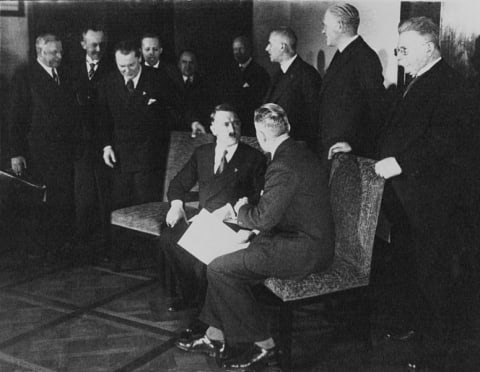
Appointed chancellor on 30 January by Hindenburg, on Papen's
arrangement, having never won a majority of the vote
-
The Reichstag is dissolved on 1 February, two days in, before
it can vote on him
-
On 3 February he tells the army commanders that democracy
will be rooted out
|
Score 3 of 3
-
The decree of 28 February suspends the constitution's civil
rights articles, and it is never lifted again
-
Emergency rule by decree, ordinary since 1930, is now turned on the parties themselves
- The election is fought with the opposition press shut
|
Score 3 of 3
-
The Enabling Act of 23 March lets the cabinet write law
without the Reichstag and against the constitution
-
The 5 March election gives 43.9 percent, still short, so the 81 communist seats are annulled to hand the party a bare majority of the chamber
-
The Day of Potsdam, 21 March, stages the new government as
the old Germany continuing
|
Score 3 of 3
-
From 7 April a Reich governor appointed from Berlin can hire and fire each state's government
-
Every other party is banned or dissolves itself within ten weeks, the last of them on 5 July
- Law is now made by cabinet decree and published as such
|
Score 3 of 3
-
The law of 14 July makes the NSDAP the only legal party and
founding another a criminal offence
-
The Concordat of 20 July buys recognition abroad six months
in
-
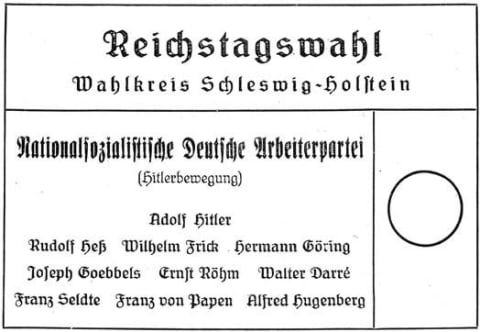
The November election offers voters a single list and no
alternative
|
Score 3 of 3
-
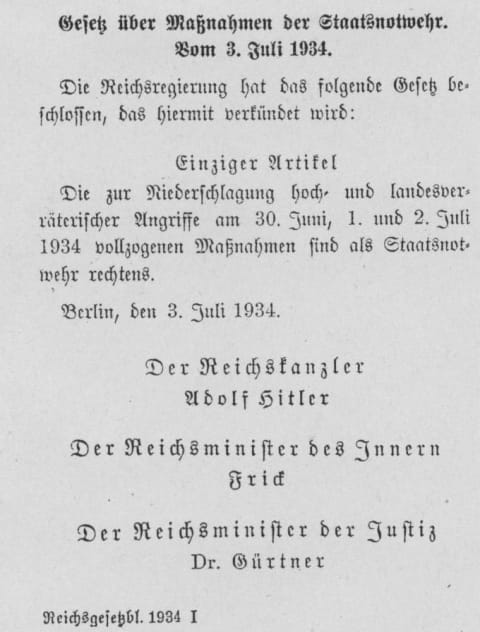
On 3 July the cabinet passes a one sentence law declaring the
previous week's murders lawful defence of the state
-
On 13 July he tells the Reichstag that he had been the
supreme judge of the German people
|
Score 3 of 3
-
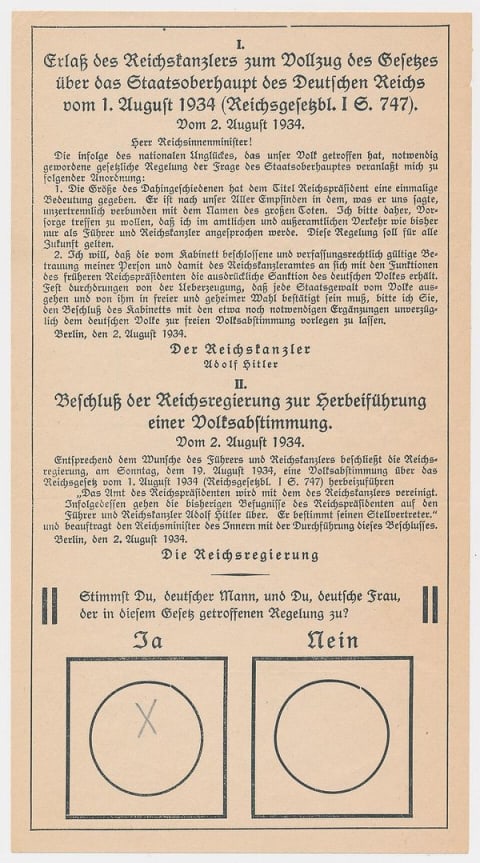
The offices of president and chancellor are merged into his
own by a law signed the day before Hindenburg dies
-
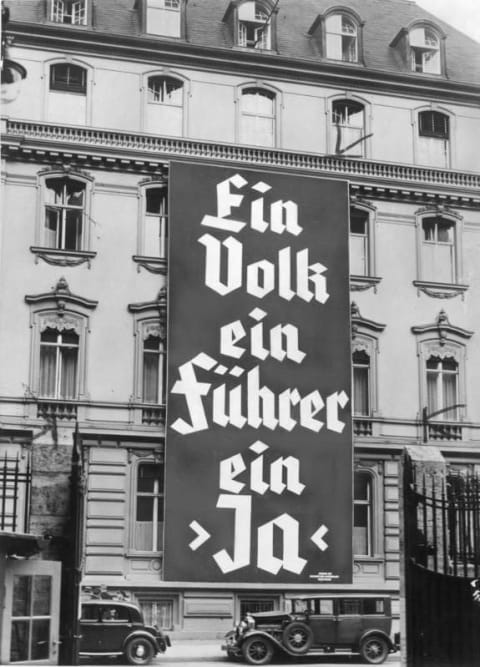
A plebiscite on 19 August approves it afterwards, with about
90 percent
-
Nothing written in the Weimar constitution still binds
anyone
|
 Indicator 2
Denial of the legitimacy of political opponents |
Score 3 of 3
-
Social democrats are the November criminals and communists a
foreign conspiracy: both are to be destroyed, not beaten at
an election
-
Other parties' meetings are broken up as a matter of routine
-
Jews and the republic are presented to voters as the same
enemy
|
Score 3 of 3
-
The appeal to the country on 1 February blames fourteen years
of ruin on the parties that governed, and asks for four years
to undo them
-
Communist demonstrations are banned across Prussia on 2 February, three days in
-
Göring inherits a Prussian police already cleared of republicans by Papen, and puts Nazis over what is left
|
Score 3 of 3
-
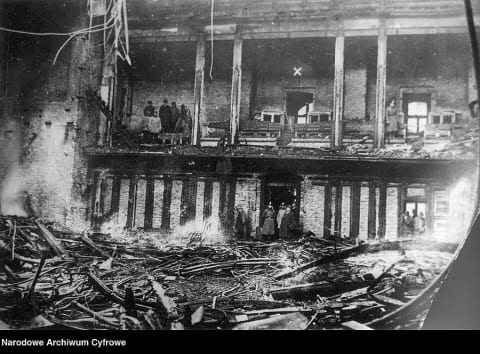
The fire is announced as the start of a communist rising, and
thousands of communists and social democrats are arrested
within days
-
The KPD is never formally banned, which is neater: its
deputies are simply taken away
|
Score 3 of 3
-
The 81 elected communist deputies are kept out of the
chamber, and on 22 March the standing orders are changed so that absent deputies count as present
-
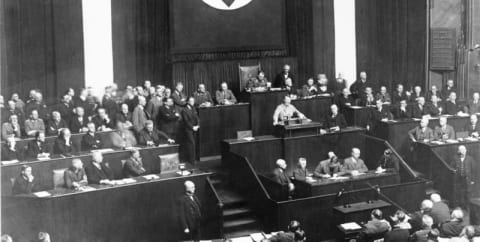
SA men line the Kroll Opera House while the social democrats
vote
-
Otto Wels speaks against the act for the SPD, the only party
that opposes it
|
Score 3 of 3
-
The civil service law of 7 April removes Jews and political
opponents from the state, the universities and the courts
-
On 1 April a national boycott puts SA men outside Jewish
shops and surgeries
-
On 22 June the SPD is banned as hostile to the people and the
state
|
Score 3 of 3
-
Opposition is now criminal by definition: there is one party,
so there is no lawful way to be against it
-
A law of 14 July cancels the naturalisation of some 16,000 Eastern European Jews and strips citizenship from opponents abroad
-
The Centre Party, which had voted for the Enabling Act,
dissolves itself on 5 July
|
Score 3 of 3
-
Opponents inside the movement are killed, Röhm and Gregor Strasser, and so are opponents who were never in it: Kurt von Schleicher and his wife at their own front door
-
Gustav von Kahr, who had blocked him in 1923, is murdered ten years later
-
Papen's speechwriter Edgar Jung is shot and Papen himself put
under guard
|
Score 3 of 3
-
There is no longer a lawful way to be an opponent, only a
criminal one
-
The People's Court, set up in April, tries treason with no
appeal
-
The Social Democrats now run their leadership from Prague
|
 Indicator 3
Toleration or encouragement of violence |
Score 3 of 3
-
In August he publicly sides with five SA men sentenced to
death for kicking a communist labourer to death at Potempa,
addressing them as comrades
-
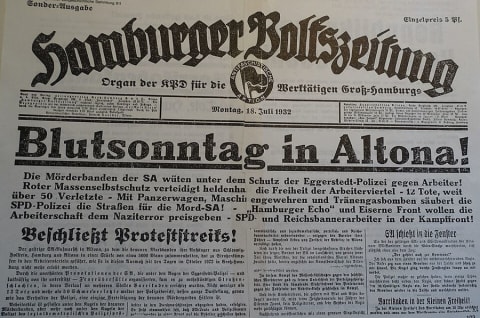
On 17 July an SA march through a working class district of
Altona ends with eighteen people dead
-
The SA has hundreds of thousands of men and the summer's
street fighting kills dozens
|
Score 3 of 3
-
The men who have been doing the street violence for years are
now the government, and nothing is asked of them
-
Attacks on communist premises begin in the first week with the police standing by; the union offices are not touched until May
|
Score 3 of 3
-
On 22 February the SA and SS are sworn in as auxiliary police
in Prussia, so the militia now makes the arrests
-
Göring's order of 17 February tells police to use their
firearms and promises to cover those who do
-
From early March unofficial SA prisons and cellars open in ordinary buildings, the first camp at Nohra in a school
|
Score 3 of 3
-
Dachau opens on 22 March, announced in the newspapers as a
camp for political prisoners
-
Protective custody under the February decree means arrest
with no charge, no limit and no court
- The first prisoners are dead within weeks
|
Score 3 of 3
-
On 2 May union offices are stormed across the country in one
coordinated morning and the officials taken to camps
-
The boycott of 1 April is enforced by SA men at the doors,
photographed doing it
-
The Gestapo is founded in Prussia on 26 April and answers to Göring, and by 1936 to no court at all
|
Score 3 of 3
-
The violence is a department of state now, not a street
fight: tens of thousands pass through the camps in 1933
-
The auxiliary police badges given to the SA, SS and Stahlhelm are withdrawn during the year, because the state can do it without them
|
Score 3 of 3
-
Between 30 June and 2 July the state murders its own: at
least eighty five people are killed, none of them charged or
tried
-
The army supplies transport and weapons, and says nothing
when two of its own generals are among the dead
-
The killings are announced publicly and defended as a duty
|
Score 3 of 3
-
Political murder has been declared lawful after the fact, by a law the cabinet approved and three ministers signed
-
The camps hold whoever the political police decide, on orders no court will overturn
|
 Indicator 4
Readiness to curtail civil liberties and the press |
Score 2 of 3
-
Where the party already holds office it already censors: as
Thuringia's interior minister in 1930 and 1931, Wilhelm Frick
banned books, films and plays
-
The party press says plainly which newspapers will be shut
when it comes in
-
Papen's own emergency decrees have already accustomed Germany
to banning a paper for what it printed
|
Score 2 of 3
-
The party takes both interior ministries, the Reich one and
Prussia's, which is where the police and the press are
controlled from
-
Frick takes the Reich Interior Ministry and Göring the
Prussian one on day one
-
Radio is already a state monopoly, and the new government
uses it from the first week
|
Score 3 of 3
-
The decree of 4 February lets any paper or meeting be banned;
the decree of 28 February removes press freedom from the
constitution altogether
-
Speech, assembly, association, letters and telephone calls
all lose their protection in one document
-
Communist and social democrat papers are shut before polling
day
|
Score 3 of 3
-
The decree of 21 March makes false or distorted statements about the government a crime, tried in new special courts
-
A Ministry of Propaganda is created on 13 March, and by 30 June it holds the press, radio, film and theatre powers taken from the other ministries
|
Score 3 of 3
-
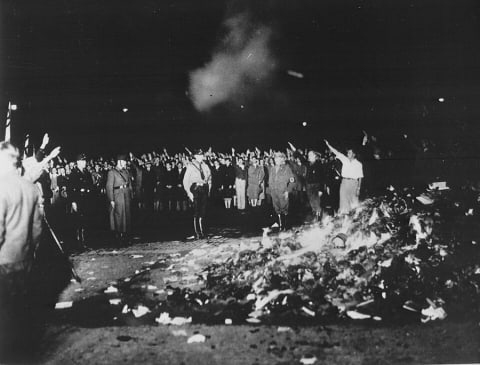
On 10 May students burn books in university towns across the
country, with the ministry's blessing and the fire brigade in
attendance
-
Union and party newspapers, buildings and funds are seized in
May and June
-
Radio's own leadership is cleared out by April, and editors are licensed by a law of their own in October
|
Score 3 of 3
-
The Editors Law of October makes every journalist a licensed
state servant, removable for a single article
-
A cheap radio set goes on sale in August, made insensitive enough that the state stations are what a kitchen can reliably hear
-
The party's own publishing house begins absorbing what is
left of the press
|
Score 3 of 3
-
Papen's Marburg speech of 17 June, the last public criticism
from inside the establishment, is banned from print and radio
and its author is shot two weeks later
-
The country reads about the killings in the government's own
words, because no other account is printable
|
Score 3 of 3
-
The plebiscite of 19 August is put to a country where the
case for voting no has nowhere to be printed
-
Every editor, broadcaster and film office answers to one
ministry
|
 Indicator 5
Who could still hold him to account
Added, not from the book |
Score 1 of 3
-
Hindenburg refuses him the chancellorship to his face on 13
August, and refuses again in November
-
Voters: the November election costs the party two million
votes and thirty four seats, and it runs out of money
-
In December Schleicher tries to split the party by offering Gregor Strasser the vice chancellorship, and nearly manages it
|
Score 1 of 3
-
Hindenburg appoints him, can dismiss him at will, and holds
the emergency power the whole government depends on
-
Only three of eleven cabinet seats are Nazi: the rest go to
conservatives who believe they have hired him, with Papen
entitled to attend every meeting with the president
-
The Reichstag can still vote the government out, and the army
is Hindenburg's, not his
|
Score 2 of 3
-
Hindenburg signs the emergency decree on 28 February, the day after the fire: without his signature there is no decree, and he gives it
-
The conservative ministers raise no objection in cabinet,
because the arrests are of communists
-
Courts still sit, but protective custody puts the arrests
out of their reach
|
Score 2 of 3
-
The Reichstag votes away its own power by 444 votes to 94,
the Centre Party voting yes for written guarantees it never
receives
- Only the Social Democrats vote no
-
Still standing: Hindenburg, the army, the churches and the unions; the states go this month
|
Score 2 of 3
-
The unions go on 2 May and the last party on 5 July, so the two largest organised bodies outside the state stop existing in about ten weeks
-
The states are put under Reich governors who can dissolve their parliaments and dismiss their governments
-
Left on the list: a president of eighty five, the army, and
the churches
|
Score 3 of 3
-
With one party lawful, there is no longer an institution that
can refuse him and survive doing it
-
The Concordat of 20 July takes the Catholic clergy out of
politics by agreement, signed on the Vatican's side
-
The army holds off because it has been promised rearmament and told in February that it will remain the only armed force
|
Score 3 of 3
-
The conservatives who thought they could control him find
out: Schleicher shot at home, Jung shot, Papen held under guard and then sent to Vienna as envoy
-
The army gets the SA broken, as promised, and pays for it by
accepting the murder of two of its own generals
-
The cabinet signs the killings into law three days later, so
the last body that could have refused signs instead
|
Score 3 of 3
-
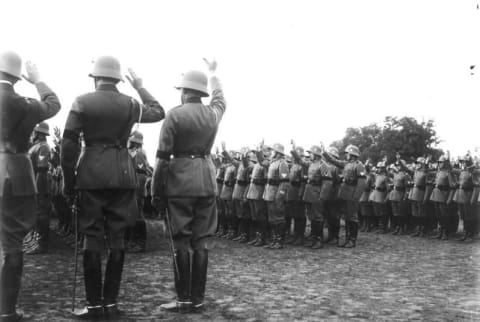
Hindenburg dies on 2 August and the one office that could
have dismissed him is abolished the same day
-
Every soldier swears a personal oath to him by name, the last words about the constitution having gone from it in 1933
-
Nobody left: no president, no opposition party, no free union, no state parliament, and no chamber or court that will rule against him
|