 Indicator 1
Rejection of the democratic rules of the game |
Score 1 of 3
-
He takes office on 28 July 2021 facing a Congress in which
the opposition parties hold the majority
-
None of this was public at the time: the court that
convicted him found that at 21:49 on 6 December 2022 he met
his prime minister, Betssy Chávez, and her adviser
Aníbal Torres in his office, and that at 22:52 a file
named "Mensaje DOC" was created on an external storage
device, a document the court linked to the three of them
|
Score 3 of 3
-
Late in the morning of 7 December, hours before Congress is
due to debate a third motion to remove him, he reads a
message to the nation on television: Congress is
"temporarily" dissolved, an "exceptional emergency
government" is set up, and until a new Congress sits he
will govern by decree laws. A new Congress with constituent
powers is to write a new constitution within nine months
-
The same message declares the justice system, the
judiciary, the public prosecutor, the National Board of
Justice and the Constitutional Tribunal "in
reorganisation". The constitution lets a president dissolve
Congress only after it has censured or denied confidence to
two cabinets
|
Score 2 of 3
-
He does not withdraw the announcement. He leaves the
presidential palace by car; the president of Mexico said
the next day that Castillo had phoned to ask for asylum at
the Mexican embassy
|
Score 1 of 3
-
Out of office. At a court hearing in the week after his
arrest he says he still considers himself president: "I
will never resign and abandon this popular cause"
|
Score 0 of 3
-
In detention. His trial for the events of 7 December opens
on 4 March 2025
|
Score 0 of 3
-
In prison. In May 2026 the Ministry of Justice says the
Presidential Pardons Commission has declared a request for
his pardon inadmissible
|
 Indicator 2
Denial of the legitimacy of political opponents |
Score 1 of 3
-
He calls the accusations behind the third removal motion
"slander" by groups seeking "to take advantage and seize
the power that the people took from them at the polls"
-
In a televised address around midnight before the third
removal vote he says a sector of Congress "has as its only
agenda item removing me from office because they never
accepted the results of an election"
|
Score 3 of 3
-
The message says the majority in Congress represents "the
interests of the big monopolies and oligopolies" and wants
to "install a congressional dictatorship"
-
At 12:01, on the interior minister's phone, he orders the
commander general of the police, Raúl Alfaro, to close
Congress and to detain the attorney general, Patricia
Benavides, who was investigating him. This is what the
court that convicted him found; Alfaro told the court he
questioned the order's legality
|
Score 1 of 3
-
The attorney general is not detained, and Congress meets
to vote on his removal
|
Score 1 of 3
-
On 12 December, in a letter from detention, he calls his
successor a "usurper" and warns Peruvians not to fall for
her "dirty game of new elections"
|
Score 0 of 3
-
In his last statement at the trial, in November 2025, he
says that on 7 December he merely read out "a document
without consequence"
|
Score 0 of 3
-
Nothing to score: he is in prison and holds no office
|
 Indicator 3
Toleration or encouragement of violence |
Score 0 of 3
-
The sources used for this page record no call by him for
violence against opponents before 7 December 2022
|
Score 1 of 3
-
Police turn away two members of Congress, Adriana Tudela
and Vivian Olivos, at the entrance to the building for
about 15 to 25 minutes; Tudela told the trial the officers
"had the order not to let anyone in, not even members of
Congress". The police general accused of giving that order
was acquitted for lack of evidence
-
No force is used. The message calls on rural patrols,
defence fronts and "all social sectors" to back the
decisions, and orders anyone with an illegal weapon to hand
it to the police within 72 hours
|
Score 0 of 3
-
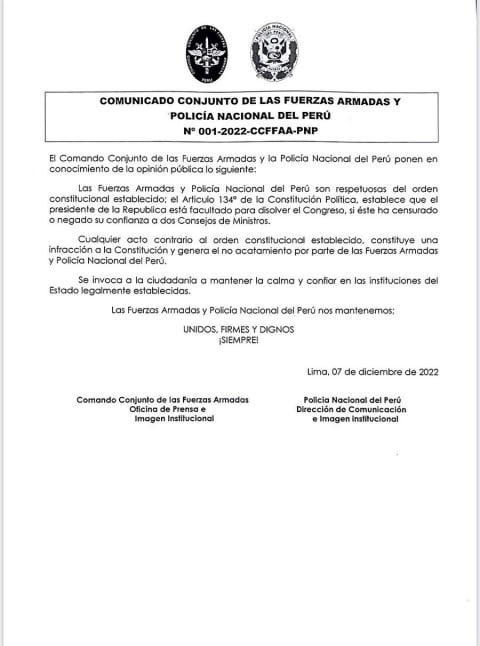
The Joint Command of the Armed Forces and the National
Police issue a joint statement: any act against the
constitutional order "generates non-compliance by the Armed
Forces and the National Police"
|
Score 0 of 3
-
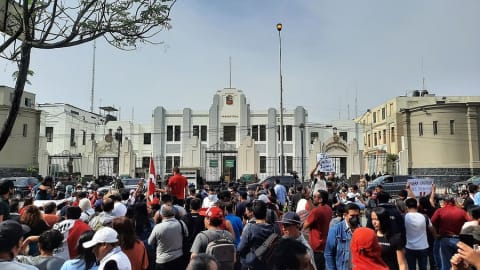
His supporters protest across the country and some call it
a "national insurgency". The sources used for this page
record no call by him for violence
|
Score 0 of 3
-
The deaths in the protests that followed his removal, at
least 50, happened under the government that replaced him,
which the Inter-American Commission on Human Rights accused
of "disproportionate, indiscriminate and lethal use of
force". They are not scored against him
|
Score 0 of 3
-
Nothing to score: he is in prison and holds no office
|
 Indicator 4
Readiness to curtail civil liberties of opponents, including media |
Score 1 of 3
-
Minutes before midnight on 4 April 2022, during protests
over fuel and fertiliser prices, he orders the people of
Lima to stay at home from 02:00 to 23:59 the next day.
Thousands defy the order, and he cancels it just after
17:00
|
Score 2 of 3
-
The message decrees a nationwide curfew from 22:00 to 04:00,
starting that night
-
It accuses Congress of charging him on the word of "the
mercenary, corrupt and cynical press"
|
Score 1 of 3
-
The curfew stands as announced until he is removed. After
the vote the presidency says that the curfew "decreed
illegally" has no effect; it was never published in the
official gazette
|
Score 0 of 3
-
Nothing to score: he is out of office and in custody from
the afternoon of 7 December
|
Score 0 of 3
-
Nothing to score: he is in detention
|
Score 0 of 3
-
Nothing to score: he is in prison and holds no office
|
 Indicator 5
Who could still hold him to account
Added, not from the book |
Score 0 of 3
-
Congress tries twice to remove him and fails: in December
2021 a motion to open proceedings gets 46 votes, too few to
go ahead, and in March 2022 the removal vote gets 55 of the
87 of 130 needed
-
Prosecutors investigate six cases against him while he is
in office, most of them for alleged corruption. In October
2022 the attorney general files a constitutional complaint
accusing him of leading "a criminal organisation"
|
Score 2 of 3
-
The foreign minister, the economy minister and two other
ministers resign, and so does the head of the army. The Ombudsman's Office says it "can't be called
anything but a coup" and that he should hand himself over to
the judicial authorities
-
Congress can still meet: the commander general of the
police questions the order to close it, and the members
turned away at the entrance get in through the back
|
Score 0 of 3
-
Congress declares his "permanent moral incapacity" and
removes him by 101 votes to 6, with 10 abstentions. He is
taken to a police station and arrested on a charge of
rebellion
|
Score 0 of 3
-
The vice president, Dina Boluarte, is sworn in before
Congress at a session called for 15:00 on 7 December
-
A judge orders seven days of preliminary detention on 8
December. On 15 December Supreme Court judge Juan Carlos
Checkley orders 18 months of pretrial detention, citing the
risk that he would flee
|
Score 0 of 3
-
On 27 November 2025 the Supreme Court's special criminal
chamber convicts him, by a majority, of conspiracy to
commit rebellion and sentences him to 11 years, 5 months and
15 days, with a two year ban from public office. It finds
that the rebellion itself was never carried out.
Prosecutors had asked for 34 years
-
His prime minister, Betssy Chávez, gets the same
sentence. She had been granted asylum in the Mexican
embassy during the trial
|
Score 0 of 3
-
As of 28 September 2026 his appeal against
the conviction has been at the Supreme Court since 7
January 2026 and has not yet been admitted for review. A
session set for 23 September to decide on admitting it was
called off when one of the judges asked to step aside; that
request is to be decided on 1 October 2026. This page found
no ruling on the appeal by 28 September 2026
|