 Indicator 1
Rejection of the democratic rules of the game |
Score 2 of 3
-
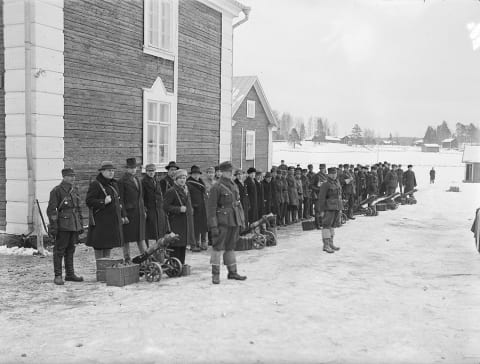
A meeting at Lapua on 1 December 1929 demands that communist activity be rooted out. Its statement already threatens action outside parliament
-
On 11 June 1930 a delegation takes the movement's demands to the president: if they are not met by mid June, the movement says it can no longer answer for what happens
-
Its backers ask the Social Democrat Väinö Tanner and then the prime minister, Kyösti Kallio, to become dictator. Both refuse
-
On 1 July it publishes its own bills: majority voting, the vote tied to paying tax, 150 members of parliament instead of 200. Newspapers estimate they would take the vote from about 600,000 people
|
Score 3 of 3
-
On 4 July P. E. Svinhufvud forms a cabinet without consulting the parliamentary groups, formed mainly so that it would have the Lapua movement's confidence. The movement had asked for three ministries; Svinhufvud keeps Kosola out
-
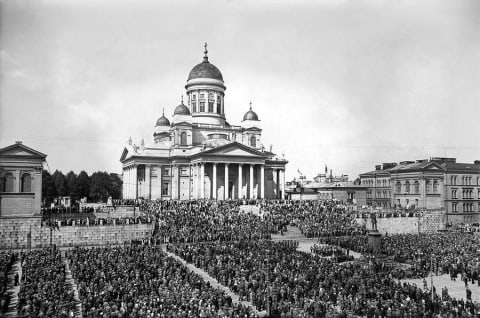
About 12,600 men march into Helsinki on 7 July. Some carry hidden weapons
-
At a meeting on 23 July the movement's leaders ask Svinhufvud to become dictator of Finland. He refuses, as he refuses their demand to take the vote from suspected communists
|
Score 3 of 3
-
At the presidential vote of 16 February 1931 the movement's council waits at Lapua, ready to declare itself a rebel government if the Progressive K. J. Ståhlberg wins. The Civil Guard commander tells the Agrarian electors he cannot guarantee civil peace if Ståhlberg is chosen. The Agrarians move to Svinhufvud, who wins 151 to 149
|
Score 2 of 3
-
On 27 October 1931 the movement makes General K. M. Wallenius, the former chief of the general staff, its secretary general. Kosola says its aim is now to change the general political direction of Finland
-
On 7 November 1931 the Helsingin Sanomat editor Eljas Erkko writes that a coup is being planned. Later research has not been able to confirm that a coup plan led by Wallenius existed
|
Score 3 of 3
-
On 28 February 1932 the Mäntsälä men's proclamation says Marxism will be crushed "even at the risk that we must first destroy the state power that supports and protects it"
-
On 29 February the movement's leaders, meeting in Hämeenlinna, join the rising and demand that the whole Sunila government resign
|
Score 3 of 3
-
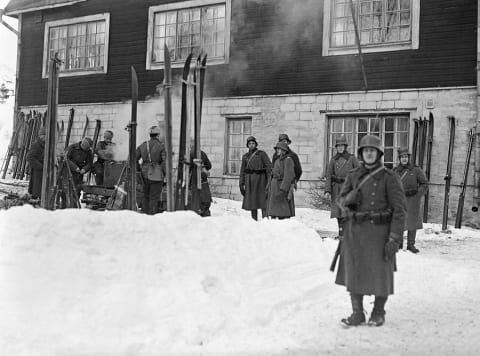
In the morning 200 to 300 rebel Civil Guards take over the Southern Ostrobothnia Civil Guard district headquarters in Seinäjoki and start sending out mobilisation orders
-
Kosola telegraphs the president demanding General Rudolf Walden as prime minister
|
Score 2 of 3
-
On 4 March a Mäntsälä delegation comes to the president under white flags, still asking for a new government under Walden. Svinhufvud refers them to his proclamation
-
In the night of 5 to 6 March the leaders agree to surrender
|
Score 0 of 3
-
The movement no longer exists as a body. Its successor, the Patriotic People's Movement (IKL), is founded on 5 June 1932 and stands in elections as a party
|
 Indicator 2
Denial of the legitimacy of political opponents |
Score 3 of 3
-
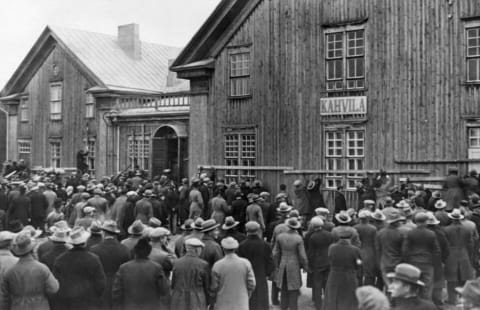
On 24 November 1929 about a thousand people led by Vihtori Kosola surround the workers' hall in Lapua during a communist youth event, tear the performers' red shirts off and drive out the communist member of parliament Emil Tabell
-
On 3 July 1930 Kosola orders the abduction of all the communist members of parliament
|
Score 3 of 3
-
On 5 July a Lapua squad walks into a meeting of parliament's Constitutional Committee and abducts the communist members Eino Pekkala and Jalmari Rötkö
-
Speaking to the marchers on 7 July, Kosola demands that communism be destroyed "to the last stroke"
-
On 18 July the Social Democratic deputy speaker of parliament, Väinö Hakkila, is abducted, beaten and threatened with being taken to the Soviet Union. Kosola and the pastor K. R. Kares knew of the plan in advance and approved it
|
Score 3 of 3
-
The founding meeting of the registered Lapua Movement association, on 22 and 23 November 1930, declares war on social democracy, which it says grows from the same root as communism
-
On 14 February 1931 the movement's paper Aktivisti prints an article hinting that Ståhlberg should be shot if he is elected. The interior minister has the edition seized
|
Score 3 of 3
-
A programme adopted at Lapua on 14 November 1931 demands a ban on the activity of the Social Democrats, then the largest party in parliament
-
On 3 February 1932 the movement demands that the interior minister, Ernst von Born, and the governor of Uusimaa, Bruno Jalander, resign, as its condition for ending the illegal acts
|
Score 3 of 3
-
The proclamation of 28 February, also telegraphed to the president, says that "Marxist social democracy" must be crushed
|
Score 2 of 3
-
The sources used for this page record no new statement against opponents on this day. The demand of 28 February is not withdrawn
|
Score 2 of 3
-
The Jyväskylä rebels' proclamation, printed in the local paper Sisä-Suomi, says their only enemy is Marxism and the government that "apparently supports" it
|
Score 1 of 3
-
Kosola comes home from prison on 20 October 1932 to a crowd of about 2,000 at Lapua station
-
In December 1932 he is chosen to lead the IKL, whose aim is to root out social democracy while following the rules of parliament, at least formally
|
 Indicator 3
Toleration or encouragement of violence |
Score 3 of 3
-
In the night of 28 March 1930 thirteen men from Lapua break into the printing house of the communist paper Työn Ääni in Vaasa and wreck it
-
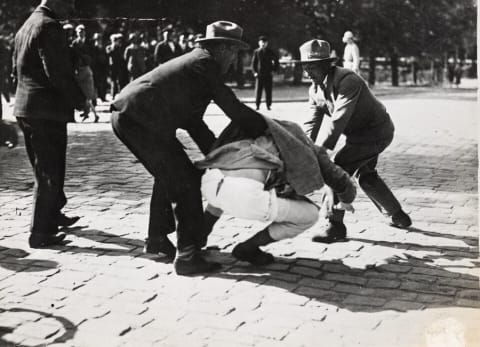
On 4 June about 2,000 supporters come to its trial in Vaasa. They beat the paper's foreman Eino Nieminen and about ten others in the street while the police look on, and abduct the communist member of parliament Asser Salo, the defence lawyer
-
From mid June its men abduct opponents by car, beat most of them and force some across the Soviet border. Over the summer 254 abductions or attempts are made in the movement's name, almost half of them in the last two weeks of June
|
Score 3 of 3
-
Three abducted men are killed: Yrjö Holm on 4 July, who resisted with a gun; Erik Mättö on 19 July, shot by Kosola's drunk son Pentti; and the Social Democratic councillor Onni Happonen, taken from a council meeting and murdered on 1 September
-
On 15 September Kosola and two other leaders appeal for an end to "private acts of violence", with the election two weeks away
|
Score 2 of 3
-
On 14 October 1930 the first president of Finland, K. J. Ståhlberg, and his wife Ester are abducted in Helsinki and driven to Joensuu. The plan was made by an officer under General Wallenius; the movement's leaders deny any part in it
-
On 20 October 404 abductors report themselves to the authorities together. By the end of 1930 more than 8,000 names have been signed on such lists, many by people who took part in no abduction
|
Score 2 of 3
-
On 21 September 1931 about 2,000 men board up the doors and windows of the workers' hall in Lapua. By the end of the year 15 workers' halls have been boarded up, burned or damaged, and more than ten more are attacked in January and February 1932
-
An attack on the office of the paper Työn Voima in Jyväskylä ends in an exchange of fire
|
Score 3 of 3
-
On the evening of 27 February 1932 an estimated 400 to 700 Civil Guards under Lieutenant Esra Terä fire about 700 shots into the ground and the air outside the Ohkola workers' hall in Mäntsälä, where the Social Democratic member of parliament Mikko Erich is speaking. Five bullets go into the hall; nobody is hurt
-
Across the country 5,000 to 7,000 Civil Guards are on the move for the rising
|
Score 3 of 3
-
While the president is speaking, a rebel squad fetches two machine guns and a field kitchen from the North Uusimaa Civil Guard depot. The district chief, Paavo Susitaival, does not stop them and joins the rebels
-
At the Civil Guard house in Pori up to a thousand men are under arms
|
Score 2 of 3
-
In Jyväskylä the rebels hold the railway station and the Civil Guard house. The army occupies the rail junctions at Haapamäki and Pieksämäki
-
The Jyväskylä rebels go home on 5 March. In Mäntsälä there are 466 men left, against 524 at the height of the rising
|
Score 1 of 3
-
On 8 March 1932 a supporter, Olavi Runolinna, shoots dead Minna Craucher, a former backer who had given information about the movement to the authorities and a newspaper during the rising
-
On 17 July 1932 a group tries and fails to abduct the defence minister, Jalo Lahdensuo, from his home in Lapua
|
 Indicator 4
Readiness to curtail civil liberties of opponents, including media |
Score 2 of 3
-
Under the movement's pressure the Kallio government decides on 13 June 1930 to close all communist papers. Governors are given powers to shut communist printing houses, against article 10 of the constitution, and eight newspapers and eight periodicals are closed
|
Score 3 of 3
-
On 5 July the interior minister orders every communist member of parliament arrested on suspicion of treason. The order rests on no particular section of law
-
Communist councillors are pushed out of about 70 municipal councils by abduction, threats of violence or boycotts, before the new municipal law takes effect
|
Score 2 of 3
-
Before the election of 1 and 2 October 1930, election boards illegally strike an estimated 20,000 suspected communists off the voters' rolls with the help of the security police. Left wing candidates are followed and voters are threatened at home
-
The new parliament passes the communist laws on 11 November, with the smallest possible two thirds majority
|
Score 2 of 3
-
On 19 January 1932 the movement's Mäntsälä branch demands that every workers' hall in the municipality be closed. When the interior minister refuses, a meeting on 25 January decides to board them up itself
|
Score 2 of 3
-
Erich's meeting is broken up. Terä makes him promise never to come to Mäntsälä again, and he leaves under police escort
|
Score 2 of 3
-
The rebels order the Lahti radio station seized, which would have kept the president off the air. According to a later account the messenger, who thought the order senseless, ate it on the way, and it was never carried out
|
Score 2 of 3
-
In Jyväskylä the rebels stop the local papers Keskisuomalainen and Työn Voima from appearing and watch the telephone and telegraph traffic
|
Score 0 of 3
-
Nothing to score: the movement's own papers and organisations are closed under the laws of 1930 it had demanded
|
 Indicator 5
Who could still hold the movement to account
Added, not from the book |
Score 2 of 3
-
Answering questions in parliament about 24 November, the interior minister and prime minister Kallio say the Lapua men will not be punished, because the communists caused it
-
Only the men who wrecked the Työn Ääni press and the man held to have incited them are charged. The Civil Guard commander refuses Kallio's request for armed guards at the Vaasa trial
-
Told on 11 June that the demands go beyond the government's powers, Kallio says he would rather die than make illegal decisions. His government resigns on 2 July, the same day it wins a confidence vote 112 to 69
|
Score 2 of 3
-
On 15 July the Social Democrats and the Swedish People's Party are enough to hold back the constitutional laws until after an election. The president dissolves parliament the same day
-
In early August the governor of Vaasa, Erik Heinrichs, resigns, because the movement was stopping him from investigating the Hakkila abduction
|
Score 1 of 3
-
After the Ståhlberg abduction the Agrarians, the Progressives and the Swedish People's Party form the Lawfulness Front, with the Social Democrats as an outside member
-
The government decides that all abductors must go to court. About half of the cases, 115, reach court, and by 1934 there are 656 charges and 70 unconditional prison sentences
|
Score 1 of 3
-
When the movement's men come to discuss the new cabinet, President Svinhufvud says he will negotiate only with the parliamentary groups. None of the ministers of his 1930 cabinet stays in the new Sunila cabinet
-
The interior minister, von Born, asks publicly who decides in the country, the government or Kosola. Supporters of the Lawfulness Front set up a secret organisation to watch the movement and prepare against a coup
|
Score 2 of 3
-
On 29 February the president applies the Protection of the Republic Act, which the movement had itself demanded, and the government orders its leaders arrested. They slip away from Hämeenlinna
-
Svinhufvud forbids the government to resign, although generals Mannerheim, Malmberg and Ignatius advise it, and tells the military leaders that not one armed man may come from Mäntsälä to the capital. On 1 March two of the four National Coalition ministers resign in protest
|
Score 1 of 3
-
Having taken over as commander in chief of the army and the Civil Guards, Svinhufvud speaks on Yleisradio at 19:15 and orders the rebels home. Those who go home at once, he says, will not be punished unless they incited the rebellion. An estimated 200,000 people hear it
-
After the speech the rebel district in Southern Ostrobothnia does not send its men to Mäntsälä, and on 3 March its regular chief, Matti Laurila, takes it back
|
Score 1 of 3
-
After 4 March the army begins to surround Mäntsälä. The leaders agree to report to the authorities in Helsinki by 10:00 on 7 March. The rank and file go home with their weapons, and their names are not taken down
|
Score 0 of 3
-
The assistant interior minister, Arvo Manner, bans the Lapua Movement association on 24 March 1932, and a court confirms it on 28 May. Parliament passes an amnesty for the rank and file in April
-
On 16 July 1932, 102 people are charged before the Turku Court of Appeal. On 21 November it rejects the treason charges and gives mild sentences: Kosola and Wallenius nine months each, suspended, and the Mäntsälä leader Artturi Vuorimaa two and a half years
-
The Supreme Court raises Kosola's and Wallenius's sentences to one year each, suspended, on 22 February 1934. The ban is upheld on appeal in February 1934 and by the Supreme Court in June 1935
|