 Indicator 1
Rejection of the democratic rules of the game |
Score 1 of 3
-
He takes office on 10 May 2022 facing a National Assembly
controlled by the opposition Democratic Party, which keeps
its majority in the April 2024 election
-
None of this was public at the time: a counterintelligence
commander later told prosecutors that Yoon first spoke of
emergency action in late December 2023, and the
indictment of his defence minister, unsealed on 27
December 2024, says they met about ten times from March
2024 to discuss martial law
-
In October 2024 military drones drop leaflets over
Pyongyang three times. On 12 June 2026 a court of first
instance convicts him of aiding the enemy over the flights,
which prosecutors said were meant to create a pretext for
martial law. His lawyers say he neither ordered nor
approved them
|
Score 3 of 3
-
At 22:27 on 3 December 2024 he declares martial law on
television. Decree No. 1, issued at 23:25 and backdated to
23:00, bans all political activity, including the National
Assembly, local councils and political parties. The
constitution gives a president no power to suspend the
Assembly
-
Troops enter the headquarters of the National Election
Commission in Gwacheon, and armed counterintelligence
officers go into its server room
|
Score 2 of 3
-
Told that the Assembly has voted, he tells the Capital
Defense commander that it is "not even confirmed that 190
people came in", according to the indictment of his
defence minister
-
In the Joint Chiefs of Staff command room he asks how many
troops were sent to the Assembly. Told about 500, he says,
by later accounts, that he had asked for 1,000
-
At 04:27 he says on television that he will lift martial
law once a quorum of the cabinet can meet, and at about
04:30 the cabinet lifts it
|
Score 2 of 3
-
On 7 December he apologises and promises there will be no
second declaration
-
On 12 December he says he will "fight to the end", calls
the declaration an act of governance, and claims the
Election Commission's network was open to hacking and
fraud. The Commission calls the claim baseless, and on 19
December the intelligence service tells the Assembly it
found no evidence of election rigging
|
Score 2 of 3
-
He refuses three summonses from the Corruption
Investigation Office for High-ranking Officials, and a
court issues a warrant for his arrest on 31 December
-
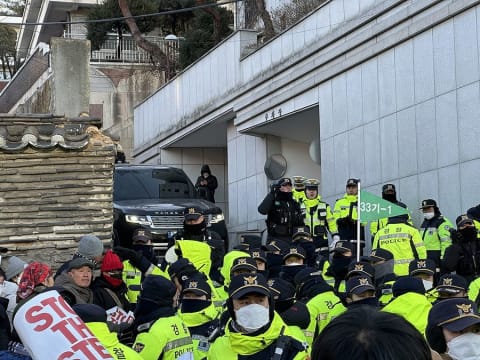
On 3 January 2025 the Presidential Security Service blocks
the investigators at his residence. After about six hours
they withdraw
|
Score 1 of 3
-
He expresses regret for failing to meet the public's
expectations, while one of his lawyers calls the ruling
"a pure political decision". He leaves the official
residence on 11 April
-
His criminal trial for insurrection opens on 14 April. He
denies that the declaration amounted to an insurrection
|
Score 0 of 3
-
The early election the constitution requires within 60 days
of a vacancy is held on 3 June 2025. The candidate of his
former party, Kim Moon-soo, concedes in the early hours of
4 June and says he "humbly accepts the choice of the
people"
|
Score 0 of 3
-
His prime minister, Han Duck-soo, is sentenced to 23 years
on 21 January 2026 for his part in the martial law
declaration
-
In the appeal against his own conviction, resumed on 25
June 2026, his lawyers argue that the declaration was a
president's political decision to overcome a national
crisis and could never be an insurrection
|
 Indicator 2
Denial of the legitimacy of political opponents |
Score 1 of 3
-
In his Liberation Day speech of 15 August 2023 he says
that "anti-state forces that blindly follow communist
totalitarianism" are "still rampant", and that such forces
"have always disguised themselves as democracy activists,
human rights advocates or progressive activists"
|
Score 3 of 3
-
In the address he calls the opposition that controls the
Assembly anti-state forces and a den of criminals trying
to overthrow the free democracy
-
His defence minister orders the counterintelligence
command to arrest politicians on a list. The deputy
director of the intelligence service later testifies that
Yoon phoned him at 22:53 to help, and that the list
included the opposition leader Lee Jae Myung, the Speaker
Woo Won-shik and Han Dong-hoon, the leader of Yoon's own
party
|
Score 2 of 3
-
The arrests are not made. Of the 190 members who vote to
lift martial law, 18 are from his own party, from the
faction of Han Dong-hoon, whose name was on the list
|
Score 2 of 3
-
His address of 12 December describes the declaration as an
act of governance to protect the country against anti-state
forces
|
Score 2 of 3
-
On 1 January 2025 he tells his supporters that the country
is "in danger due to internal and external forces
threatening its sovereignty" and that he will "fight
alongside you to the very end"
-
A letter posted on his Facebook account after his arrest
returns to the claims of possible election fraud
|
Score 0 of 3
-
Out of office. On 17 May 2025 he leaves the People Power
Party and endorses its candidate, Kim Moon-soo
|
Score 0 of 3
-
Lee Jae Myung, whose name had been on the arrest list,
takes the oath as president on 4 June 2025
|
Score 0 of 3
-
The court that convicts him on 19 February 2026 finds that
he sent troops to the Assembly intending to "prevent and
paralyse" it for a significant period, and rejects the
prosecutors' claim that he planned a long-term dictatorship
|
 Indicator 3
Toleration or encouragement of violence |
Score 0 of 3
-
The sources used for this page record no call by him for
violence against opponents before 3 December 2024
|
Score 3 of 3
-
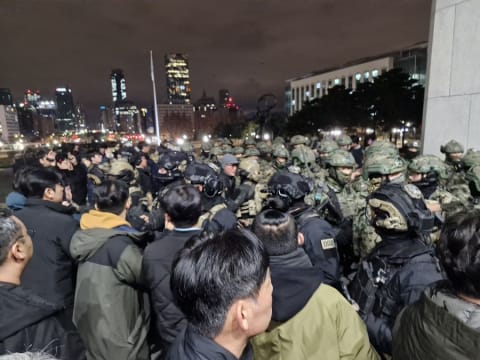
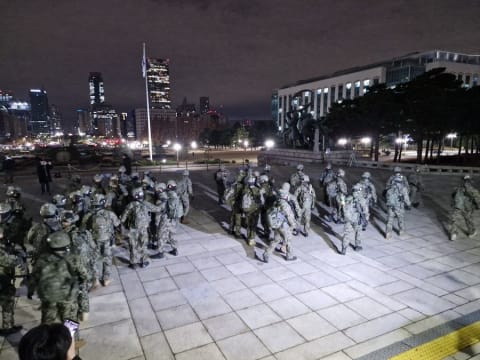
Police close every entrance to the Assembly by 23:04.
Between 23:31 and 01:18, 24 helicopter flights carry 240
troops there, and at 00:45 about 300 soldiers enter the
building and break windows. Staff hold them back with
furniture barricades and fire extinguishers
-
The commander of the Army Special Warfare Command later
tells the Assembly that the president phoned him and told
him to break open the door and drag the lawmakers out. He
says he told his troops not to enter the chamber
-
A defence ministry report puts the forces used for martial
law at about 1,580 troops and more than 9,000 rounds of
live ammunition
|
Score 2 of 3
-
At 01:06, after the vote, seven soldiers cut
the main and backup power to part of the building's
basement for 5 minutes and 48 seconds, as CCTV released
in February 2025 shows
-
The soldiers withdraw. The Speaker's office later says
they had left altogether by 01:18
|
Score 0 of 3
-
On 6 December the defence ministry and the Joint Chiefs of
Staff say they would not obey a second declaration of
martial law
|
Score 1 of 3
-
At 03:00 on 19 January 2025, after a court extends his
detention, his supporters break into the Seoul Western
District Court, injure several police officers and attack
journalists. Police restore order by 06:08
|
Score 0 of 3
-
Among the illegal acts the Constitutional Court lists on 4
April 2025 is ordering the military and police to block
lawmakers from entering the Assembly
|
Score 0 of 3
-
On 3 July 2025 the Assembly amends the rules on martial law
so that security forces may not enter its building without
the Speaker's approval
|
Score 0 of 3
-
His defence minister, Kim Yong-hyun, is sentenced to 30
years on 19 February 2026 for planning and taking part in
the insurrection
|
 Indicator 4
Readiness to curtail civil liberties of opponents, including media |
Score 1 of 3
-
On 14 September 2023 prosecutors search the offices of the
broadcaster JTBC and the investigative outlet Newstapa and
the homes of two Newstapa reporters, over reports published
before the 2022 election that they say defamed him as a
candidate
|
Score 3 of 3
-
Decree No. 1 puts all media and publications under the
control of the Martial Law Command and allows arrest,
detention and search without a warrant
-
According to his indictment, at 22:30 he tells the interior
minister to cut power and water to the Hankyoreh, the
Kyunghyang Shinmun, MBC, JTBC and the pollster Flower
Research
|
Score 2 of 3
-
The decree putting the media under military control stays
formally in force until the cabinet lifts martial law at
about 04:30, and the Martial Law Command is disbanded with
it
|
Score 0 of 3
-
On 4 December all the major newspapers and the National
Union of Media Workers condemn him and call for his arrest
|
Score 0 of 3
-
His powers suspended since 14 December, he gives no new
order touching the press. On 13 January 2025 the head of
the National Fire Agency tells the Assembly that on the
night of 3 December he was asked to help cut power and
water to the newspapers, and that no action was taken
|
Score 0 of 3
-
Reading the ruling, the acting chief justice says he
"damaged people's political rights"
|
Score 0 of 3
-
Nothing to score: he is out of office, and in custody again
from 10 July 2025
|
Score 0 of 3
-
The charges in his obstruction case, whose seven year
sentence is made final on 9 July 2026, include directing
false statements about the declaration to foreign media
|
 Indicator 5
Who could still hold him to account
Added, not from the book |
Score 1 of 3
-
The opposition has the Assembly but not the 200 of 300
votes needed to impeach him
-
He vetoes three bills for a special counsel to investigate
his wife, Kim Keon Hee, the third on 26 November 2024
|
Score 2 of 3
-
Members of the Assembly get past the police by climbing the
fences, Lee Jae Myung on a livestream at about 23:00 and the
Speaker as well. The session opens at 00:48
-
Two officials refuse orders: the deputy director of the
intelligence service says he declined to help with the
arrests, and the police commissioner says he ignored a
request to track the targets because it was illegal
|
Score 1 of 3
-
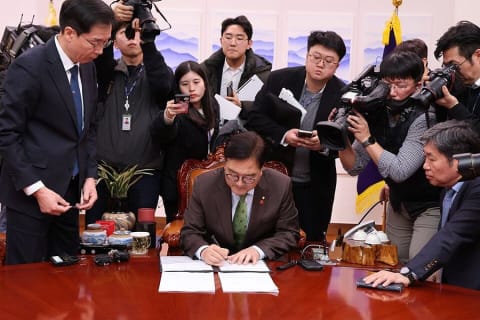
At 01:02 the 190 members present vote 190 to 0 to lift
martial law. Under the constitution a simple majority of
the Assembly is enough. The session stays open until the
cabinet confirms the lifting, and adjourns at 05:54
|
Score 1 of 3
-
On 7 December the first impeachment motion fails for lack
of a quorum when his party's members boycott the vote
-
On 14 December the second passes, 204 to 85, with 12 of his
party's members in favour. His powers are suspended when
the resolution reaches his office
|
Score 1 of 3
-
On 15 January 2025 investigators get into the residence and
he gives himself up, the first sitting president of South
Korea to be arrested. On 26 January he is indicted for
leading an insurrection
-
On 8 March he leaves detention after a court cancels it and
the prosecutor general decides not to appeal
|
Score 0 of 3
-
On 4 April 2025 the Constitutional Court upholds the
impeachment 8 to 0 and removes him from office, effective
at 11:22
|
Score 0 of 3
-
On 3 June 2025 voters elect Lee Jae Myung with 49.42
percent to Kim Moon-soo's 41.15, on a turnout of 79.38
percent
-
He is arrested again on 10 July 2025, on a warrant sought by
the special counsel Cho Eun-suk
|
Score 0 of 3
-
On 19 February 2026 the Seoul Central District Court
convicts him of leading an insurrection and sentences him
to life in prison. The prosecutors had asked for death
-
A separate sentence for obstructing his arrest and other
charges, five years on 16 January 2026, is raised to seven
on appeal on 29 April and made final by the Supreme Court on
9 July, the first of his cases to be final
-
As of 28 September 2026 the appeal against
the life sentence is still before the Seoul High Court's
insurrection division. Both sides appealed; at the hearing
of 25 June 2026 the special counsel asked for the death
penalty. This page found no appeal ruling by 28 September
2026
|